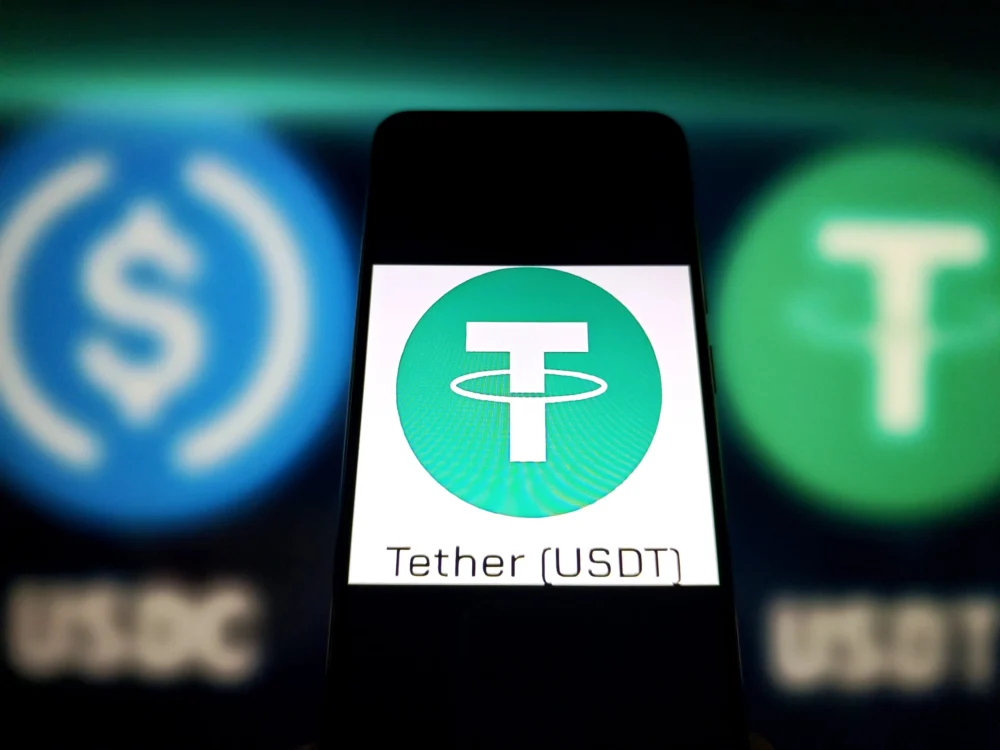
In the volatile theaters of global geopolitics, where traditional banking systems often crumble under the weight of sanctions, hyperinflation, or military intervention, a new financial protagonist has emerged: the dollar-pegged stablecoin. Recent events in Venezuela have underscored a profound shift in how citizens in distressed economies preserve their wealth. As the threat of U.S. military intervention loomed and political instability reached a fever pitch, the local population did not rush to the banks—many of which were already paralyzed—but rather to digital exchanges. Their target was USDT, the stablecoin issued by Tether, which has transformed from a speculative crypto-asset into a vital "escape valve" for millions living on the edge of economic collapse.
The rush to convert the Venezuelan bolívar into USDT was not merely a trend but a desperate act of self-preservation. For years, the bolívar has served as a cautionary tale of monetary mismanagement, with inflation rates at times exceeding 1,000,000%, effectively erasing the life savings of the middle class. When the geopolitical situation sharpened this month, the urgency to exit the local currency hit a breaking point. However, this surge in demand revealed a peculiar market phenomenon: the "stability" of a stablecoin is often relative to the local infrastructure. On various peer-to-peer (P2P) platforms, the price of one USDT spiked to as high as $1.40 in bolívar terms. This 40% premium reflects a "fear tax," where the desperation to hold a dollar-equivalent asset far outweighs the cost of the transaction.
This phenomenon is not isolated to Caracas. From the bazaars of Tehran to the financial hubs of Moscow and the border towns of Colombia, USDT is increasingly functioning as a parallel shadow currency. In regions where the U.S. dollar is the preferred store of value but physical greenbacks are scarce or illegal to hold, digital tokens provide a frictionless alternative. As the Trump administration signals a more aggressive stance toward foreign interventions in countries like Iran and Colombia, the demand for these digital safety nets is expected to accelerate. The irony is stark: while the U.S. government often views stablecoins with regulatory skepticism, the digital dollar is perhaps the most potent tool of American soft power in the 21st century, allowing citizens to bypass their own governments’ capital controls.
The mechanics of this adoption are driven by necessity rather than ideology. Unlike Bitcoin, which is often viewed as a "digital gold" subject to wild price swings, USDT offers the psychological and practical familiarity of the dollar. In emerging markets, the primary concern is not "to the moon" price appreciation, but rather ensuring that the money earned today can still buy bread tomorrow. Mauricio Di Bartolomeo, co-founder of the digital asset lender Ledn, notes that stablecoins are effectively "better dollars" for those in restrictive environments. They bypass the physical limitations of cash—which can be seized at checkpoints or lost in transit—and the bureaucratic hurdles of legacy banking, which is often tied to the state’s whims.
The rise of USDT as a global intermediary is particularly evident in the remittance sector. For the millions of Venezuelans who have fled the country, sending money back home through traditional channels like Western Union or SWIFT is often prohibitively expensive or blocked by sanctions. By using USDT, workers in Bogota or Miami can send value across borders instantly and for a fraction of the cost. The recipient in Venezuela can then trade that USDT for bolívares in small increments to cover daily expenses, or use it directly at a growing number of local merchants who prefer the digital token over the depreciating national currency.
However, the rapid "tetherization" of these economies carries significant macroeconomic risks. When a population en masse abandons its local currency for a dollar-pegged token, it triggers a feedback loop of depreciation. As bolívares are sold for USDT, the value of the bolívar drops further, fueling more inflation and driving even more people toward stablecoins. This process, often referred to as "spontaneous dollarization," strips central banks of their ability to manage monetary policy. Austin Campbell, CEO of Zero Knowledge Consulting and an adjunct professor at NYU, suggests that for repressive regimes, this is a "feature, not a bug." The ability for citizens to move their wealth into a digital space beyond the reach of the state puts immense pressure on authoritarian governments, potentially acting as a catalyst for political reform—or total economic collapse.
The liquidity challenges observed during the recent Venezuelan spike also highlight the fragility of the current crypto infrastructure. The 40% premium on USDT was not a failure of the Tether protocol itself, but a bottleneck in the P2P markets. In an emergency, there simply weren’t enough sellers of USDT willing to take bolívares, creating a supply-demand mismatch. This "violent repricing," as described by industry experts, underscores that while stablecoins offer a rail for survival, they are not yet a perfect substitute for a stable, integrated financial system. For the average person, paying $1.40 for a $1.00 asset is a steep price, yet it is often the only price available when the alternative is a currency headed toward zero.
Global comparisons illustrate that this is a systemic shift in the Global South. In Argentina, another nation plagued by chronic inflation and strict capital controls, "Cripto Dólar" has become a household term. Local exchanges often trade USDT at a rate that mirrors the "Blue Dollar" (the unofficial black-market rate), providing a real-time barometer of public confidence in the government. In Lebanon, following the 2020 banking collapse, USDT became a primary medium for business-to-business transactions, allowing companies to import goods when the local banks could no longer provide letters of credit.
The geopolitical implications for the United States are equally complex. Tether, the company behind USDT, has faced intense scrutiny from U.S. regulators regarding its reserves and transparency. Yet, USDT remains the most widely used stablecoin globally, largely because it has proven its resilience over a decade of market cycles. For a citizen in Iran or Russia, the fact that Tether operates outside the traditional U.S. banking system—even while being pegged to the dollar—is actually an advantage. It provides a level of censorship resistance that a more "regulated" or "compliant" U.S.-based stablecoin might not offer if the U.S. Treasury decided to freeze assets in specific jurisdictions.
As we look toward the future, the "stablecoinization" of emerging markets appears inevitable. The technology has proven it can "bust through the door" of any country attempting to trap its citizens’ wealth within a failing fiat system. While central banks around the world experiment with Central Bank Digital Currencies (CBDCs) as a way to maintain control, they are competing against the organic, bottom-up adoption of USDT. For the resident of a country in turmoil, the choice is simple: hold a currency that is managed by a local government with a history of failure, or hold a digital token that represents the world’s reserve currency, accessible via a smartphone.
Ultimately, the story of USDT in Venezuela is a story of human ingenuity in the face of systemic collapse. It represents the decoupling of "money" from "state," a shift that is as significant as the invention of the printing press or the internet. While the premiums are high and the risks are real, the digital dollar has become the ultimate "real-time safety rail." In the high-stakes game of global economics, when the only other option is for the government to inflate away your life’s work, the stablecoin—despite its imperfections—stands as the only viable path to financial survival. The Venezuelan experience serves as a blueprint for the next decade of economic crises: when governments wobble, the people will find their own way to the dollar, one digital token at a time.