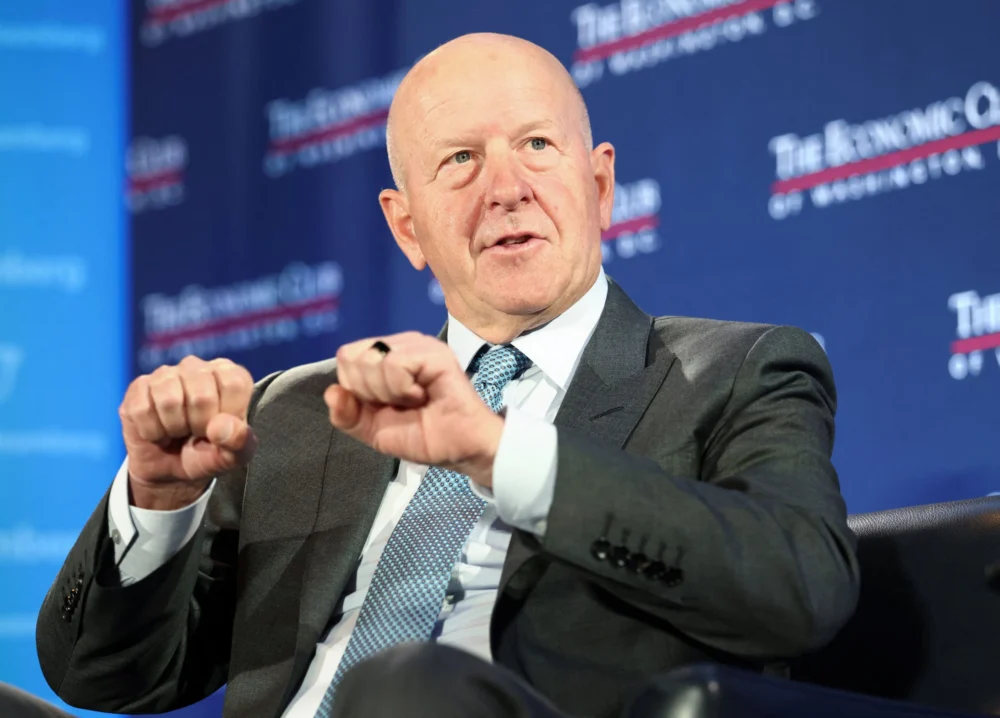
The landscape of global finance is currently witnessing a significant shift as one of the world’s most influential investment banks, Goldman Sachs, begins to formalize its interest in the burgeoning sector of prediction markets. Speaking during the bank’s fourth-quarter earnings call, Chief Executive Officer David Solomon revealed that the firm is actively exploring how to integrate these event-based trading platforms into its vast financial ecosystem. Solomon’s disclosure marks a pivotal moment for a sector that has long resided on the periphery of mainstream finance, signaling that the "wisdom of crowds" is moving from a theoretical economic concept to a tangible institutional asset class.
The surge in institutional interest follows a year of unprecedented growth and regulatory clarity for prediction markets. These platforms, which allow participants to trade contracts on the outcome of future events—ranging from central bank interest rate decisions and corporate mergers to geopolitical shifts and election results—have evolved from niche hobbies into high-volume financial venues. Solomon confirmed that he has personally engaged in high-level discussions with the leadership of the industry’s two dominant players, likely referring to the regulated platform Kalshi and the decentralized giant Polymarket. These meetings, coupled with a dedicated internal team at Goldman Sachs analyzing the space, suggest that the bank views prediction markets not merely as a novelty, but as a legitimate extension of the derivatives market.
The economic rationale behind prediction markets lies in their ability to aggregate dispersed information into a single, real-time price point. In traditional finance, price discovery is driven by fundamental analysis and sentiment; in prediction markets, the price reflects the collective probability of a binary outcome. For a firm like Goldman Sachs, which thrives on providing liquidity and sophisticated hedging tools to corporate clients, these markets offer a new frontier for risk management. If a multinational corporation faces significant exposure to a specific regulatory change or a trade policy shift, a liquid prediction market could theoretically provide a more efficient hedge than traditional insurance or complex over-the-counter (OTC) derivatives.
Central to Goldman’s interest is the evolving regulatory framework governing these platforms. For years, the U.S. Commodity Futures Trading Commission (CFTC) maintained a skeptical, often adversarial, stance toward event-based betting, frequently citing concerns over market integrity and the potential for "gambling" to masquerade as finance. However, a landmark legal victory by Kalshi against the CFTC in 2024 fundamentally altered the trajectory of the industry. The court’s ruling, which allowed Kalshi to list contracts on U.S. election outcomes, effectively categorized these instruments as a form of "event-based swap" or derivative. Solomon specifically highlighted this distinction, noting that when these activities fall under the oversight of the CFTC, they begin to look indistinguishable from the traditional derivative contracts that Goldman Sachs has traded for decades.
The scale of capital now flowing through these markets is difficult to ignore. During the 2024 U.S. election cycle, Polymarket, a decentralized platform built on blockchain technology, saw its cumulative trading volume exceed $3 billion. While Polymarket currently restricts U.S. users due to regulatory constraints, its global footprint demonstrated a massive appetite for event-based speculation. Meanwhile, Kalshi has seen its user base and liquidity depth grow as it operates within the U.S. regulatory "sandbox." For Wall Street, volume is the ultimate magnet. The entrance of a bulge-bracket bank like Goldman Sachs would provide the one thing these markets still lack: deep, institutional-grade liquidity. Currently, many prediction markets suffer from wide bid-ask spreads and limited depth, making it difficult for large hedge funds or institutional investors to move significant positions without moving the price. Goldman’s potential role as a market maker could solve this liquidity bottleneck, effectively "professionalizing" the order books.
However, the path to full integration is fraught with complexities. Solomon, a veteran of several market cycles, struck a characteristically cautious tone regarding the timeline for Wall Street’s adoption. While expressing personal excitement about the technology’s potential, he warned that the pace of change might be more deliberate than the rapid-fire predictions of fintech enthusiasts. The hurdles are not merely technical but cultural and compliance-based. Integrating prediction markets into a global bank requires rigorous "Know Your Customer" (KYC) protocols, anti-money laundering (AML) checks, and a clear understanding of how these trades impact the bank’s capital requirements under Basel III and other international banking standards.
Furthermore, the ethical and social implications of prediction markets remain a point of contention. Critics argue that allowing large-scale financial wagering on sensitive social or political outcomes could create perverse incentives or lead to market manipulation. There are fears that individuals with insider knowledge of a policy decision or a corporate move could use these markets to profit, potentially undermining public trust in democratic or economic institutions. Goldman Sachs, which is hyper-sensitive to reputational risk, will likely proceed with a high degree of "compliance-first" caution, focusing initially on economic and financial events rather than the more controversial social or political contracts.
From a broader economic perspective, the rise of prediction markets represents a challenge to traditional polling and forecasting industries. During recent global events, market prices often proved to be more accurate and faster to react than traditional opinion polls or expert consensus. This "real-time data" aspect is invaluable to Goldman’s proprietary trading desks and its asset management division. If the price of a "Federal Reserve Rate Hike" contract begins to shift, it provides an immediate signal that may not yet be fully priced into the bond or equity markets. In this sense, Goldman isn’t just looking to trade these markets; it is looking to use them as a sophisticated data feed to inform its broader investment strategies.
The global comparison of these markets also reveals a bifurcated landscape. While the United States is slowly warming to regulated event trading, other jurisdictions have long permitted various forms of "spread betting" or "binary options," though often under different regulatory umbrellas. The UK and parts of Europe have more established markets for such instruments, but they have historically been viewed through the lens of consumer gambling rather than institutional finance. The "Goldman effect" could rebrand this entire sector, shifting the narrative from "betting" to "information-contingent risk management."
As the financial services industry moves toward the mid-2020s, the convergence of traditional banking and specialized event-based trading seems increasingly inevitable. The infrastructure for these markets is being built not just by startups in Silicon Valley, but by the legal and compliance departments of 200 West Street. Solomon’s comments suggest that Goldman Sachs is positioning itself to be the bridge between the two. Whether through prime brokerage services, where the bank clears and settles trades for hedge fund clients, or through the creation of structured products tied to event outcomes, the institutionalization of prediction markets is underway.
The long-term impact on the economy could be profound. By creating a price for every possible future event, society gains a more accurate tool for assessing risk. Insurance companies could use prediction markets to better price catastrophe bonds; farmers could use them to hedge against specific weather patterns; and governments could use them to gauge the public’s confidence in various policy proposals. For Goldman Sachs, the goal is to remain at the center of this information flow. As Solomon noted, these markets are "important" and "real," and while the transition may be a slow burn rather than a sudden explosion, the direction of travel is clear. The bank’s exploration of this space is a testament to the fact that in modern finance, information is the most valuable commodity, and prediction markets may be the most efficient way to price it.