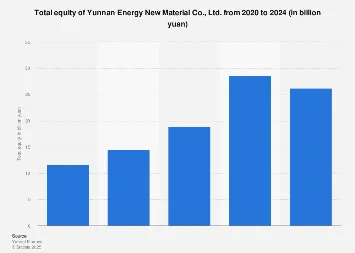
Yunnan Energy New Material Co., Ltd., a prominent player in China’s burgeoning new energy materials sector, is navigating a dynamic financial environment as it progresses through 2024. While specific, granular equity figures for the current year are often proprietary and subject to real-time market fluctuations, an analysis of the company’s trajectory, industry trends, and financial reporting provides crucial insights into its overall financial health and potential equity evolution. Understanding the forces shaping Yunnan Energy’s balance sheet requires a comprehensive examination of its operational performance, strategic investments, and the broader economic context within which it operates.
The company’s core business revolves around the production and sale of advanced materials critical to the new energy revolution, particularly lithium-ion battery components and related chemicals. As global demand for electric vehicles (EVs) and renewable energy storage solutions continues its exponential ascent, companies like Yunnan Energy are positioned at the vanguard of a transformative industrial shift. This inherent growth potential, however, is intrinsically linked to its ability to manage capital efficiently, attract investment, and maintain profitability. Equity, representing the ownership stake in the company, is a direct reflection of this intricate interplay.
Yunnan Energy’s financial statements, when available, typically detail several key components that contribute to its total equity. These include share capital, which represents the nominal value of shares issued; additional paid-in capital, reflecting any premium received over the par value of shares; retained earnings, the accumulated profits not distributed as dividends; and other comprehensive income, which accounts for unrealized gains and losses. Fluctuations in these accounts, driven by factors such as net income, dividend payouts, share buybacks or issuances, and currency translation adjustments, directly impact the total equity figure.
The first half of 2024, based on available industry analyses and company announcements, likely saw Yunnan Energy continue to leverage its established market position. The company’s strategic focus on high-purity materials for the battery industry, a segment experiencing robust growth, suggests a sustained revenue stream. However, this growth is often accompanied by significant capital expenditure. Investments in expanding production capacity, research and development for next-generation materials, and vertical integration to secure raw material supply chains are crucial for long-term competitiveness. These investments, while vital for future equity appreciation, can place short-term pressure on retained earnings and cash reserves, thereby influencing the overall equity picture.
Market data indicates that the global market for lithium-ion battery materials is projected to grow at a compound annual growth rate (CAGR) exceeding 15% in the coming years. This macro trend directly benefits Yunnan Energy. For instance, the demand for cathode materials, a key product area for many companies in this sector, is directly correlated with EV production targets set by major automakers worldwide. As these targets are revised upwards, the pressure on material suppliers like Yunnan Energy intensifies, creating opportunities for increased sales and, consequently, profitability. This enhanced profitability, if not fully distributed as dividends or reinvested in short-term assets, contributes positively to retained earnings and thus, total equity.
However, the new energy materials sector is not without its challenges. Volatility in raw material prices, particularly lithium and cobalt, can significantly impact production costs and profit margins. Geopolitical tensions and supply chain disruptions, as witnessed in recent years, can also create uncertainties. Yunnan Energy’s management of these external risks plays a pivotal role in its financial stability. Effective hedging strategies, diversified sourcing, and robust supply chain management are essential to mitigate these risks and ensure consistent profitability, which in turn bolsters equity.
Furthermore, the competitive landscape is increasingly intense. Numerous domestic and international players are vying for market share, leading to price pressures and the constant need for innovation. Yunnan Energy’s investment in R&D, aimed at developing more efficient production processes and novel materials with superior performance, is a critical determinant of its long-term success and, by extension, its equity value. Successful innovation can lead to premium pricing, capture new market segments, and enhance its competitive moat, all of which contribute to a stronger equity position.
Looking at global comparisons, Chinese new energy material companies, including Yunnan Energy, have become increasingly influential on the world stage. Their scale of production, technological advancements, and cost efficiencies often surpass those of their Western counterparts. This global competitiveness translates into export opportunities and international partnerships, further diversifying revenue streams and enhancing financial resilience. However, it also exposes them to international regulatory frameworks and trade dynamics, which can introduce complexities to financial planning and equity valuation.
An analysis of the company’s balance sheet KPIs, such as debt-to-equity ratios, would offer further insights. A lower debt-to-equity ratio generally indicates a stronger financial position and less financial risk, which can be attractive to investors and contribute to a higher equity valuation. Conversely, a high ratio might suggest greater reliance on borrowed funds, potentially increasing financial leverage but also posing higher risks. Similarly, profitability KPIs, such as net profit margin and return on equity (ROE), are direct indicators of how effectively the company is generating profits from its equity base. A consistently high ROE suggests efficient utilization of shareholder capital.
In the context of 2024, Yunnan Energy’s equity is likely influenced by its ongoing capital allocation decisions. The company may be considering share buyback programs to enhance shareholder value by reducing the number of outstanding shares, thereby increasing earnings per share and potentially boosting the share price. Alternatively, it might be planning for equity financing through new share issuances to fund ambitious expansion projects or strategic acquisitions. Each of these actions has a direct and quantifiable impact on the total equity figure and its composition.
The broader economic outlook for China also plays a significant role. Government policies supporting the new energy sector, including subsidies and tax incentives, can create a favorable operating environment. Conversely, any slowdown in domestic economic growth or shifts in industrial policy could present headwinds. Yunnan Energy’s ability to adapt to these macroeconomic shifts and capitalize on favorable policy environments will be crucial in shaping its financial trajectory and, consequently, its equity valuation throughout 2024 and beyond.
In conclusion, while precise, real-time equity figures for Yunnan Energy New Material Co., Ltd. in 2024 remain within proprietary financial disclosures, a comprehensive understanding of the company’s operational strengths, market dynamics, strategic imperatives, and the broader economic context allows for a robust assessment of its evolving financial landscape. Its position within the high-growth new energy materials sector, coupled with prudent financial management and strategic investments, suggests a trajectory aimed at strengthening its equity base, thereby solidifying its standing as a key contributor to the global transition towards sustainable energy. The interplay of revenue generation, cost management, capital expenditure, and shareholder returns will continue to define the narrative of Yunnan Energy’s equity in the coming periods.