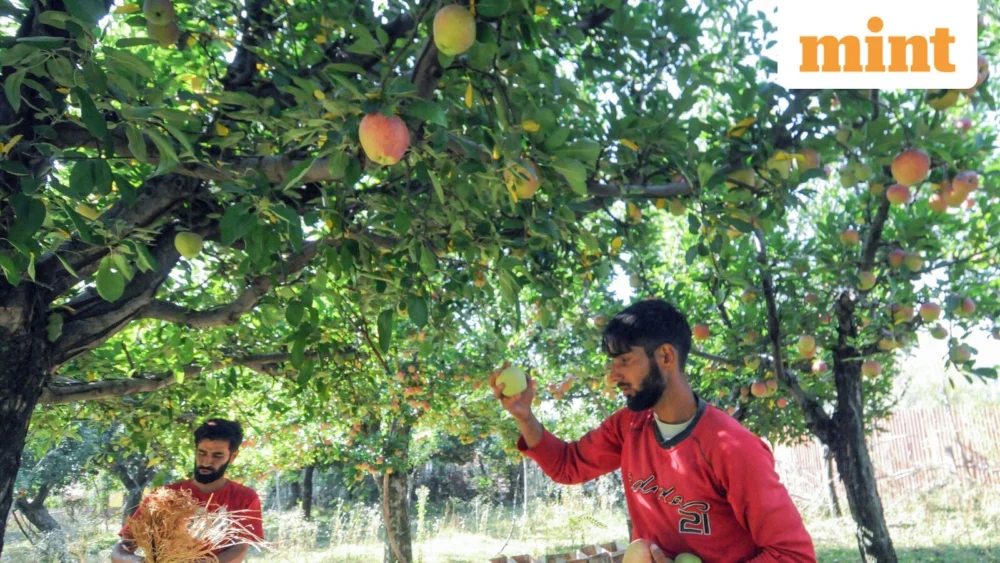
The picturesque valleys of Jammu and Kashmir, renowned for their pristine beauty, are home to a burgeoning fruit economy that forms the bedrock of regional livelihoods. At the heart of this agricultural powerhouse lies the apple industry, contributing a staggering ₹15,000 crore annually and sustaining over 3.5 million people through direct and indirect employment. However, this vital sector, which positions the region as India’s primary apple producer, is navigating an increasingly volatile landscape, caught between the accelerating impacts of climate change and a glaring deficit in effective crop insurance mechanisms. Growers find themselves in a perilous gamble, where a single adverse weather event can decimate years of investment and plunge families into cycles of debt.
The specter of climate change looms large over Kashmir’s orchards, manifesting in unpredictable and destructive weather patterns that are fundamentally altering the agricultural calendar and challenging traditional farming wisdom. Hailstorms, once sporadic, now strike with greater frequency and intensity during critical growth phases, scarring fruit and diminishing market value. Intense heatwaves foster an environment ripe for disease outbreaks, compromising crop health and necessitating increased, costly pesticide applications. Perhaps most critically, the region is experiencing increasingly snowless winters and a drastic reduction in "chilling hours"—the period of cold temperatures essential for apple trees to break dormancy and produce quality fruit. Experts note that areas like Shopian, historically recording nearly 4,000 chilling hours, now barely register 320, a precipitous drop that pushes cultivation towards unviability once temperatures consistently exceed 28 degrees Celsius. This ecological shift transforms what were once robust A-grade harvests into C-grade produce, often resulting in losses rather than profit for the growers.
The human toll of this climatic instability is profound. In Allaiepora village, Pulwama, Khursheed Ahmad Allaie, a 34-year-old apple grower, laments the transformation of his high-density orchards—once a symbol of progress and higher yields—into a source of mounting anxiety. Scars on his trees from an extreme weather event last August bear silent witness to the destruction. Without a robust safety net, growers like Allaie are left to absorb colossal losses, watching their harvest spoil, unable to meet financial obligations for inputs, labor, or even their children’s education. Similarly, Mohammad Yousuf Bhat, whose family has cultivated orchards in Katrasoo, Kulgam, for nearly 80 years, recalls a hailstorm that wiped out half his crop in a single season, following early snowfalls in previous years that snapped fruit-laden trees. The meager relief received – a mere ₹1,000 – highlights the inadequacy of current support systems, underscoring the desperate need for comprehensive insurance.
Despite the undeniable and escalating risks, the existing national agricultural insurance framework, particularly the Pradhan Mantri Fasal Bima Yojana (PMFBY) launched in 2016, has largely failed to provide meaningful coverage for Kashmir’s horticulture sector. While the PMFBY has seen significant enrolment across Jammu and Kashmir, insuring approximately 960,000 farmers covering 560,000 hectares and settling claims worth ₹156 crore (with farmers receiving ₹68 crore), the lion’s share of this protection has been directed towards staple crops like wheat, paddy, and oilseeds, predominantly in the Jammu region. In the Kashmir Valley, where agricultural land is increasingly converted to apple orchards, insurance penetration remains dismally low, covering only about 16% of cropped land – significantly below the government’s 25% target.
Bashir Ahmad Basheer, chairman of the Kashmir Valley Fruit Growers-cum-Dealers Union, points out the fundamental misalignment: "Our economy depends on fruit, not food grains. But the PMFBY is still largely designed around agricultural crops." This institutional bias leaves the region’s primary economic engine exposed. The reluctance of insurance companies to cover apple cultivation stems from a confluence of factors, primarily a critical lack of reliable, long-term data. Altaf Aijaz Andrabi, former director of agriculture and the first mission director of crop insurance in J&K, emphasizes that insurers struggle with apple-yield estimation due to the absence of a standardized, notified assessment model backed by extensive historical weather and yield data. This data vacuum, exacerbated by climate change making apples a "highly fluctuating, high-risk crop," renders them an unattractive proposition for profit-driven insurance providers.

Economist and former finance minister of the erstwhile state, Haseeb Drabu, echoes this sentiment, asserting that effective insurance design is impossible without comprehensive data, ideally spanning a century of weather and yield patterns for accurate risk assessment. He also highlights structural issues within the orchards themselves; traditional orchards with highly variable yields are harder to insure than modern, high-density, standardized plantations, which offer more predictable output and thus lower perceived risk. This underscores the need for policy design to be rooted in rigorous research and empirical data.
Administrative bottlenecks have further compounded the problem. Earlier operational guidelines under crop insurance schemes mandated insurers to bid for entire crop-cluster combinations. If even one crop within a cluster lacked a ratified yield-assessment module—a common issue for apples—the entire bid would be invalidated. This rigid structure led to repeated failures in securing horticulture insurance tenders, leaving growers without a safety net for years. While the J&K government’s intervention in 2019 led to the rollout of the Restructured Weather-Based Crop Insurance Scheme (RWBCIS) for horticulture, promising a more tailored approach, the challenges persist.
Even with revised schemes, affordability remains a significant barrier for farmers already grappling with rising input costs. Fertilizers, pesticides, labor, and packaging expenses have surged, while returns fluctuate wildly. Andrabi suggests that a farmer’s contribution of 1% of the premium might be manageable, but even 5% is often prohibitive. He estimates that premiums would need to drop to around ₹8,000 per hectare for growers to seriously consider enrolment. Despite the current premium structure—capped at 25%, with the Centre bearing 11%, the Union territory government 9%, and growers 5%—apple cultivation has consistently failed to attract insurer interest. This stark reality contrasts sharply with agricultural insurance models in other developed economies, where comprehensive data infrastructure, advanced actuarial science, and often substantial government subsidies create more viable markets for specialized crop insurance. For instance, in parts of Europe or North America, sophisticated weather indexing and satellite-based yield monitoring, combined with robust state support, allow for more granular and effective risk transfer mechanisms for high-value crops like apples.
The cycle of debt and despair among Kashmiri apple growers is palpable. Mohammad Ashraf Wani, president of the mega fruit mandi in Shopian, emphasizes that climate change impacts both the quality and quantity of fruit, directly threatening the industry’s survival. He points to the critical importance of snow for winter chill and rainfall during flowering, conditions increasingly disrupted by cloudbursts and unexpected heat. For growers who have pending fertilizer bills, pesticide payments, and overdue school fees, the absence of insurance means economic ruin.
There are glimmers of hope. In 2025, the government reportedly invited fresh bids for horticulture insurance, attracting four companies for the Kashmir division and five for Jammu—an unprecedented level of interest. Vikas Anand, director of horticulture, Kashmir, asserts that the agriculture department is committed to implementing the RWBCIS to address climate-induced losses, specifically mentioning coverage for hailstorms, uneven temperature patterns, and excessive rainfall. However, turning this interest into tangible, accessible, and affordable coverage for apple growers will require concerted effort, a significant overhaul of data collection and risk assessment methodologies, and potentially higher subsidies to bridge the gap between insurer viability and farmer affordability. The long-term economic stability of Jammu and Kashmir hinges on transforming its vulnerable fruit economy into a resilient one, safeguarding not just crops, but the very fabric of millions of lives.