Spain’s university sector is undergoing a subtle but significant transformation, with recent data for the 2024/2025 academic year revealing a stabilization in public university enrollment figures following a historical peak, while private institutions continue to witness a sustained and notable surge in student numbers. This evolving dynamic has profound implications for educational access, institutional funding, and the broader economic impact of higher education in the Iberian nation.
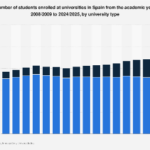
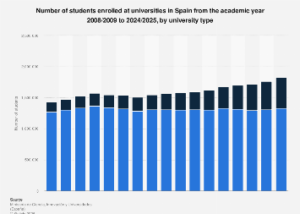
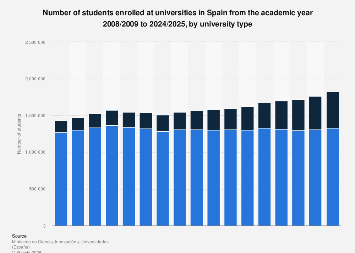
For the 2024/2025 academic year, approximately 1.33 million students are enrolled in Spain’s public universities. This figure represents a slight decrease from the peak enrollment of roughly 1.37 million students recorded during the 2012/2013 academic year, a period that coincided with the aftermath of the global financial crisis and subsequent austerity measures that impacted various public services, including education. While the current numbers indicate a plateau rather than a sharp decline, they signal a departure from the consistent growth seen in earlier years.
In stark contrast, the private university sector has demonstrated remarkable resilience and consistent expansion. In the 2024/2025 academic year, private universities are projected to host around 496,000 students. This represents a substantial increase from the 155,004 students enrolled in the 2008/2009 academic year, showcasing a growth trajectory that has outpaced the public sector significantly over the past decade and a half. The compound annual growth rate (CAGR) for private university enrollment over this period can be estimated to be in the high single digits, a figure that would be enviable in most mature higher education markets.
Several factors likely contribute to this divergence. The economic climate plays a crucial role. While public universities traditionally offer more affordable tuition fees, economic uncertainties and evolving student preferences can influence choices. The rise of private institutions may also be linked to perceptions of greater flexibility, specialized program offerings, and potentially faster adaptation to labor market demands. Furthermore, demographic shifts and a greater emphasis on lifelong learning and postgraduate studies could be fueling demand across both sectors, with private institutions perhaps better positioned to cater to niche or rapidly evolving fields.
Looking at the historical data provides a clearer picture of this trend. From the 2008/2009 academic year, public universities saw a steady increase, reaching their zenith in 2011/2012 and 2012/2013. Post-2013, enrollment numbers in public institutions began to fluctuate, hovering around the 1.3 million mark. For instance, the 2013/2014 academic year saw a slight dip to approximately 1.32 million, followed by a period of relative stability. The 2020/2021 academic year, impacted by the global pandemic, saw a temporary increase to over 1.32 million, potentially reflecting a delayed enrollment or a shift towards online learning options that many public institutions expanded. However, the figures for 2023/2024 and 2024/2025 indicate a slight contraction from the pandemic-era highs, settling back into the pre-pandemic range.
The growth in private university enrollment has been far more consistent. Starting from just over 155,000 students in 2008/2009, the numbers have climbed year after year. By 2014/2015, private universities had surpassed 221,000 students, and they crossed the 300,000 mark by 2019/2020. The pandemic period, while challenging for many sectors, did not significantly derail this growth, with enrollment reaching over 350,000 in 2020/2021 and continuing its upward trajectory. This sustained expansion suggests a growing demand for the educational models and services offered by private providers.
The economic implications of this shift are multifaceted. Public universities, often a cornerstone of national research and development and a driver of social mobility, rely heavily on government funding. A stabilization or slight decrease in enrollment, coupled with potential funding pressures, could impact their capacity for innovation and outreach. Conversely, the burgeoning private sector contributes significantly to the economy through tuition fees, employment generation, and investment in infrastructure. The increasing reliance on private education also raises questions about equity and accessibility, particularly for students from lower socioeconomic backgrounds, though many private institutions offer scholarships and financial aid.
Globally, the trend of private higher education expansion is not unique to Spain. Many developed and developing economies have witnessed a similar phenomenon, driven by increased demand for higher education, diversification of offerings, and the commercialization of educational services. In countries like the United States, private institutions, including both non-profit and for-profit entities, play a substantial role in the higher education landscape. Similarly, in parts of Asia and Latin America, private universities have grown rapidly to meet the educational aspirations of a growing middle class.
However, the Spanish context presents its own nuances. The historical strength and reputation of its public university system mean that any shift towards the private sector is carefully watched. Policymakers face the challenge of ensuring that the public system remains robust and competitive, while also fostering a healthy and regulated private sector. Issues such as quality assurance, accreditation, and the alignment of private university curricula with national and international labor market needs are paramount.
Moreover, the COVID-19 pandemic has undoubtedly accelerated certain trends, including the adoption of digital learning technologies. Both public and private institutions have had to adapt, and the long-term impact on enrollment patterns and the preferred modes of delivery remains to be fully understood. The data for 2024/2025, while indicating a return to pre-pandemic levels for public universities, also shows continued growth for private ones, suggesting that the flexibility and accessibility offered by some private institutions may be resonating with a segment of the student population.
The economic impact extends beyond direct revenue. Graduates from both public and private institutions contribute to the national workforce, innovation, and tax base. A well-functioning higher education system, regardless of the sector, is a critical component of a nation’s long-term economic competitiveness. The increasing enrollment in private universities could lead to a more diversified talent pool, but it also necessitates a continuous dialogue about the role of public institutions in providing foundational, accessible, and high-quality education for all.
As Spain navigates this evolving educational landscape, close monitoring of enrollment trends, student outcomes, and the economic contributions of both public and private universities will be essential for informed policymaking and ensuring a vibrant and inclusive future for higher education in the country. The data for 2024/2025 serves as a critical snapshot, highlighting the ongoing interplay between institutional models, economic conditions, and the aspirations of Spanish students.