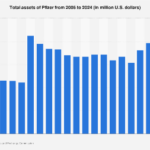
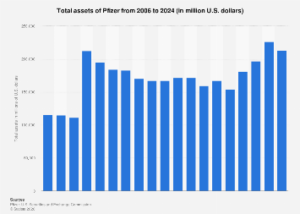

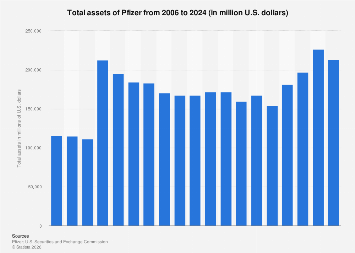
The global pharmaceutical giant, Pfizer Inc., headquartered in New York City, has reported its total assets for 2024, reaching an impressive approximately $213.396 billion. This figure represents a significant portion of the company’s financial standing and reflects its vast operational scale, extensive research and development investments, and its portfolio of intellectual property and physical assets. Analyzing Pfizer’s asset trajectory over nearly two decades provides a compelling narrative of strategic growth, market adaptation, and the inherent volatility within the life sciences sector.
Examining the historical data from 2006 to the present, Pfizer’s asset base has demonstrated a dynamic evolution. In 2006, the company’s total assets stood at around $115.5 billion. A notable surge occurred between 2007 and 2009, with assets climbing from approximately $111 billion to over $212 billion. This period likely reflects significant acquisitions, mergers, or substantial investment in its pipeline and manufacturing capabilities. Following this peak, assets saw a gradual decline and fluctuation, reaching a low of around $154 billion in 2020 before embarking on another upward trend. The period between 2021 and 2023 witnessed a substantial increase, culminating in $226.5 billion in 2023, before a slight dip to the current $213.4 billion in 2024.
This ebb and flow in asset valuation is a common characteristic of large pharmaceutical enterprises. It is intrinsically linked to factors such as blockbuster drug approvals and patent expirations, strategic divestitures, major capital expenditures on new facilities or technologies, and the impact of global economic conditions. For instance, the substantial asset growth in the late 2000s could be attributed to strategic maneuvers aimed at consolidating market position and expanding therapeutic areas. Conversely, the fluctuations in subsequent years may indicate the impact of patent cliffs on revenue streams, necessitating reinvestment or strategic realignments.
The $213.4 billion in total assets for 2024 situates Pfizer among the world’s largest corporations, not just within the pharmaceutical industry but across all sectors. Total assets provide a comprehensive snapshot of everything a company owns, including cash, accounts receivable, inventory, property, plant, equipment, and intangible assets like patents and goodwill. For Pfizer, this massive asset base underpins its ability to conduct cutting-edge research, develop novel treatments, manufacture medicines at scale, and maintain a robust global supply chain.
In the broader context of the global pharmaceutical industry, Pfizer’s asset size is substantial, though comparisons with peers reveal the competitive landscape. Companies like Johnson & Johnson, Roche, and Novartis also command enormous asset bases, often exceeding $100 billion, driven by diversified portfolios and extensive R&D efforts. The pharmaceutical sector is inherently capital-intensive, with billions of dollars required for drug discovery, clinical trials, regulatory approvals, and marketing. Pfizer’s reported assets are indicative of its capacity to navigate these demanding financial requirements.
The recent surge in Pfizer’s assets, particularly in the early 2020s, is undeniably linked to its pivotal role in developing and distributing COVID-19 vaccines and therapeutics. The unprecedented global demand for these products generated significant revenue, which in turn bolstered the company’s financial position and likely fueled further investments in its research pipeline and manufacturing infrastructure. While the extraordinary demand for COVID-19 related products may normalize, the strategic advantage and financial strength derived from this period continue to shape Pfizer’s asset portfolio.
However, the pharmaceutical industry is constantly in flux. Patent expirations for key drugs can lead to significant revenue declines, forcing companies to innovate aggressively and pursue new growth avenues. Mergers and acquisitions are also a common strategy to acquire new technologies, drug candidates, or market access. Pfizer’s asset management strategy will undoubtedly continue to be influenced by these dynamics. The company’s ability to effectively deploy its substantial assets in research and development, strategic partnerships, and potential acquisitions will be crucial for sustaining its competitive edge and delivering long-term value to shareholders.
Furthermore, the valuation of intangible assets, such as intellectual property and brand reputation, plays a significant role in a pharmaceutical company’s total assets. Pfizer’s extensive patent portfolio, representing decades of scientific innovation, contributes substantially to its overall asset value. The ongoing development of new drugs and therapies, coupled with successful marketing and brand building, further enhances these intangible assets.
Economically, a company of Pfizer’s magnitude and asset base has a profound impact. Its operations create jobs directly within its research, manufacturing, and administrative functions, as well as indirectly through its extensive network of suppliers, distributors, and service providers. The company’s investment in R&D not only drives its own growth but also contributes to the advancement of medical science, potentially leading to improved public health outcomes globally. The sheer scale of its operations means that decisions made by Pfizer regarding asset allocation and investment can have ripple effects across regional and global economies.
Looking ahead, Pfizer faces the ongoing challenge of maintaining its growth trajectory in a complex and highly regulated industry. The company’s substantial asset base provides a strong foundation, but its future success will depend on its agility in responding to scientific advancements, evolving healthcare needs, and the competitive pressures from both established players and emerging biotechnology firms. The reported $213.4 billion in total assets for 2024 is not merely a financial figure; it represents a potent engine of innovation and a testament to Pfizer’s enduring presence and influence in the global healthcare ecosystem.