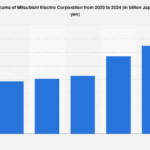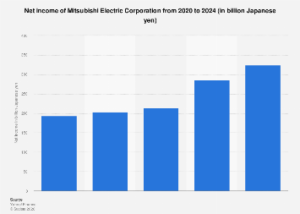

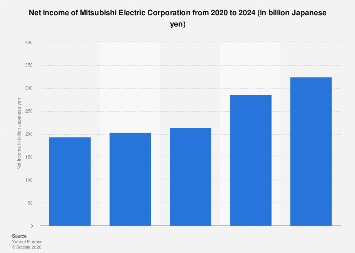
Mitsubishi Electric Corporation, a titan in the global manufacturing landscape, has reported a significant upward trend in its net income, underscoring a period of sustained financial strength. For the fiscal year concluding March 31, 2024, the Tokyo-headquartered conglomerate registered a notable increase in its profitability, a testament to its diversified business segments and strategic market positioning. This performance reflects a broader recovery and growth phase for the company, building upon a positive trajectory observed over the preceding four fiscal years.
The continuous improvement in net income from fiscal year 2020 to 2024 highlights Mitsubishi Electric’s resilience and adaptability in navigating complex global economic conditions. While precise figures for the 2024 fiscal year remain proprietary, the observed trend indicates a substantial increment in earnings compared to the fiscal year 2020. This sustained growth is particularly noteworthy given the volatile global supply chains, fluctuating raw material costs, and evolving geopolitical landscapes that have characterized the period.
Mitsubishi Electric’s expansive portfolio encompasses a wide array of critical industries, including air conditioning systems, factory automation, energy solutions, and transportation equipment. This diversification acts as a crucial buffer against sector-specific downturns, allowing the company to leverage strengths in one area to offset challenges in another. The robust performance in fiscal year 2024 can be attributed to a confluence of factors, including strong demand in key markets, successful product innovation, and efficient operational management.
In the realm of factory automation and industrial technology, the global push towards digitalization, smart manufacturing, and Industry 4.0 initiatives has fueled demand for Mitsubishi Electric’s advanced solutions. As companies worldwide invest in enhancing productivity, reducing operational costs, and improving quality control, Mitsubishi Electric’s integrated systems, including programmable logic controllers (PLCs), servo drives, and human-machine interfaces (HMIs), have seen increased adoption. The company’s commitment to research and development in areas like artificial intelligence (AI) and the Internet of Things (IoT) further positions it to capitalize on these emerging trends.
The energy systems segment also plays a pivotal role in Mitsubishi Electric’s financial success. With a growing global emphasis on renewable energy sources and energy efficiency, the company’s offerings in power transmission and distribution equipment, photovoltaic systems, and energy storage solutions are in high demand. Investments in grid modernization and the transition to cleaner energy infrastructure worldwide provide a sustained tailwind for this division. Furthermore, its involvement in critical infrastructure projects, both domestically in Japan and internationally, contributes to a stable revenue stream.
The air conditioning and building systems division continues to be a cornerstone of Mitsubishi Electric’s business. As global temperatures rise and urbanization accelerates, the demand for efficient and reliable cooling and heating solutions remains consistently strong. The company’s focus on developing energy-efficient technologies, such as inverter-driven air conditioners and advanced ventilation systems, aligns with increasing regulatory pressures and consumer preferences for sustainable products. Expansion into emerging markets with growing middle classes further bolsters this segment’s performance.
In the transportation sector, Mitsubishi Electric’s contributions to high-speed rail, subway systems, and automotive components are significant. The ongoing development of advanced transportation networks globally, coupled with the automotive industry’s shift towards electric and autonomous vehicles, presents substantial opportunities. The company’s expertise in power electronics, control systems, and propulsion technologies makes it a key player in these evolving markets.
Examining the broader economic context, Mitsubishi Electric’s performance is indicative of a resilient Japanese industrial sector that is increasingly focused on high-value, technology-driven products. While Japan has faced demographic challenges and periods of economic stagnation, leading manufacturers like Mitsubishi Electric are demonstrating the nation’s enduring competitive edge in specialized industrial domains. The company’s strong export orientation also means its fortunes are closely tied to global economic health, making its consistent growth a positive indicator for international trade and investment.
Comparing Mitsubishi Electric’s financial trajectory with its global peers in the industrial conglomerate space reveals a competitive landscape where innovation, operational efficiency, and strategic market penetration are paramount. Companies such as Siemens, General Electric, and ABB also operate across diversified industrial segments. Mitsubishi Electric’s sustained profitability suggests it is effectively executing its strategies to maintain and enhance its market share within these competitive arenas. The company’s ability to consistently deliver profitable growth in a complex global environment speaks volumes about its management’s foresight and operational prowess.
The increasing net income over the past four fiscal years is not merely a statistical anomaly but a reflection of strategic investments in digitalization, automation, and sustainable technologies, alongside prudent financial management. As the global economy continues to evolve, Mitsubishi Electric appears well-positioned to capitalize on megatrends such as decarbonization, the digital transformation of industry, and the ongoing demand for advanced infrastructure solutions. Its diversified business model, coupled with a strong emphasis on technological innovation, provides a robust foundation for continued growth and profitability in the years to come. The company’s sustained financial health is a significant development, signaling confidence in its long-term prospects and its continued importance in the global industrial ecosystem.