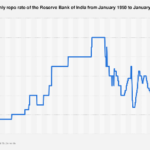
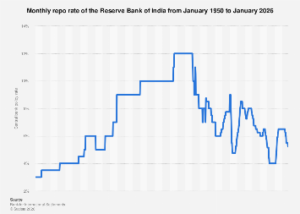

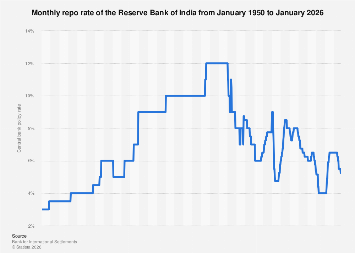
As of January 2026, India’s central bank policy rate is projected to hover around a specific percentage, signaling a deliberate move towards monetary easing. This anticipated reduction reflects a cooling of inflationary pressures that had previously necessitated a more restrictive monetary stance. The period leading up to these projected cuts in 2025 was marked by a significant tightening cycle. Between April 2022 and February 2023, the Reserve Bank of India (RBI) implemented a series of aggressive rate hikes, escalating the policy rate from a lower benchmark to a substantially higher level. This decisive action was a direct response to a surge in inflation, which posed a considerable risk to economic stability and purchasing power.
The history of India’s central bank policy rate, particularly the repo rate, offers a compelling narrative of the nation’s economic evolution and the RBI’s adaptive strategies. Spanning from 1950 to the projected figures extending to 2026, this journey illustrates the delicate balancing act of managing growth, controlling inflation, and maintaining financial stability in a dynamic emerging market economy. The repo rate, the rate at which the RBI lends money to commercial banks, serves as a crucial tool in monetary policy transmission, influencing borrowing costs, liquidity, and ultimately, economic activity.
Navigating Economic Cycles: The RBI’s Historical Stance
The early post-independence era in India was characterized by a focus on nation-building and development, often accompanied by a more interventionist economic policy. During this period, interest rate decisions were likely influenced by the government’s developmental objectives, with the repo rate potentially being used to channel credit towards priority sectors. Data from the mid-20th century would likely reveal a relatively stable, though perhaps higher, interest rate environment, reflecting the nascent stage of financial markets and the need to encourage investment in foundational industries.
As India’s economy liberalized and integrated more deeply into the global financial system, the RBI’s policy framework evolved. The liberalization reforms of the early 1990s marked a significant turning point, ushering in an era of greater market orientation and a more proactive approach to inflation management. This period would likely see increased volatility in the repo rate as the RBI grappled with the complexities of a more open economy, including managing capital flows and responding to external economic shocks.
The early 2000s witnessed a period of sustained economic growth in India, often referred to as the "India Shining" era. During these years, monetary policy likely aimed to support this growth trajectory while keeping inflation within acceptable bounds. This might have translated into a period of relatively stable or moderately declining interest rates, fostering investment and consumption. However, global economic events, such as the Asian Financial Crisis or the Dot-com bubble, could have introduced periods of policy adjustment.
The Inflationary Challenge and the Tightening Response
The global financial crisis of 2008 and its aftermath presented a new set of challenges. While some economies experienced deflationary pressures, India, like many emerging markets, faced the dual challenge of stimulating growth while managing inflationary risks, particularly from rising commodity prices. The RBI’s response during this period would have involved a careful calibration of interest rates, potentially seeing periods of easing to support recovery followed by tightening to curb price pressures.
The period between 2022 and 2023 stands out as a critical juncture. The global economy experienced a significant surge in inflation, driven by a confluence of factors including supply chain disruptions, increased energy prices, and pent-up demand following pandemic-related lockdowns. India was not immune to these global trends. Elevated inflation threatened to erode household purchasing power, impact corporate profitability, and undermine macroeconomic stability. In response, the RBI embarked on an aggressive monetary tightening cycle, a move mirrored by central banks across the globe. The sharp increase in the repo rate during this time was a clear signal of the RBI’s commitment to bringing inflation under control, even at the risk of temporarily dampening economic growth.
Looking Ahead: The Path to Easing and Future Challenges
The projected moderation in inflationary pressures by 2025 and the anticipated shift towards monetary easing suggest a positive outlook for India’s economy. Lower interest rates can stimulate investment by reducing the cost of capital for businesses, and boost consumption by making borrowing cheaper for households. This can translate into higher economic growth, job creation, and improved living standards.
However, the path to sustained economic stability is rarely linear. The RBI will need to remain vigilant to a range of potential risks. Global economic uncertainties, geopolitical developments, and the trajectory of commodity prices can all influence India’s inflation outlook. Furthermore, the pace and extent of monetary easing will need to be carefully managed to avoid reigniting inflationary pressures or creating asset bubbles.
The RBI’s policy decisions are closely watched by domestic and international investors alike. The central bank’s credibility, built over decades of navigating complex economic landscapes, plays a crucial role in anchoring inflation expectations and fostering investor confidence. The historical data on the repo rate provides valuable insights into the RBI’s responses to past economic challenges, offering a framework for understanding its current and future policy actions.
Global Context and Economic Impact
India’s monetary policy decisions are not made in isolation. The RBI’s actions are often influenced by, and in turn influence, global monetary policy trends. The recent synchronized tightening by central banks worldwide highlights the interconnectedness of the global financial system. As major central banks begin to consider or implement rate cuts, the RBI’s own easing cycle will be shaped by these broader global dynamics.
The impact of the RBI’s policy rate extends beyond inflation and growth. It affects the cost of borrowing for governments, influencing fiscal policy and debt management. It also impacts the performance of financial markets, including the equity and bond markets, and can influence foreign direct investment and portfolio flows. A stable and predictable monetary policy environment is crucial for attracting long-term investment and fostering sustainable economic development.
The long-term trend of India’s repo rate, from its inception to the projected figures, underscores the RBI’s evolving role as a guardian of price stability and a facilitator of economic growth. The ability to adapt to changing economic conditions, manage external shocks, and maintain a delicate balance between competing policy objectives will continue to be paramount for the Reserve Bank of India in the years to come. The period ahead, with its projected easing, will be a testament to the central bank’s success in navigating the complexities of a modern, rapidly developing economy.