


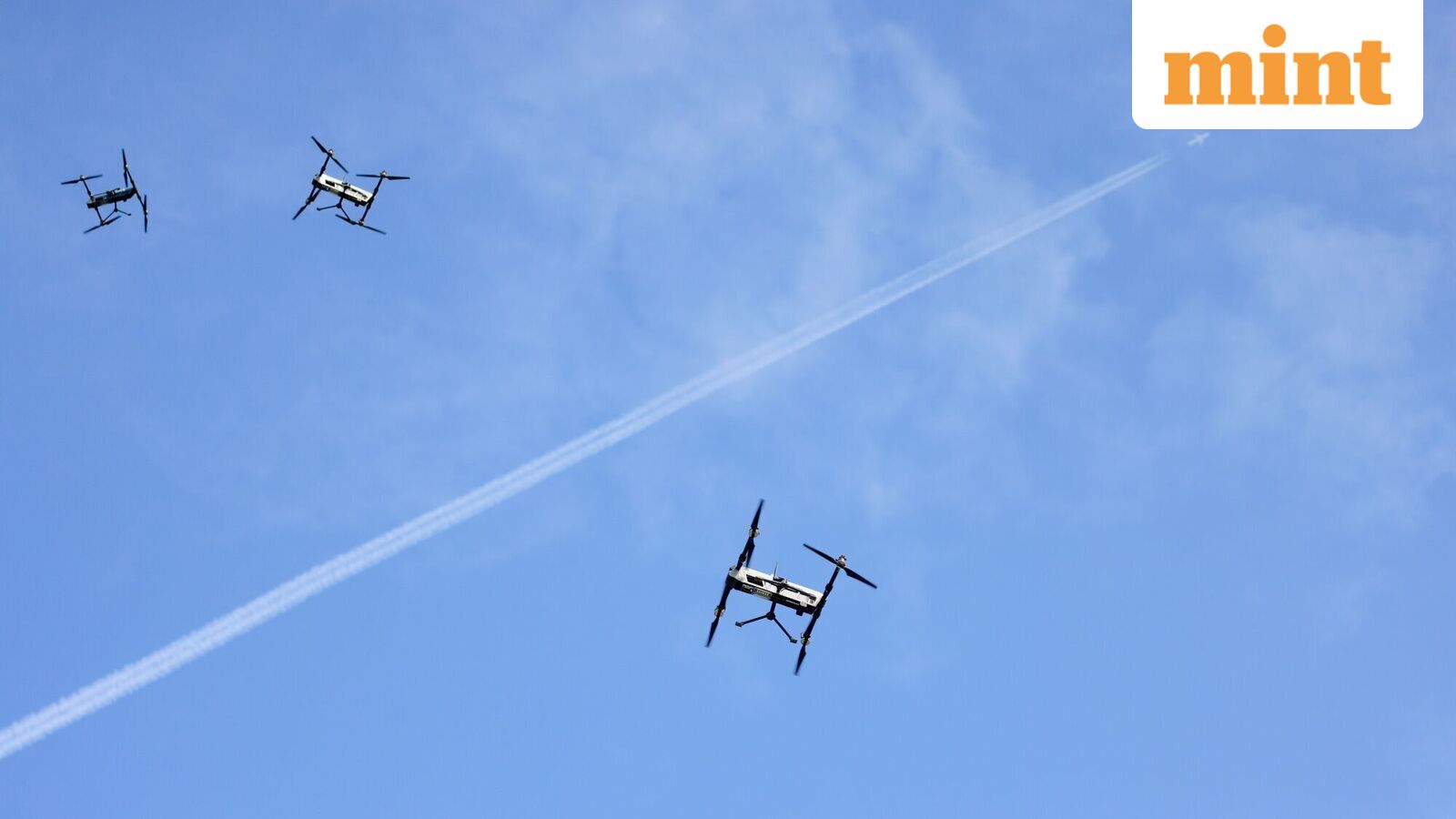
India is embarking on a significant strategic initiative, tentatively named Mission Drone Shakti, proposing an outlay of up to ₹1,800 crore to fundamentally transform its domestic drone industry. This comprehensive incentive scheme, spearheaded by the civil aviation ministry, is designed to aggressively stimulate local manufacturing, foster advanced research and development, and markedly reduce the nation’s pronounced reliance on imported drone components, particularly from China. The ambitious program mirrors India’s broader industrial strategy, drawing inspiration from the successful Production-Linked Incentive (PLI) schemes that have galvanized over 14 key sectors, including electronics, pharmaceuticals, and automobiles, with a cumulative financial commitment exceeding ₹1.97 trillion.
The proposed financial framework for Mission Drone Shakti envisions a robust allocation over a five-year period, ranging from ₹1,600 crore to ₹1,800 crore. This substantial investment is strategically divided to address critical aspects of the drone ecosystem. A significant portion, estimated at ₹500 crore to ₹600 crore, is earmarked for bolstering research and development efforts, aiming to cultivate indigenous innovation and technological breakthroughs. The remaining ₹1,000 crore to ₹1,200 crore will be channeled into providing direct manufacturing support for crucial components such as propellers, motors, airframes, and advanced avionics, alongside sales-linked incentives designed to spur market adoption and expansion. The scheme is primarily targeted at private Indian enterprises, with its introduction anticipated in FY27, following a rigorous finalization process and requisite approvals from the finance ministry and the Union Cabinet.
The incentive mechanism is meticulously crafted to promote genuine domestic value addition. Financial benefits will be directly correlated with the extent of local content incorporation and the incremental sales achieved by beneficiary companies. This performance-based approach mandates a minimum threshold of domestic value addition for eligibility, ensuring that the scheme effectively fosters an integrated local supply chain rather than merely subsidizing assembly operations. This strategic design aims to cultivate a resilient ecosystem, moving beyond superficial localization to deep-seated manufacturing capabilities.
The impetus behind Mission Drone Shakti is fundamentally rooted in India’s imperative for self-reliance, or ‘Atmanirbhar Bharat,’ especially concerning critical technologies with dual-use applications. The current landscape reveals a substantial dependence on foreign suppliers for sophisticated drone components. Industry data, including insights from the Drone Federation India, highlights that smaller drone manufacturers often import more than 50% of their components, while even the larger players, which command 80% of the market share, still exhibit an import dependency of around 30%. Key imported items include advanced GPS modules, high-precision sensors, long-lasting lithium polymer batteries, complex flight controllers, and specialized propulsion systems like motors and propellers. This reliance not only presents economic vulnerabilities but also carries significant geopolitical and national security implications, particularly given the predominant role of Chinese suppliers in the global component market.
The government’s overarching vision extends beyond merely substituting imports; it aims to position India as a global hub for drone manufacturing and services by 2030. This ambitious goal necessitates a vibrant domestic ecosystem capable of producing cutting-edge drone technology and providing sophisticated drone-based services across a spectrum of sectors. The existing drone market in India is currently valued at approximately ₹4,500 crore, with projections from industry players like RattanIndia, through its subsidiary NeoSky India Ltd, indicating a massive expansion to ₹1.66 trillion by FY28. This exponential growth forecast underscores the immense potential and strategic importance of the sector.

The applications for drones are rapidly diversifying and expanding across numerous economic and strategic domains. In agriculture, drones are becoming indispensable for precision farming, monitoring crop health, targeted pesticide spraying, and land surveying, promising enhanced efficiency and yields. For infrastructure, they offer invaluable tools for inspecting vast networks of pipelines, power lines, bridges, and construction sites, reducing human risk and accelerating maintenance schedules. The logistics sector is exploring drones for last-mile delivery, particularly in remote or challenging terrains, and for inventory management in large warehouses. Surveillance and security applications are growing rapidly, providing enhanced capabilities for law enforcement and border management. Furthermore, the defense sector is a primary driver, utilizing drones for reconnaissance, intelligence gathering, target acquisition, and even combat operations. To ensure coordinated growth and adoption, at least 12 government ministries are being integrated into the broader strategy for drone deployment and ecosystem development.
This new scheme represents a significant scale-up from previous governmental support for the drone sector. In 2021, India introduced a more modest ₹120 crore PLI scheme for drones, spread over three years. While that initial scheme was noteworthy, being almost double the combined turnover of all domestic drone manufacturers in FY21 and successfully identifying 12 drone manufacturers and 11 component makers for benefits, Mission Drone Shakti’s proposed outlay of up to ₹1,800 crore signifies a tenfold increase in financial commitment. This dramatic escalation reflects a deeper understanding of the sector’s strategic importance, its growth trajectory, and the sheer investment required to build a globally competitive ecosystem.
Industry leaders and experts largely welcome this elevated level of governmental support. Smit Shah, President of the Drone Federation India, which boasts a network of 550 drone companies and 204 component manufacturers on its ‘Bharat Drone Stack’ platform, emphasizes that such a scheme is "long pending to drive up economies of scale in India." He highlights the need for the scheme to also vigorously push drone adoption into non-defense sectors to fully realize the market’s potential. Major domestic players like Adani Defence and Aerospace, Tata Advanced Systems Ltd, IdeaForge, and Newspace Research and Technologies are already making significant strides, but the broader ecosystem, particularly smaller and medium-sized enterprises (SMEs), requires targeted support.
A crucial aspect of the scheme’s success will be its ability to democratize benefits across the entire spectrum of drone manufacturers. As Uday Narang, founder of Sooryauday Aerial Vehicles, a Faridabad-based drone-maker, articulates, "The benefits of the new incentive scheme should accrue to the smaller players too, so that they actually get economies of scale and there is sufficient demand. This will push indigenous component manufacturing too, rather than rely on imports. If only the larger players derive the benefits, then it would not help develop an ecosystem. Sector control remains limited to few." This sentiment underscores the need for an inclusive policy framework that nurtures emerging players and prevents market concentration, thereby fostering a truly diverse and competitive industry.
Globally, leading nations are heavily investing in drone technology, recognizing its pivotal role in future economic competitiveness and national security. The United States, through defense procurement and R&D grants, actively supports its drone manufacturers, while the European Union has focused on regulatory harmonization and funding for innovative drone applications. China, already a dominant force in commercial drone manufacturing, continues to pour resources into advanced R&D and strategic market expansion. India’s Mission Drone Shakti, therefore, is not merely an internal economic program but a critical move to assert its position in this global technological race. It aims to generate a significant economic multiplier effect through job creation in manufacturing, R&D, and services, foster skill development, and spur innovation across allied industries.
Beyond direct financial incentives, a supportive regulatory environment is equally crucial. India’s Drone Rules 2021, which liberalized drone policy and simplified operational frameworks, have already laid a foundational framework. Mission Drone Shakti complements these regulatory reforms by providing the necessary industrial muscle. The long-term outlook for India’s drone sector appears robust, with potential for significant exports, continuous technological advancements integrating artificial intelligence and the Internet of Things, and a progressive move towards complete self-reliance. This ambitious scheme is a clear declaration of India’s intent to not just participate but to lead in the global drone revolution, securing both its economic future and strategic autonomy.