

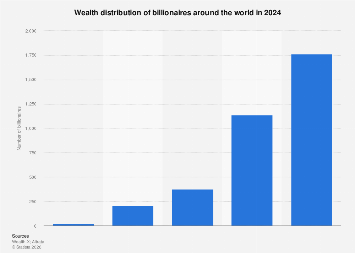
The concentration of extreme wealth at the very top of the global economic ladder continues to be a defining feature of the 21st century, with a select cohort of individuals commanding fortunes that dwarf the economies of many nations. While specific, granular data on the precise distribution of this wealth often requires specialized access, available reports and analyses consistently paint a picture of a widening chasm between the ultra-rich and the rest of the global population. This phenomenon is not merely an academic curiosity; it carries profound implications for economic growth, social mobility, and geopolitical stability.
The sheer scale of billionaire wealth is staggering. While the exact number fluctuates with market performance and new entrants to the ranks, estimates typically place the global billionaire population in the thousands. However, the distribution of their colossal net worth is far from uniform. A significant portion of this wealth is concentrated in the hands of a smaller, more elite group within this already exclusive club. This stratification within the billionaire class itself underscores the dynamic nature of extreme wealth accumulation and the mechanisms that drive it. These fortunes are often built and expanded through a complex interplay of ownership in publicly traded companies, private equity stakes, real estate portfolios, and increasingly, through digital assets and innovative technologies.
Geographically, the United States and China remain the dominant powerhouses for billionaire creation and wealth concentration. These nations, with their vast domestic markets, robust innovation ecosystems, and deep capital markets, provide fertile ground for the kind of large-scale enterprises that generate mega-fortunes. The entrepreneurial spirit, coupled with access to venture capital and public offerings, has propelled numerous individuals to billionaire status. Europe, while home to a substantial number of wealthy individuals, generally sees a more distributed pattern of wealth compared to the sheer scale of accumulation in the US and China. Emerging economies are increasingly contributing to the global tally, driven by rapid industrialization, burgeoning consumer classes, and technological advancements, though often from a lower base.
The industries that fuel this immense wealth are also evolving. Historically, manufacturing, retail, and finance were the primary engines of billionaire wealth. Today, technology has ascended to a dominant position. The digital revolution, encompassing software, e-commerce, social media, and artificial intelligence, has created new avenues for unprecedented wealth creation. Companies born from these sectors often exhibit rapid scaling capabilities, allowing founders and early investors to amass fortunes in relatively short periods. Beyond tech, sectors like healthcare, renewable energy, and biotechnology are also becoming increasingly significant contributors to the billionaire landscape, reflecting global trends and investment priorities.
Understanding the economic impact of such concentrated wealth requires a nuanced perspective. Proponents of high concentrations of wealth often argue that it fuels investment, innovation, and job creation. Billionaires, with their substantial capital, are positioned to fund ambitious projects, launch disruptive technologies, and invest in companies that drive economic activity. The argument is that this capital, if dispersed too widely, would be less effectively deployed for large-scale economic impact. Furthermore, the pursuit of such immense wealth incentivizes risk-taking and innovation, leading to advancements that can benefit society as a whole. The venture capital model, often driven by individuals with substantial personal fortunes, is a prime example of how concentrated capital can foster nascent industries.
Conversely, critics highlight the potential downsides of extreme wealth concentration. A primary concern is the exacerbation of income inequality. When a small percentage of the population controls a disproportionately large share of the world’s wealth, it can lead to reduced economic mobility for the majority, creating a society where opportunities are dictated more by inherited wealth than by merit or hard work. This can stifle overall economic demand, as a larger portion of the population has less disposable income to spend. There are also concerns about the political influence that vast fortunes can wield, potentially skewing policy decisions in favor of the wealthy elite, further entrenching existing economic structures. The debate over wealth taxes, inheritance taxes, and regulatory frameworks is often framed by these concerns about fairness and broad-based prosperity.
Global comparisons reveal differing approaches and outcomes regarding wealth distribution. Scandinavian countries, for instance, often exhibit lower levels of income and wealth inequality, attributed to robust social welfare systems, progressive taxation, and strong labor protections. While they may have fewer billionaires in absolute terms, the overall distribution of wealth is often perceived as more equitable. In contrast, countries with more laissez-faire economic policies and less developed social safety nets tend to see higher levels of wealth concentration. The effectiveness of various economic models in promoting both growth and equitable distribution remains a subject of ongoing research and policy debate among international economic institutions.
The future trajectory of billionaire wealth distribution is subject to numerous variables. Technological disruption, geopolitical shifts, climate change initiatives, and evolving regulatory landscapes will all play a role. The increasing focus on environmental, social, and governance (ESG) principles in investment may also influence where and how new fortunes are made and how existing wealth is managed. Furthermore, demographic shifts, including the aging of current billionaires and the emergence of new generations of inheritors and entrepreneurs, will undoubtedly reshape the composition and geographic distribution of this elite group. As global economic systems continue to adapt, the dynamics of wealth creation and concentration will remain a critical area of observation for understanding the health and direction of the global economy. The ongoing narrative of billionaire wealth is not just about the individuals at the apex, but about the broader economic forces and societal structures that enable and are shaped by such extraordinary concentrations of capital.