

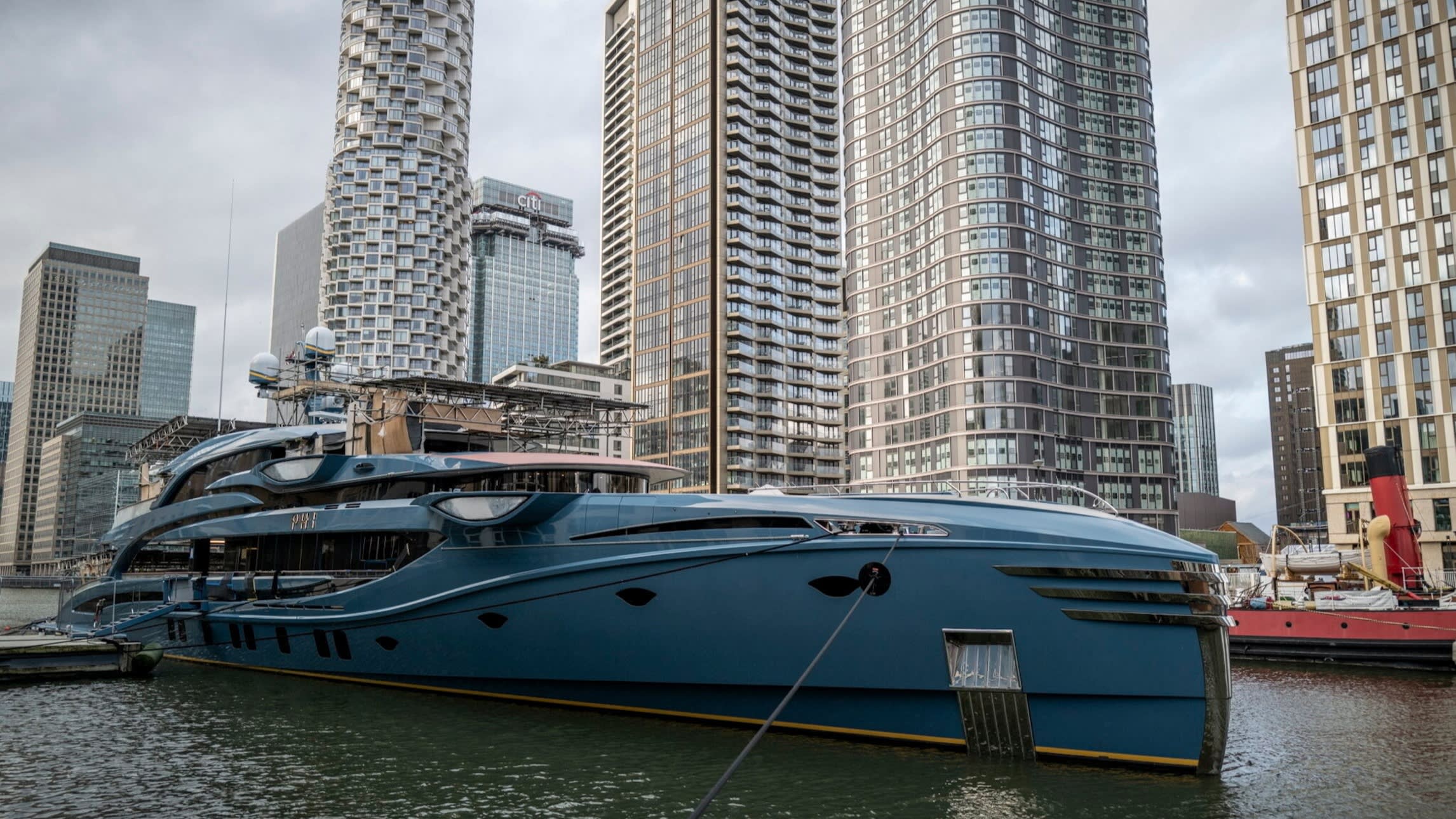
The gleaming white hulls and tiered decks of the world’s most luxurious superyachts were once the ultimate symbols of untouchable wealth and global mobility for Russia’s billionaire class. Today, however, these floating palaces have been transformed into stagnant monuments of geopolitical tension, anchored in European and American ports while their values plummet. Recent financial assessments indicate that the fleet of yachts impounded following the 2022 invasion of Ukraine has collectively lost more than €580 million in market value. This staggering depreciation highlights a growing economic dilemma for Western governments: the difficulty of maintaining high-maintenance assets that are caught in a legal and financial limbo.
The depreciation of these vessels is not merely a reflection of a cooling luxury market but is the direct result of the unique nature of maritime assets. Unlike real estate or gold, a superyacht is a depreciating asset that requires constant, specialized, and incredibly expensive upkeep to retain its seaworthiness and aesthetic appeal. In the yachting industry, the standard rule of thumb is that annual maintenance, staffing, and insurance costs average approximately 10% of the vessel’s original purchase price. For the "ghost fleet" of Russian-linked yachts currently under arrest, the cessation of regular maintenance schedules, the dismissal of expert crews, and the lack of engine exercise have accelerated their decline toward obsolescence.
The scale of the financial erosion is most evident when examining the flagship vessels currently held by authorities. Among the most prominent is the Dilbar, a 156-meter behemoth owned by Alisher Usmanov, which was valued at nearly $600 million before it was blocked in Hamburg, Germany. Similarly, the Scheherazade, a $700 million vessel linked to high-ranking Russian officials and currently held in Italy, represents a massive concentration of wealth that is effectively evaporating in the salt air. As these ships sit idle, their advanced technical systems—ranging from desalination plants to complex stabilization stabilizers—begin to fail. Without the constant attention of a full-time engineering crew, the internal components corrode, and the bespoke interiors, often featuring rare woods and delicate leathers, succumb to humidity and neglect.
This €580 million loss in value presents a significant headache for the jurisdictions hosting these vessels. Under international law and the specific domestic regulations of many EU member states, "freezing" an asset is fundamentally different from "seizing" it. When an asset is frozen, the owner retains title, but their right to use or sell the asset is suspended. This means that in many cases, the host government is responsible for the basic security and safety of the vessel to ensure it does not become a navigational hazard or an environmental threat in their harbors. In some instances, the costs of docking and basic maintenance are being footed by taxpayers, a situation that has sparked political backlash in countries like Italy, France, and Spain.
The legal quagmire surrounding these assets has prevented a swift liquidation that might have mitigated the financial losses. For a government to sell a yacht and use the proceeds—often earmarked for Ukrainian reconstruction—they must typically prove that the asset was not just owned by a sanctioned individual, but was involved in a specific crime, such as money laundering or sanctions evasion. This evidentiary burden is high. While the United States has successfully moved to forfeit some vessels, such as the Amadea, which was seized in Fiji and brought to San Diego, the process has been bogged down by claims from third-party shell companies and "straw man" owners who argue they have no ties to the Kremlin.
Market analysts suggest that even if these yachts were cleared for sale today, they would struggle to find buyers at their previous valuations. The "sanctions taint" has created a two-tier market in the superyacht industry. Potential buyers—often other ultra-high-net-worth individuals—are wary of purchasing a vessel with a controversial history, fearing future legal challenges or the social stigma associated with "oligarch assets." Furthermore, the pool of buyers capable of maintaining a 100-meter-plus vessel is extremely small, and many of those buyers are themselves under increased regulatory scrutiny. This lack of liquidity in the "mega-yacht" segment means that any forced sale would likely result in a "fire sale" price, further deepening the loss of value.
Beyond the individual ships, the stagnation of the Russian fleet has sent ripples through the broader maritime economy. The Mediterranean hubs of Monaco, Antibes, and Palma de Mallorca, which traditionally thrive on the servicing and provisioning of these vessels, have seen a decline in high-end activity. Russian owners were once among the most prolific spenders in the refit and repair sector. With dozens of the world’s largest yachts out of commission, specialized shipyards are losing millions in projected revenue. This shift is forcing the industry to pivot toward a new generation of owners, largely from the American tech sector and the Middle East, though the transition is not without its friction.
The economic impact analysis of these impounded assets also touches on the insurance industry. Most of these vessels are currently uninsurable in the standard market due to sanctions restrictions. This creates a massive liability risk. If one of these multi-hundred-million-dollar ships were to catch fire or sink at its moorings, there is no clear mechanism for who would cover the environmental cleanup or the damage to the port infrastructure. This risk profile contributes to the "frozen" status of the assets, as no commercial entity wants to touch a vessel that lacks comprehensive P&I (Protection and Indemnity) coverage.
Some governments are attempting to bypass the slow-moving legal system through new legislation. In the United States, the REPO (Rebuilding Economic Prosperity and Opportunity) for Ukrainians Act aims to provide the executive branch with more power to confiscate and repurpose frozen Russian sovereign assets, and by extension, there is pressure to apply similar logic to the private assets of the elite. However, critics warn that such moves could undermine the principle of property rights and lead to a flight of capital from Western financial centers. The European Union has been more cautious, sticking to a regime where assets remain frozen but the "windfall" profits or interest from those assets are redirected, though this is harder to apply to a physical object like a yacht than it is to cash or bonds.
The €580 million decline is also a psychological blow in the context of economic warfare. The original intent of targeting the yachts was to create a "circle of pressure" around the Russian leadership by making the lifestyle of the elite untenable. While the loss of a yacht might not change the course of a military campaign, the physical decay of these assets serves as a potent visual metaphor for the isolation of the Russian economy. However, as the bills for docking fees and basic upkeep mount, the question of who is truly being penalized becomes more complex. If the vessels eventually rot to the point of being scrap metal, the potential for using their value to aid victims of the conflict vanishes entirely.
As we move into the third year of these sanctions regimes, the international community faces a "use it or lose it" moment regarding seized luxury assets. The rapid depreciation suggests that the window for extracting significant value from the Russian yacht fleet is closing. Without a streamlined international legal framework to move from freezing to seizing and selling, these vessels will continue to lose millions of euros every month. What were once the crown jewels of the high seas are increasingly becoming white elephants—expensive, immobile, and a drain on the resources of the very nations that sought to use them as leverage. The €580 million loss is likely just the beginning of a much larger financial erasure in the luxury sector as the geopolitical stalemate continues.