
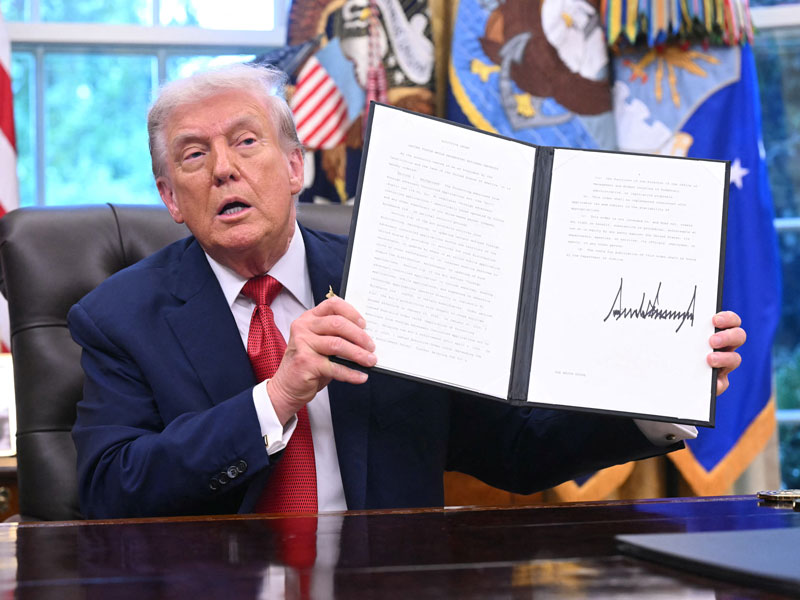
After a protracted period of diplomatic wrangling, regulatory pressure, and a series of extended deadlines, the future of the immensely popular social media platform TikTok has seemingly been resolved with a shift towards US ownership. President Donald Trump’s executive order mandating divestment marks a significant development in the ongoing saga that has captivated both geopolitical and economic observers. However, a closer examination of the intricate agreement reveals that Beijing may have secured a strategic victory, retaining substantial influence over the technology that propelled TikTok to global cultural dominance.
The declared outcome of the protracted negotiations presents a narrative of American success. Under the terms of the proposed framework, a new US-based entity would be established to manage TikTok’s operations within the United States. This entity would be primarily controlled by Oracle, a major American technology firm, and a consortium of US investors, collectively holding an 80% stake. Crucially, all data pertaining to American users is slated to reside on Oracle’s secure servers located within Texas. Furthermore, the new company would license TikTok’s proprietary recommendation algorithms, with plans to retrain them using American user data. The governance structure is also designed to reflect US control, with six out of seven board seats designated for American appointees. This arrangement appears to assuage immediate concerns regarding data privacy and algorithmic manipulation by ensuring that both user data and operational infrastructure are firmly under American stewardship. The deal even includes a financial sweetener for the US administration, with investors reportedly committing a substantial sum, viewed by some as a fee for facilitating the resolution.
Yet, beneath the surface of this apparent capitulation, a more nuanced reality emerges, one that suggests China’s leverage remains considerable. Global investment in TikTok’s parent company, ByteDance, is already substantial, with international investors reportedly holding approximately 60% of the company. ByteDance’s founders own an additional 20%, and employees the remaining 20%. The new agreement, therefore, primarily alters the ownership structure of the US operations, raising the US stake to 80% within that specific entity. ByteDance, while no longer the sole proprietor, would still retain a near 20% stake, making it the largest single shareholder in the US operation.
More critically, the intellectual property underpinning TikTok’s potent recommendation engine—the very engine that drives its addictive user experience and viral content dissemination—remains firmly within ByteDance’s possession. The US entities are not acquiring the algorithm outright; instead, they are obtaining a license. This distinction is profound. Algorithms are not static software programs; they are dynamic, data-intensive systems that require continuous refinement, updates, and substantial engineering expertise to maintain their efficacy. While Oracle may gain access to the code and be able to adapt a version of it for the US market, the fundamental dependence on China for ongoing algorithmic development and updates persists. This raises significant questions about the true extent of US control: will the US entity consistently receive these vital updates? And if so, can it conduct meaningful oversight and auditing of them?
The power of any recommendation algorithm is intrinsically linked to the breadth and depth of the data it is trained upon. By restricting the US version of TikTok to data generated solely by American users, the new entity will be deprived of the vast, diverse global dataset that has enabled ByteDance to develop such sophisticated and effective models. This inherent limitation could hinder the US version’s ability to compete effectively with its global counterparts, potentially leading to a less engaging and less impactful user experience.
Beijing has strategically positioned itself to maintain significant control through its export-control regulations. Since 2020, China has classified personalized recommendation algorithms as sensitive technologies, subjecting any transfer or update of such technology to government approval. This classification grants the Chinese authorities a powerful lever. In the event of escalating geopolitical tensions, whether concerning trade disputes, territorial issues, or technological sanctions, China could deliberately delay or withhold approval for algorithmic updates. This capability transforms TikTok into a potent diplomatic tool, allowing Beijing to exert pressure on the US and other nations by leveraging the platform’s global reach and cultural significance. The deal, therefore, risks transforming a commercial transaction into an instrument of statecraft.
For US investors involved in the new TikTok entity, this licensing arrangement introduces a substantial degree of uncertainty. The terms of the license are likely to be as much influenced by evolving geopolitical dynamics as by traditional legal contractual obligations. Rather than achieving a complete transfer of control from Chinese to American hands, the agreement appears to substitute one form of dependence for another. While the immediate security concerns related to direct Chinese access to US user data or algorithmic manipulation may be mitigated, the underlying technological reliance on China endures.
The arrangement empowers China to dictate the scope of the license, the frequency of essential updates, and the US version’s capacity to keep pace with its global competitors. This scenario does not diminish China’s influence; it potentially entrenches it in a more subtle, yet equally potent, manner. The fear of overt data exploitation or algorithmic manipulation may recede, but it will be supplanted by the enduring risk of technological dependence, with China holding a crucial chokehold on the very engine that drives TikTok’s success. The Trump administration has, in essence, traded one vulnerability for another.
However, there is a counterargument to be made regarding the potential benefits of a less globally competitive US version of TikTok. Some analysts suggest that a less potent iteration of the platform might not be detrimental to American interests. A less addictive and less virally effective TikTok could, in fact, prove beneficial for American teenagers and young adults, potentially reducing screen time and fostering healthier digital habits. This outcome, while not the primary objective of the divestment order, could be perceived as an unintended but positive consequence, offering a form of societal benefit that users may not immediately recognize. The long-term economic and social implications of this intricate technological and geopolitical dance remain to be fully understood, but the power dynamic clearly favors Beijing’s strategic interests.