

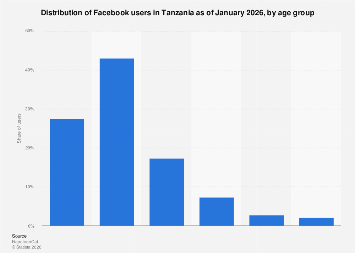
As of January 2026, the social media giant Facebook continues to hold a significant presence in Tanzania, with younger adults forming the largest demographic of its user base. Projections indicate that individuals between the ages of 25 and 34 years represent the most substantial segment of Facebook users in the East African nation, accounting for approximately 31.7% of the total. This age bracket, often characterized by growing professional careers and increased disposable income, is a crucial demographic for advertisers and content creators alike. Following closely, the 18-to-24-year-old cohort constitutes a significant 28.9% of the platform’s users in Tanzania. This demographic, comprising students and early-career professionals, demonstrates a strong inclination towards digital engagement and social networking.
The overall penetration of Facebook within Tanzania is noteworthy. In January 2026, an estimated 12.5 million individuals were active on the platform, representing a substantial 19.4% of the country’s total population. This figure underscores the growing digital connectivity and the increasing reliance on social media for communication, information dissemination, and entertainment across the nation. The steady growth in user numbers suggests that digital adoption is outpacing traditional communication channels, presenting both opportunities and challenges for businesses operating in or targeting the Tanzanian market.
Examining the broader age distribution reveals further insights into Tanzania’s evolving digital landscape. The 35-to-44-year-old segment comprises 17.2% of Facebook users, indicating continued engagement from a slightly older, established demographic. This group often possesses greater purchasing power and plays a vital role in household decision-making. The 45-to-54-year-old demographic accounts for 10.1% of users, showing sustained interest in maintaining social connections and accessing information online. Even older demographics are participating, with the 55-to-64-year-old group representing 6.4% of users, and those aged 65 and above making up 5.7%. This wider age participation signifies that digital platforms are becoming increasingly integrated into the daily lives of Tanzanians across various life stages, moving beyond being solely the domain of the youth.
This demographic breakdown is not merely a collection of statistics; it reflects significant socio-economic trends and holds considerable economic implications for Tanzania. The dominance of the 25-to-34 and 18-to-24 age groups on Facebook suggests a population that is largely digitally native or has rapidly adopted digital technologies. This demographic is more likely to be receptive to e-commerce, digital marketing campaigns, and online services. Businesses can leverage this understanding to tailor their product offerings, marketing messages, and customer engagement strategies to resonate effectively with these key segments.
The substantial penetration of Facebook, reaching nearly one-fifth of the Tanzanian population, signifies a fertile ground for digital innovation and economic growth. The platform serves as a critical conduit for information, news, and social discourse, influencing consumer behavior and market trends. For businesses, this translates into enhanced opportunities for brand building, customer acquisition, and market penetration. Companies can utilize targeted advertising on Facebook to reach specific demographic groups with personalized messaging, thereby optimizing their marketing spend and improving return on investment.
Furthermore, the growing online population contributes to the burgeoning digital economy in Tanzania. The rise of social commerce, where transactions occur directly through social media platforms, is a significant trend. As more Tanzanians, particularly the younger demographics, become comfortable with online interactions and transactions, the potential for e-commerce growth is immense. This can stimulate local entrepreneurship, create new employment opportunities in digital sectors, and contribute to overall economic diversification.
However, this digital shift also presents challenges. Ensuring equitable access to the internet and digital literacy across all segments of the population remains a critical concern. While urban areas often see higher rates of digital adoption, bridging the digital divide in rural communities is essential to prevent a widening socio-economic gap. Governments and private sector entities have a role to play in expanding internet infrastructure, reducing data costs, and promoting digital education programs to ensure that all Tanzanians can benefit from the opportunities presented by the digital revolution.
The implications extend beyond consumer markets. The data also suggests a potential for increased engagement in online civic participation, political discourse, and the formation of online communities. This can foster greater transparency, accountability, and citizen engagement, contributing to the development of a more informed and active citizenry.
Globally, Tanzania’s digital landscape mirrors trends seen in many developing economies. As mobile penetration increases and data costs decrease, social media platforms like Facebook become increasingly accessible and influential. Countries across Sub-Saharan Africa are experiencing similar digital transformations, with social media playing a pivotal role in shaping communication, commerce, and culture. Understanding these demographic shifts within Tanzania provides a valuable case study for regional analysis and international comparisons of digital adoption and its economic and social consequences.
In conclusion, the demographic data of Facebook users in Tanzania for early 2026 paints a picture of a digitally engaged and evolving nation. The concentration of users in younger age groups highlights a demographic poised for digital consumption and innovation. This presents a significant opportunity for businesses, policymakers, and entrepreneurs to tap into a growing online market, drive economic development, and foster a more connected and informed society. The challenge lies in ensuring inclusive growth and addressing the digital divide to maximize the benefits for all Tanzanians.