

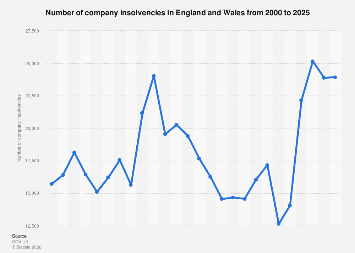
The landscape of business closures in England and Wales saw a marginal uptick in 2025, with the total number of company insolvencies reaching 23,938. This figure represents a slight increase from the 23,881 insolvencies recorded in 2024, indicating a period of relative stability rather than a dramatic surge. While the overall numbers remain a key indicator of economic health, a deeper analysis of trends over the past two decades reveals a complex narrative of recovery, disruption, and evolving business environments.
Examining the data from 2000 to 2025, the period showcases significant fluctuations. The early 2000s saw insolvency numbers generally hovering in the mid-to-high 15,000s and 16,000s. A notable spike occurred in 2009, with 24,040 insolvencies, directly correlating with the global financial crisis that sent shockwaves through economies worldwide. This was followed by a gradual decline in the early 2010s, with numbers dipping below 15,000 by 2016 and 2017.
The pre-pandemic year of 2019 saw a slight increase to 17,170 insolvencies, a trend that was dramatically disrupted by the onset of the COVID-19 pandemic in 2020. During 2020 and 2021, company insolvencies plummeted to historic lows of 12,630 and 14,057 respectively. This artificial suppression was largely attributed to unprecedented government support measures, including furlough schemes, loan guarantees, and temporary moratoriums on creditor action, designed to keep businesses afloat during lockdowns and severe economic uncertainty.
As these support mechanisms began to wind down and the global economy grappled with supply chain disruptions, rising inflation, and increased interest rates, insolvency figures began to rebound. 2022 saw a significant jump to 22,133 insolvencies, followed by a further increase to 25,164 in 2023, surpassing pre-pandemic levels. The slight moderation in 2024 and 2025, therefore, suggests that while economic headwinds persist, the business environment in England and Wales may be entering a more predictable, albeit still challenging, phase.
The figures for 2025, while showing a modest increase, can be interpreted in several ways by economic analysts and business leaders. On one hand, the continued elevated level compared to the pandemic lows indicates that the lingering effects of inflation, increased operational costs, and higher borrowing expenses are still pressuring businesses, particularly smaller enterprises with less financial resilience. Sectors heavily reliant on discretionary consumer spending, or those with thin profit margins, are likely to be disproportionately affected.
Conversely, the stabilization or slight increase, rather than a sharp escalation, could be seen as a sign of underlying business adaptability. Companies that survived the pandemic and the subsequent economic shocks have likely undertaken significant restructuring, innovation, or cost-cutting measures to remain viable. The continued operation of nearly 24,000 businesses in England and Wales, despite the challenging macroeconomic climate, speaks to the inherent dynamism of the UK’s economy.
Global comparisons offer further context. Many developed economies have experienced similar patterns of insolvency post-pandemic, with initial lows followed by a rebound as support measures were withdrawn and inflation took hold. For instance, data from the United States and Germany have also shown a trend of increasing business failures in the period following 2021, albeit with different magnitudes and timelines influenced by their respective economic policies and industry structures. The UK’s insolvency rate in 2025, while higher than its pandemic nadir, remains within a range that many economists would consider manageable for a developed economy, particularly when viewed against the backdrop of the extraordinary global economic disruptions of the preceding years.
The economic impact of these insolvencies extends beyond the direct loss of businesses and jobs. Each company failure can have ripple effects across supply chains, impacting suppliers, customers, and regional economies. The cost of administering insolvencies, including legal fees and the redeployment of resources, also represents a drain on economic efficiency. Furthermore, a consistently high rate of business failures can deter investment and innovation, as potential entrepreneurs and investors become more risk-averse.
Looking ahead, several factors will continue to shape the insolvency landscape. The trajectory of interest rates, the government’s approach to fiscal policy, and the global economic outlook will be critical. Geopolitical stability and the resolution of ongoing supply chain issues will also play a significant role. For businesses, a focus on financial prudence, operational efficiency, and strategic agility will be paramount in navigating the ongoing economic uncertainties. The ability of policymakers to strike a balance between supporting struggling businesses and maintaining fiscal discipline will also be a key determinant in whether insolvency numbers stabilize or trend upwards in the coming years. The data from 2025 serves as a snapshot, highlighting a period where the resilience of the business community is being tested, and the long-term economic recovery continues to be shaped by a complex interplay of global and domestic forces.