


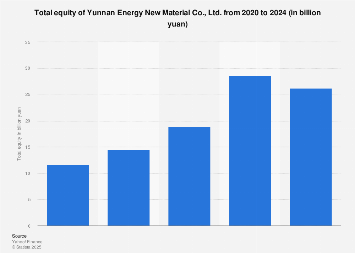
The total equity of Yunnan Energy New Material Co., Ltd. in 2024 presents a crucial indicator for investors, analysts, and industry observers seeking to understand the financial health and growth trajectory of this significant player in the advanced materials sector. While precise, up-to-the-minute figures for total equity are typically reserved for premium subscribers of financial data platforms, the underlying trends and the company’s positioning within its industry provide a rich narrative of its economic standing and future potential. Understanding a company’s equity is fundamental; it represents the net worth of the company, calculated as total assets minus total liabilities. For Yunnan Energy New Material, this figure is not merely a static number but a reflection of its operational performance, strategic investments, and the broader economic environment in which it operates.
Yunnan Energy New Material operates within a global landscape increasingly focused on sustainable energy solutions and advanced materials critical for these transitions. The company’s focus, likely encompassing areas such as battery materials, specialty chemicals, or other components vital for renewable energy technologies, places it at the nexus of significant global economic shifts. The demand for these materials is driven by macro trends including the accelerating adoption of electric vehicles (EVs), the expansion of solar and wind power generation, and the ongoing miniaturization and enhancement of electronic devices. Consequently, the company’s equity is influenced not only by its internal management and operational efficiency but also by external factors such as commodity prices, technological advancements by competitors, and governmental policies promoting green initiatives.
The equity structure of a publicly traded company like Yunnan Energy New Material is a composite of various components, including common stock, preferred stock (if any), additional paid-in capital, and retained earnings. Retained earnings, in particular, are a key driver of equity growth, representing the accumulated profits that the company has chosen to reinvest back into the business rather than distributing as dividends. A rising level of retained earnings suggests a history of profitability and successful reinvestment, contributing to a stronger equity base. Conversely, consistent losses or significant dividend payouts could lead to a decline in retained earnings and, consequently, total equity.
Examining the company’s profitability, balance sheet, and cash flow key performance indicators (KPIs) would offer a more granular understanding of the factors shaping its total equity. Profitability KPIs, such as net profit margin and return on equity (ROE), reveal how effectively the company is generating profits from its operations and shareholder investments. A healthy ROE, for instance, indicates that the company is adept at using its equity to generate earnings, which in turn bolsters retained earnings and total equity. The balance sheet, beyond equity, provides insights into the company’s assets (what it owns) and liabilities (what it owes). The composition of assets – whether they are primarily tangible assets like property, plant, and equipment, or intangible assets like intellectual property – and the nature of its liabilities – short-term versus long-term debt – all contribute to the overall financial risk and stability that underpins its equity value.
Cash flow statements are equally vital. Positive operating cash flow is essential for a company to meet its day-to-day obligations, fund investments, and service debt. Strong and consistent cash flow generation provides the financial flexibility necessary for strategic growth, which can then translate into enhanced equity value through reinvestment and increased profitability. The interplay between these financial statements paints a comprehensive picture. For example, a company might report positive net income (which increases retained earnings), but if its cash flow from operations is weak, it might struggle to fund necessary capital expenditures, potentially limiting future growth and impacting the long-term health of its equity.
Global comparisons can further contextualize Yunnan Energy New Material’s financial standing. Companies in the advanced materials sector, particularly those serving the burgeoning EV battery market, have experienced significant valuation swings and capital injections in recent years. For instance, major lithium producers and cathode material manufacturers in countries like China, Australia, and Chile have seen their market capitalizations and equity values fluctuate with commodity prices (like lithium and cobalt) and the pace of EV adoption. Analyzing Yunnan Energy New Material’s equity relative to its peers in these key global markets, considering their asset bases, revenue growth, and profitability, would provide valuable benchmarks.
The economic impact of a company like Yunnan Energy New Material extends beyond its shareholders. Its total equity is intrinsically linked to its capacity for investment, which in turn fuels job creation, supply chain development, and technological innovation. A robust equity position allows the company to undertake ambitious expansion projects, invest in research and development to stay ahead of technological curves, and potentially engage in mergers and acquisitions to consolidate its market position or acquire new capabilities. This investment activity stimulates economic growth at local, regional, and even national levels. Furthermore, as a supplier of materials for critical green technologies, the company plays a role in the global transition towards a lower-carbon economy, with broader societal and economic implications.
The specific equity figures for Yunnan Energy New Material in 2024 would be influenced by recent financial performance, any capital raises undertaken, and the company’s strategic decisions regarding dividend policy and profit reinvestment. For example, if the company recently completed a successful share offering to fund a new manufacturing facility or R&D initiative, its total equity would likely show an increase, reflecting the inflow of capital. Conversely, a period of intense capital expenditure funded by debt could see liabilities rise, potentially impacting the overall equity ratio if not matched by a corresponding increase in assets or profitability.
In conclusion, while the precise total equity figure for Yunnan Energy New Material Co., Ltd. in 2024 remains a proprietary data point, its significance lies in what it represents: the financial foundation upon which the company builds its future. This foundation is shaped by a complex interplay of operational efficiency, strategic investments, market dynamics, and the broader macroeconomic forces driving the global demand for advanced materials. A thorough analysis of its profitability, balance sheet health, and cash flow generation, benchmarked against international peers, is essential for a comprehensive understanding of its current economic standing and its prospects for sustained growth in a rapidly evolving industrial landscape. The company’s ability to manage its equity effectively will be a key determinant of its long-term success and its contribution to the critical sectors it serves.