


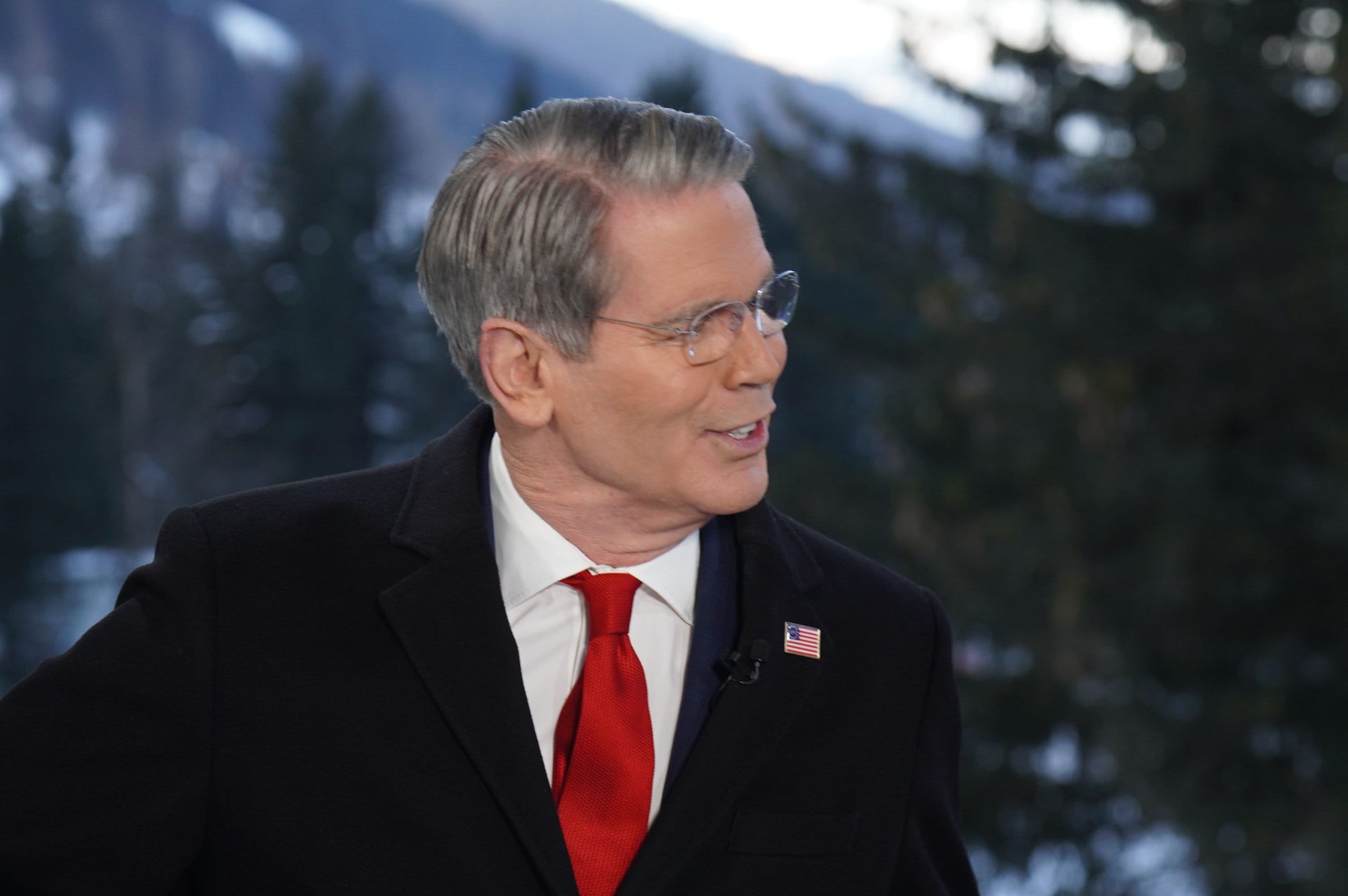
The delicate balance of power between the United States Treasury and the Federal Reserve faced a new trial this week as Treasury Secretary Scott Bessent issued a sharp public rebuke of Fed Chair Jerome Powell. Speaking from the World Economic Forum in Davos, Switzerland, Bessent characterized Powell’s intended presence at an upcoming Supreme Court hearing as a strategic error that threatens to further politicize the nation’s central bank. The dispute centers on a high-stakes legal battle regarding President Donald Trump’s attempt to remove Federal Reserve Governor Lisa Cook, a move that has sparked a constitutional showdown over the limits of executive authority and the traditional autonomy of the world’s most influential financial institution.
The friction between the executive branch and the Federal Reserve has reached a fever pitch, moving beyond policy disagreements over interest rates into the realm of judicial confrontation and criminal allegations. At the heart of the current controversy is the President’s assertion that he possesses the unilateral authority to terminate members of the Federal Reserve Board of Governors. This claim directly challenges decades of legal precedent and statutory protections designed to insulate monetary policy from the shifting winds of electoral politics. When news surfaced that Jerome Powell planned to attend the oral arguments in the Lisa Cook case to show solidarity or represent the interests of the Board, Bessent signaled that such a move would be viewed by the administration as an overt attempt to influence the judiciary.
Bessent’s critique, delivered on the sidelines of the global summit in Davos, emphasized the optics of the situation. He argued that if the Federal Reserve’s primary goal is to maintain an image of impartial, data-driven governance, the Chair should not be perceived as "putting his thumb on the scale" in a courtroom setting. The Treasury Secretary’s comments reflect a broader administration strategy to reassert executive control over independent agencies, a philosophy often rooted in the "unitary executive theory," which posits that the President holds absolute authority over the executive branch, including the personnel of independent commissions.
The legal battle over Lisa Cook’s tenure began in August when President Trump announced his intention to fire her, citing allegations of mortgage fraud. Cook, an economist who made history as the first Black woman to serve on the Fed’s Board of Governors, has remained in her position, supported by the legal framework that typically requires "for cause" justification—such as inefficiency, neglect of duty, or malfeasance in office—to remove a governor before their term expires. The administration’s pursuit of her removal is seen by many economists as a test case for whether the Supreme Court will extend its recent trend of limiting the power of "alphabet soup" agencies to the Federal Reserve itself.
The implications of this case extend far beyond the career of a single governor. For global markets, the independence of the Federal Reserve is a cornerstone of the U.S. dollar’s status as the world’s primary reserve currency. If the President is granted the power to fire Fed officials at will, investors fear that monetary policy could be manipulated to favor short-term political gains—such as lowering interest rates to stimulate the economy before an election—at the expense of long-term price stability. Historical data from emerging markets suggests that when central banks lose their independence, inflation expectations often become unanchored, leading to higher risk premiums on sovereign debt and increased currency volatility.
The tension has been further exacerbated by Jerome Powell’s recent public disclosures. In an unprecedented move for a sitting Fed Chair, Powell released a video statement earlier this month revealing that he is the subject of a criminal investigation. Powell forcefully defended the institution, labeling the investigation a "pretext" and asserting that the inquiry was not actually about congressional oversight or specific administrative projects, but rather an attempt to undermine the Fed’s autonomy. This defensive posture by the central bank suggests a leadership that feels increasingly besieged by political pressure, leading to a breakdown in the traditional "quiet period" regarding inter-branch disputes.

Market analysts are closely monitoring the rhetoric for signs of how it might influence upcoming Federal Open Market Committee (FOMC) decisions. While the Fed maintains that its decisions are based solely on economic data, the constant public sparring with the Treasury and the White House creates a "noise" that can complicate the transmission of monetary policy. If the market perceives that the Fed is making decisions to prove its independence, or conversely, that it is caving to political pressure, the resulting uncertainty could lead to increased yields on 10-year Treasury notes as investors demand a higher "uncertainty premium."
The situation in the United States stands in stark contrast to other major economies. In the Eurozone, the European Central Bank (ECB) enjoys a high degree of treaty-protected independence, though it too faces occasional friction with national governments. In the United Kingdom, the Bank of England’s independence is governed by a clear mandate from Parliament, which generally avoids the level of personal vitriol seen in the current U.S. landscape. The escalating conflict in Washington raises questions among international finance ministers and central bankers at Davos about the stability of the U.S. institutional framework, which has historically been the gold standard for global finance.
The Supreme Court’s eventual ruling on the removal of Lisa Cook will likely be a watershed moment for American administrative law. Legal scholars point to recent cases, such as Seila Law LLC v. Consumer Financial Protection Bureau and Collins v. Yellen, where the Court ruled that the heads of certain agencies could be removed at will by the President. However, those cases involved agencies led by a single director. The Federal Reserve is a multi-member board, a distinction that has historically provided a stronger legal shield against executive interference. If the Court sides with the administration, it could fundamentally rewrite the relationship between the White House and the Fed, potentially allowing for a wholesale clearing of the Board by any sitting president.
Secretary Bessent’s remarks also highlight the personal nature of the current friction. Having been a prominent figure in global macro investing before his appointment to the Treasury, Bessent is well-aware of how his words resonate in the halls of investment banks and trading floors. By publicly labeling Powell’s courtroom attendance a "mistake," he is signaling that the administration views the Fed’s current leadership not just as policy rivals, but as political actors. This characterization is a significant departure from the historical norm, where Treasury Secretaries acted as a bridge between the White House and the Fed, often shielding the central bank from the most aggressive political impulses of the West Wing.
As the oral arguments approach, the eyes of the financial world will be on the Supreme Court gallery. Whether Powell appears in person or not, the shadow of the Federal Reserve’s independence will loom large over the proceedings. The outcome will dictate not only the future of Lisa Cook’s role but also the degree of freedom the central bank will have to combat inflation and manage unemployment in an increasingly volatile global economy. For now, the public exchange between the Treasury and the Fed serves as a stark reminder that the "neutral" ground of economic policy is becoming one of the most contested battlefields in modern American governance.
In the long term, the erosion of the boundary between the executive branch and the central bank could lead to a fundamental repricing of American assets. If the "Fed put"—the market’s belief that the central bank will act independently to stabilize the economy—is replaced by a "Political put," the resulting shift in institutional trust could have ramifications for decades. As the debate continues to unfold from the snowy peaks of Davos to the marble halls of the Supreme Court, the core question remains: Can a modern economy function effectively if its central bank is viewed merely as another wing of the political apparatus? The answer to that question will likely define the economic legacy of the current era.