

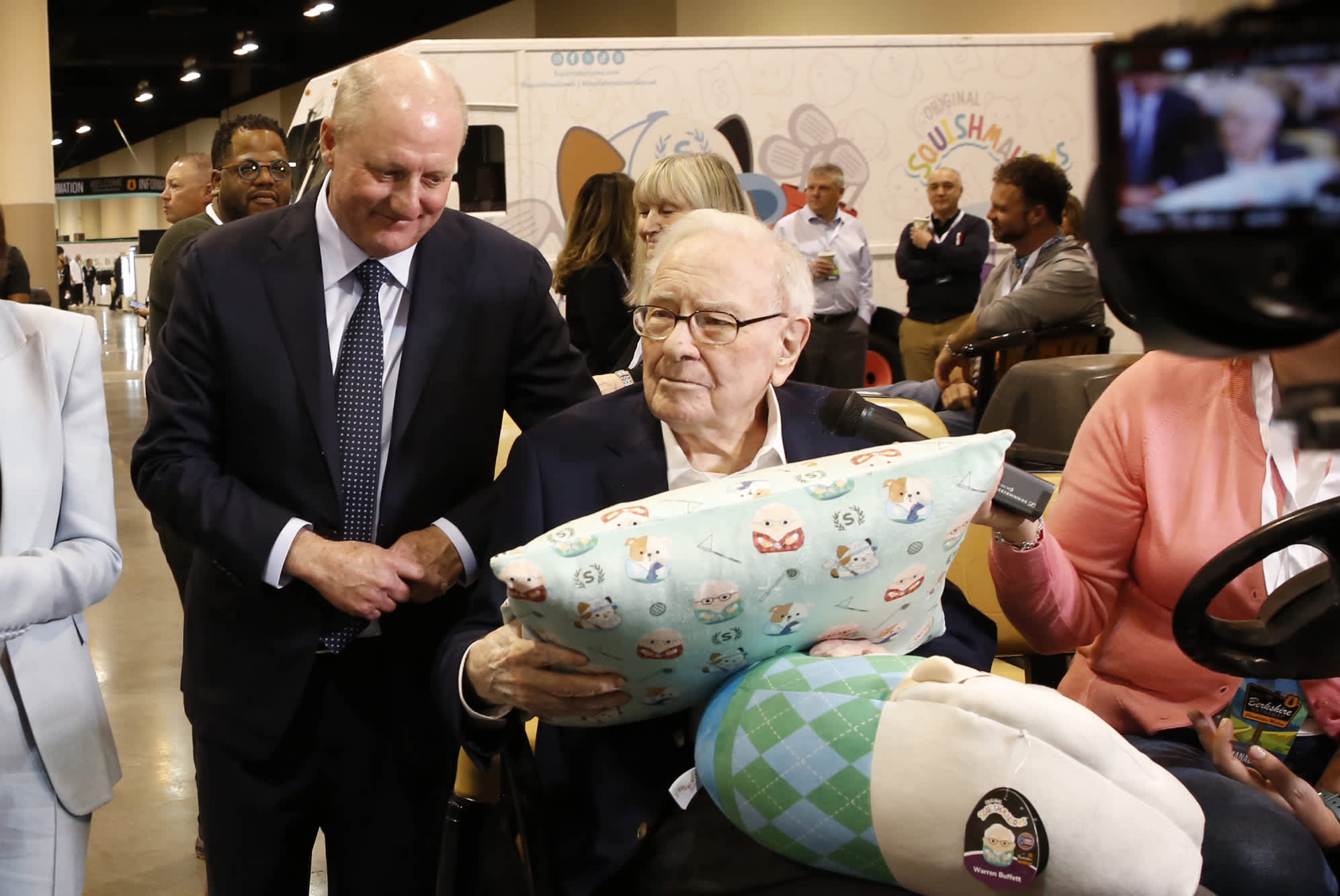
The dawn of a new era at Berkshire Hathaway began with a subtle recalibration in the equity markets, as investors worldwide processed the formal conclusion of Warren Buffett’s nearly 60-year tenure as Chief Executive Officer. On the first day of Greg Abel’s leadership, Class A shares of the Omaha-based conglomerate saw a modest decline of 1.4%, a figure that market analysts suggest reflects the inevitable "key man risk" associated with the departure of arguably the greatest capital allocator in financial history. While the dip was marginal in the context of the company’s massive market capitalization, it signaled a moment of profound psychological transition for a firm that has become synonymous with the persona and philosophy of its founder.
Warren Buffett, who celebrated his 95th birthday shortly before the official handoff, will remain as Chairman of the Board, but the operational and strategic reins have now passed firmly to Abel. This transition marks the end of a corporate odyssey that began in the mid-1960s when Buffett, then a young value investor, took control of a struggling New England textile manufacturer. Over the subsequent six decades, he transformed that dying industrial relic into a global powerhouse, delivering a compounded annual return of 19.9% through 2024. To put that figure into perspective, the S&P 500 returned approximately 10.4% annually over the same period. The cumulative result was a staggering 5.5 million percent return, a feat of compounding that has no modern parallel in the annals of Western capitalism.
As Abel takes the helm, he inherits a corporate structure that is as much a cultural institution as it is a financial one. Berkshire Hathaway is often described as a microcosm of the United States economy, with its vast portfolio of wholly-owned subsidiaries ranging from the Burlington Northern Santa Fe (BNSF) railway and Geico insurance to Precision Castparts and Fruit of the Loom. This diversification has allowed Berkshire to act as a stabilizer for the broader market, though the company’s performance in 2025—a 10.9% gain—trailed the S&P 500’s 16.4% advance. Despite trailing the index in a year dominated by technology and artificial intelligence surges, Berkshire achieved its tenth consecutive year of positive returns, reinforcing its reputation for resilience in volatile environments.
The most significant tool at Abel’s disposal is an unprecedented war chest of $381.6 billion in cash and short-term equivalents. This record liquidity follows a period of disciplined net equity selling, including a notable reduction in Berkshire’s massive stake in Apple and other core holdings. Buffett has been vocal in his endorsement of Abel’s ability to manage this liquidity, stating that the new CEO will have final authority over all capital allocation decisions. This is a critical distinction; while many expected the investment duties to be split between Abel and investment managers Todd Combs and Ted Weschler, Buffett has clarified that "Greg will be the decider." The transition of this specific power—the ability to deploy hundreds of billions of dollars at a moment’s notice—is perhaps the most scrutinized aspect of the succession plan.
Greg Abel is no stranger to the complexities of the Berkshire ecosystem. Having previously overseen the company’s sprawling non-insurance operations, particularly the energy division, Abel has earned a reputation for operational rigor and a deep understanding of industrial logistics. Buffett’s public praise for Abel has been effusive, suggesting that Abel can accomplish more in a week than Buffett could in a month at this stage of his life. However, the challenge facing Abel is not merely one of maintenance, but of scale. With a market capitalization nearing the trillion-dollar mark, the "anchor of size" makes it increasingly difficult for Berkshire to find "elephant-sized" acquisitions that can significantly move the needle on its earnings per share.
Economists and market strategists are closely watching how Abel’s approach to capital allocation might differ from the "Oracle of Omaha." Under Buffett, Berkshire was famously patient, often waiting years for a market dislocation to provide the right price for a high-quality asset. In a contemporary landscape defined by rapid technological disruption and high-frequency trading, the question remains whether Abel will maintain this stoic patience or pivot toward a more aggressive acquisition strategy. Furthermore, the 1.4% dip in share price highlights the "Buffett Premium"—the additional valuation investors have historically placed on the stock due to Buffett’s personal touch. As that premium begins to erode, Abel will need to prove that the "Berkshire System"—a decentralized management style that empowers subsidiary CEOs—can thrive without its primary architect.
The decentralized model is indeed the bedrock of Berkshire’s success. Unlike traditional conglomerates that utilize a heavy-handed corporate headquarters to manage subsidiaries, Berkshire’s home office in Omaha remains famously lean, employing only a few dozen people. This structure allows the leaders of companies like Dairy Queen or See’s Candies to run their businesses with total autonomy, provided they send their excess cash flow to Omaha for reallocation. Buffett has argued that this culture is the company’s greatest moat, claiming it has a better chance of surviving a century than any other firm in the United States. For Abel, preserving this culture while modernizing the portfolio will be a delicate balancing act.
Global comparisons further illustrate the unique position Abel now occupies. In the world of private equity and sovereign wealth funds, few entities command the same level of uncommitted capital as Berkshire. However, unlike a private equity firm that operates on a five-to-seven-year exit horizon, Berkshire’s holding period is "forever." This long-termism has made Berkshire the preferred buyer of choice for family-owned businesses looking for a permanent home. Abel must ensure that this reputation remains intact, even as the face of the company changes. The transition comes at a time of shifting global economic dynamics, where trade tensions and domestic industrial policy are reshaping the landscape for many of Berkshire’s capital-intensive businesses, such as rail and energy.
Institutional investors have expressed a mix of caution and optimism regarding the transition. Many large-scale shareholders have spent the last decade preparing for this moment, noting that the "Abel Era" has effectively been in a soft-launch phase for years. Abel’s deep involvement in the acquisition of Alleghany Corp and his leadership during the integration of various energy assets provided a preview of his management style. Nevertheless, the psychological weight of Buffett’s departure cannot be understated. For millions of retail investors who travel to Omaha every May for the "Woodstock for Capitalists," Buffett was more than a CEO; he was a teacher of fiscal prudence and ethical business conduct.
As the market looks ahead, the focus will inevitably shift to Berkshire’s next quarterly earnings report—the first under Abel’s full executive control. Investors will be looking for clues in the buyback activity and any shifts in the equity portfolio. With $381.6 billion at his fingertips, Abel has the power to reshape the American corporate landscape. Whether he chooses to wait for a market crash to deploy those funds or begins a series of strategic mid-sized acquisitions will define the early years of his tenure.
The modest decline in shares on his first day may simply be the market’s way of exhaling after decades of anticipation. While the Warren Buffett era has reached its formal conclusion, the structural integrity of the empire he built remains the ultimate test for Greg Abel. If Berkshire can continue to compound wealth at a rate that exceeds the broader market without the presence of its founder, it will serve as the final validation of Buffett’s life work: creating a machine that is greater than the man who built it. For now, the world watches Omaha, waiting to see how the "decider" will navigate the complexities of a post-Buffett world.