


As the global semiconductor industry grapples with an increasingly fractured geopolitical landscape, Nvidia co-founder and CEO Jensen Huang is reportedly preparing for a strategic visit to mainland China. This high-profile trip, scheduled just ahead of the Lunar New Year festivities in mid-February, signals a critical inflection point for the world’s most valuable chipmaker. Huang’s arrival in Beijing is not merely a routine executive tour; it represents a sophisticated "charm offensive" aimed at stabilizing a vital revenue stream that has been significantly disrupted by escalating U.S. export controls and the rapid rise of domestic Chinese competitors.
The stakes for Nvidia could not be higher. For years, the Chinese market served as a cornerstone of the company’s explosive growth, at one point accounting for more than 20% of its massive data center revenue. However, the architectural foundation of this partnership has been shaken by the U.S. Department of Commerce’s Bureau of Industry and Security (BIS). Through a series of increasingly stringent regulations, Washington has effectively cordoned off China from the world’s most advanced artificial intelligence hardware, including Nvidia’s flagship H100 and A100 GPUs. These chips are the lifeblood of the generative AI revolution, and by denying Beijing access to them, the U.S. seeks to maintain a strategic lead in dual-use technologies that have profound implications for both economic productivity and national security.
During his visit, Huang is expected to attend a company-wide celebration in Beijing, an event that serves as a morale booster for Nvidia’s substantial local workforce. Beyond internal festivities, however, the CEO’s itinerary is focused on damage control and relationship management. According to industry insiders, Huang is slated to meet with key customers and logistics partners to address the mounting friction in the supply chain. The central challenge lies in the deployment of "compliant" chips—specifically designed, lower-performance versions of Nvidia’s hardware that fall just below the threshold of U.S. export bans.
The market’s reception to these "sanction-busting" variants, such as the H20, L20, and L2, has been lukewarm at best. While these products allow Nvidia to continue operating within the letter of U.S. law, they present a significant performance trade-off for Chinese tech giants like Alibaba, Baidu, and Tencent. Recent reports suggest that Chinese authorities have begun encouraging local firms to prioritize domestic hardware over these downgraded American imports, limiting the use of Nvidia’s H20 chips to specific research applications rather than broad commercial deployment. When questioned about these restrictive measures, China’s Ministry of Commerce maintained a stance of strategic ambiguity, claiming no knowledge of official bans while the industry continues to feel the chill of protectionist policies.
This regulatory squeeze has inadvertently accelerated China’s drive for technological self-reliance. In the absence of top-tier Nvidia silicon, Chinese enterprises are pivoting toward homegrown alternatives. Huawei Technologies, once crippled by U.S. sanctions on its smartphone business, has emerged as a formidable rival in the AI space. Its Ascend 910B processor is widely viewed as the most viable domestic alternative to Nvidia’s restricted hardware, reportedly offering performance levels that rival the older A100. As Chinese cloud service providers begin migrating their workloads to Huawei’s ecosystem, the long-term risk for Nvidia is not just a temporary dip in sales, but a permanent loss of ecosystem dominance.
The economic impact of this shift is reflected in the broader semiconductor market data. While Nvidia’s overall valuation has soared to historic heights—driven by insatiable demand from U.S. hyperscalers like Microsoft and Meta—the "China-sized hole" in its balance sheet remains a concern for analysts. In previous fiscal years, China contributed billions to Nvidia’s bottom line. If the company cannot convince Chinese buyers that its compliant chips are worth the investment, or if the U.S. government further lowers the performance ceiling, Nvidia faces the prospect of being phased out of the world’s second-largest economy.

Global comparisons highlight the uniqueness of Nvidia’s predicament. Unlike other tech sectors that can easily diversify their supply chains, the high-end GPU market is characterized by extreme specialization. There is no "Plan B" for a data center designed around Nvidia’s proprietary CUDA software architecture. By visiting China personally, Huang is attempting to bridge this gap, reassuring clients that Nvidia remains a committed partner despite the "Silicon Curtain" being drawn by policymakers in Washington.
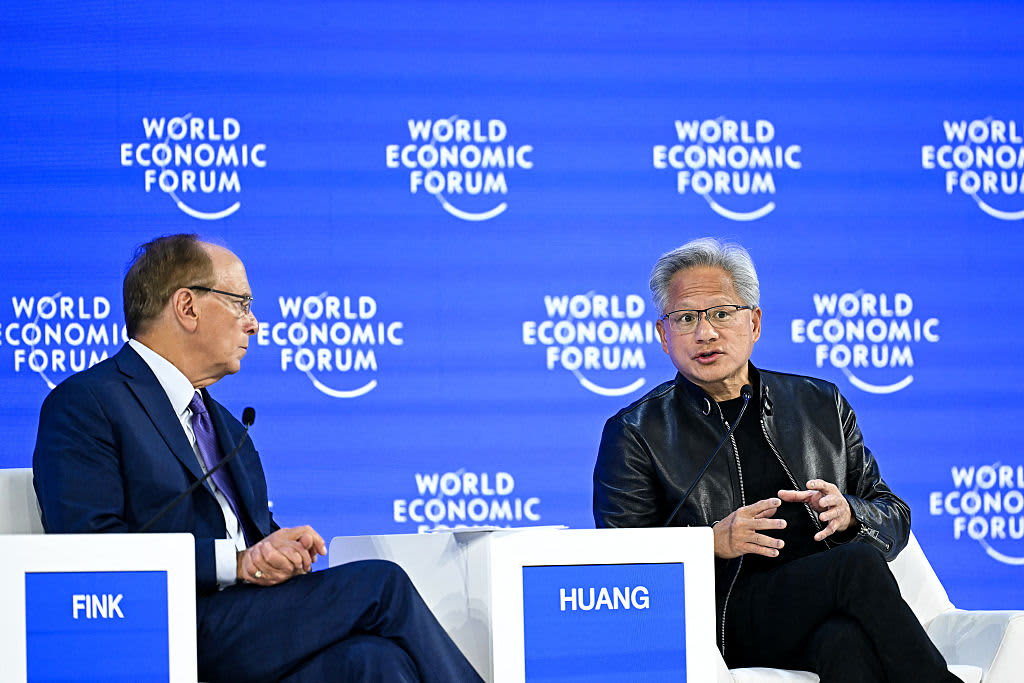
The geopolitical backdrop of this visit is equally complex. Huang’s recent appearance at the World Economic Forum in Davos, where he shared the stage with global financial leaders, underscored his role as a statesman of the digital age. In Davos, the discourse centered on the democratizing power of AI; however, the reality on the ground in Beijing is one of fragmentation. The "splinternet" is no longer just about firewalls and software; it has moved down the stack to the very atoms of the chips themselves.
Market analysts suggest that Huang’s trip is also a logistical fact-finding mission. The supply chain for AI chips is incredibly fragile, involving precision manufacturing from TSMC in Taiwan and advanced packaging techniques that are subject to their own set of geopolitical risks. By engaging directly with Chinese buyers, Huang can better gauge the inventory levels and the true appetite for Nvidia’s adjusted product lineup. There is a delicate balancing act to perform: Nvidia must show the U.S. government that it is a compliant corporate citizen, while simultaneously showing the Chinese government that it is not an instrument of American foreign policy.
Furthermore, the economic repercussions extend to the global AI arms race. If Chinese firms are forced to rely on less efficient hardware, the cost of training large language models (LLMs) in China will inevitably rise. This could lead to a two-tier AI world: one tier powered by unbridled Nvidia hardware in the West, and another tier in China characterized by ingenious software workarounds designed to compensate for hardware limitations. Some experts argue that this constraint might actually foster a new wave of innovation in China, as engineers are forced to develop more efficient algorithms that require less raw computing power—a development that could eventually challenge Western dominance in AI efficiency.
As the Lunar New Year approaches, a period traditionally defined by homecoming and renewal, Jensen Huang’s presence in China is a powerful symbol of the enduring links between the world’s two largest economies, even as they drift apart. The success of this mission will not be measured in immediate contracts, but in the preservation of trust. For Nvidia, the goal is to ensure that when the geopolitical dust eventually settles, it still has a seat at the table in the Chinese market.
The coming months will be telling. If Nvidia can successfully navigate the regulatory hurdles and maintain its foothold in Beijing, it will prove that technological interdependency is a force capable of transcending political friction. However, if the "stall" in sales turns into a permanent decline, it will mark the beginning of a new era in global commerce—one where the borders of technology are defined not by innovation, but by the reach of export licenses. For now, all eyes are on Huang as he steps off the plane, carrying the weight of a trillion-dollar company’s future in his hands, navigating a path through the most complex economic minefield of the twenty-first century.