


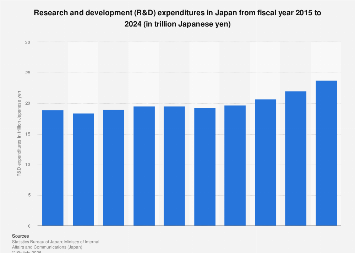
Japan’s commitment to research and development (R&D) saw a significant uptick in fiscal year 2023, with expenditures reaching approximately [redacted] trillion Japanese yen. This represents a notable increase of [redacted] percent compared to the preceding fiscal year, underscoring a strategic national focus on fostering innovation and maintaining a competitive edge in the global economic landscape. This sustained investment reflects a broader trend observed across leading industrialized nations, where R&D is increasingly recognized as the bedrock of long-term economic growth, technological advancement, and societal progress.
The allocation of these substantial R&D funds reveals a clear prioritization of scientific inquiry and its practical applications. In recent years, a significant portion of Japan’s R&D budget has been channeled into the natural sciences. This encompasses a wide array of disciplines including physical sciences, engineering sciences, agricultural sciences, and health sciences, all of which are critical for addressing contemporary global challenges and driving future economic sectors. The emphasis on these fields suggests a strategic foresight, aiming to build robust foundational knowledge that can underpin breakthroughs in areas such as advanced materials, renewable energy, artificial intelligence, and personalized medicine.
Examining the institutional breakdown of R&D expenditure provides further insight into Japan’s innovation ecosystem. Business enterprises consistently emerge as the dominant investors, accounting for over [redacted] percent of the nation’s total R&D outlay. This robust private sector involvement is crucial, as it signals a strong alignment between research endeavors and market needs, fostering the commercialization of new technologies and products. The significant investment by corporations demonstrates their commitment to future competitiveness, often driven by the pursuit of intellectual property, product differentiation, and the development of disruptive technologies. This corporate-driven innovation is a hallmark of Japan’s advanced economy, characterized by large, technologically sophisticated conglomerates and a dynamic ecosystem of smaller, specialized firms.
Complementing the private sector’s contribution, tertiary education institutions play a vital role, collectively spending nearly [redacted] percent of Japan’s overall R&D expenditure. Universities and research institutes serve as crucial incubators of fundamental research, training the next generation of scientists and engineers, and often collaborating with industry on cutting-edge projects. Their investment signifies a dedication to pushing the boundaries of knowledge and exploring novel scientific frontiers that may not have immediate commercial applications but are essential for long-term technological advancement. The synergy between academic research and industrial application is a key determinant of a nation’s innovative capacity, and Japan appears to be actively cultivating this crucial link.
Within the broad spectrum of scientific research, Japan has demonstrated a particularly strong inclination to invest its financial resources in [redacted] (life sciences). This focus on life sciences, which includes areas like biotechnology, pharmaceuticals, and medical research, reflects both demographic realities and emerging global opportunities. Japan, like many developed nations, faces an aging population, increasing the demand for advanced healthcare solutions, novel therapeutics, and technologies that enhance quality of life for its citizens. Furthermore, the life sciences sector is a rapidly growing area of global innovation, with immense potential for economic growth and significant societal impact, from developing cures for diseases to advancing sustainable agriculture and bio-based industries. The substantial investment in this domain signals Japan’s intent to be a leader in addressing these critical needs and capitalizing on the economic potential of this dynamic field.
Beyond financial inputs, the human capital within the R&D sector is equally important. As of March 2023, Japan’s research workforce stood at over [redacted] individuals. This substantial pool of talent is fundamental to the nation’s innovative capacity. A key aspect of this workforce composition is the participation of women. Around [redacted] percent of these researchers were women, a figure that, while representing progress, indicates an area where further enhancement is both desirable and strategically beneficial. The proportion of female researchers in science and technology fields in Japan has historically been described as [redacted] compared to other member countries of the Organisation for Economic Co-operation and Development (OECD).
Recognizing the imperative to broaden the talent base and harness the full spectrum of intellectual potential, the Japanese government has implemented targeted initiatives to promote women’s participation in science and research. These efforts include providing subsidies to research institutions, such as universities, to offset the labor costs associated with employing female researchers. Such policies aim to dismantle existing barriers, encourage more women to pursue careers in STEM fields, and foster a more inclusive and diverse research environment. A diverse research team is often more innovative, bringing a wider range of perspectives and approaches to problem-solving, which can lead to more robust and creative outcomes. This strategic investment in human capital, particularly in underrepresented groups, is not just a matter of equity but a critical component of maximizing a nation’s R&D potential.
The global context of R&D spending highlights Japan’s position among leading innovation economies. While the United States and China consistently lead in absolute R&D expenditure, Japan has historically maintained a strong position, often ranking among the top three or four nations in terms of R&D intensity (R&D spending as a percentage of GDP). This intensity is a crucial metric, as it indicates how much of a nation’s economic output is dedicated to innovation. Countries with high R&D intensity are generally characterized by strong knowledge-based economies, a significant presence of technology-intensive industries, and a proactive approach to scientific discovery and technological development. Japan’s continued investment demonstrates its commitment to remaining at the forefront of global technological competition.
The economic implications of Japan’s sustained R&D investment are far-reaching. Increased R&D spending typically correlates with higher productivity growth, the creation of high-value jobs, and enhanced export competitiveness. Innovations stemming from R&D can lead to the development of entirely new industries, such as the burgeoning fields of green technology and advanced digital services. Moreover, a strong R&D ecosystem can attract foreign investment, as multinational corporations seek to tap into Japan’s pool of scientific talent and cutting-edge research capabilities. In an era of rapid technological change and intensifying global competition, a robust and strategically directed R&D effort is not merely an option but a fundamental necessity for ensuring sustained economic prosperity and national resilience. Japan’s current trajectory suggests a clear understanding of this imperative, with investments aimed at securing its position as a global leader in innovation for years to come.