
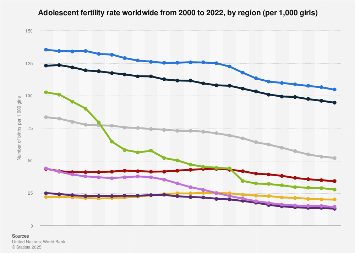
The global landscape of adolescent fertility has undergone a significant transformation since the dawn of the 21st century, marked by a discernible downward trend in birth rates among individuals aged 15 to 19. This widespread decline, observed across various regions, signifies a complex interplay of socio-economic development, educational advancements, and evolving reproductive health policies. However, a closer examination of the data for 2022 reveals persistent and profound regional disparities, underscoring the uneven progress in addressing adolescent pregnancy globally.
Data compiled for 2022 indicates that while many regions have experienced substantial reductions in adolescent births, West and Central Africa stands out with the highest rate worldwide, registering approximately 104.7 births per 1,000 girls. This figure represents a critical challenge, highlighting the urgent need for targeted interventions and sustained investment in these areas. In contrast, regions like East Asia and the Pacific, and Europe and Central Asia, demonstrate considerably lower rates, with figures around 20.1 and 13.1 births per 1,000 girls, respectively. These contrasting statistics paint a picture of a global issue with deeply entrenched regional variations.
The historical trajectory of adolescent fertility rates reveals a compelling narrative of progress, particularly in South Asia. Between 2000 and 2006, this region witnessed a dramatic reduction in fertility rates among adolescent girls. This sharp decline is widely attributed to increased access to education for girls and young women, a factor that consistently emerges as a cornerstone in mitigating adolescent pregnancy. Indeed, the global literacy rate among youth has seen a steady increase for both boys and girls since 2000, correlating with the positive trends in adolescent fertility. Educational empowerment not only delays the onset of sexual activity but also equips young individuals with the knowledge and resources to make informed decisions about their sexual and reproductive health.
Analyzing the specific regional data from 2000 to 2022 provides a granular view of these trends. In West and Central Africa, the adolescent birth rate, while showing a decline from 135.38 per 1,000 girls in 2000 to 104.67 in 2022, has remained stubbornly high. This sustained elevated rate suggests that the socio-economic and structural factors contributing to adolescent pregnancy in this region require more intensive and comprehensive strategies than those implemented thus far. Factors such as poverty, limited access to contraception and sexual education, cultural norms, and child marriage likely play a significant role in perpetuating this trend.
East and Southern Africa, while also experiencing a reduction from 123.13 per 1,000 in 2000 to 94.69 in 2022, continues to face considerable challenges. The rate, though lower than West and Central Africa, still represents a significant public health and development concern. Latin America and the Caribbean have shown more consistent progress, with rates dropping from 83.53 in 2000 to 52.17 in 2022. This region’s progress can be linked to greater availability of family planning services and increased awareness campaigns, though regional variations within this broad category likely exist.
The Middle East and North Africa region has also seen a notable decline, moving from 43.71 per 1,000 in 2000 to 34.22 in 2022. This suggests that efforts to improve reproductive health services and education are yielding positive results. South Asia, as previously mentioned, has made remarkable strides, with its rate falling from 102.67 in 2000 to 27.85 in 2022. This dramatic improvement underscores the transformative power of focused educational initiatives and improved access to reproductive health services in densely populated regions.
East Asia and the Pacific region has consistently maintained some of the lowest adolescent birth rates, with figures ranging from 22.11 in 2000 to 20.10 in 2022. This consistent low rate can be attributed to a combination of factors, including high levels of education, robust healthcare systems, and strong social norms that generally discourage early childbearing. Similarly, Europe and Central Asia have demonstrated a consistent downward trend, from 25.08 in 2000 to 13.13 in 2022, reflecting well-established reproductive health infrastructure and widespread access to family planning. North America, while also exhibiting a decline from 43.97 in 2000 to 14.38 in 2022, presents a slightly different pattern, with rates in the earlier part of the period being higher than many other developed regions, likely influenced by varying access to services and socio-economic factors within the continent.
The economic implications of adolescent birth rates are substantial and multifaceted. High rates of adolescent pregnancy are often associated with cycles of poverty, as young mothers may face limited educational and employment opportunities, thus perpetuating intergenerational disadvantage. The strain on public health systems, increased demand for social services, and potential long-term health consequences for both mother and child represent significant economic burdens. Conversely, reductions in adolescent birth rates can lead to a more educated and economically empowered female population, contributing to overall economic growth and development. Increased investment in girls’ education and comprehensive sexual and reproductive health services can be viewed not merely as social spending but as strategic investments with significant economic returns.
Expert analysis consistently points to the critical role of comprehensive sexuality education, accessible and affordable contraception, and supportive policies that empower young women. These interventions are not only crucial for reducing unintended pregnancies but also for promoting the overall well-being and life chances of adolescents. The UN’s Sustainable Development Goals, particularly Goal 3 (Good Health and Well-being) and Goal 5 (Gender Equality), directly address the issue of adolescent fertility and its associated challenges. Achieving these goals requires a concerted global effort, with a particular focus on the regions that continue to grapple with the highest rates of adolescent childbearing.
The persistent disparities observed in 2022 serve as a stark reminder that while global progress is evident, the path towards equitable outcomes remains long. Addressing the root causes of adolescent pregnancy – including poverty, lack of education, gender inequality, and limited access to reproductive healthcare – is paramount. International organizations, national governments, and local communities must collaborate to implement evidence-based strategies that empower young people to make healthy choices and realize their full potential. The economic and social dividends of successfully tackling adolescent fertility are immense, paving the way for a more equitable and prosperous future for all.