

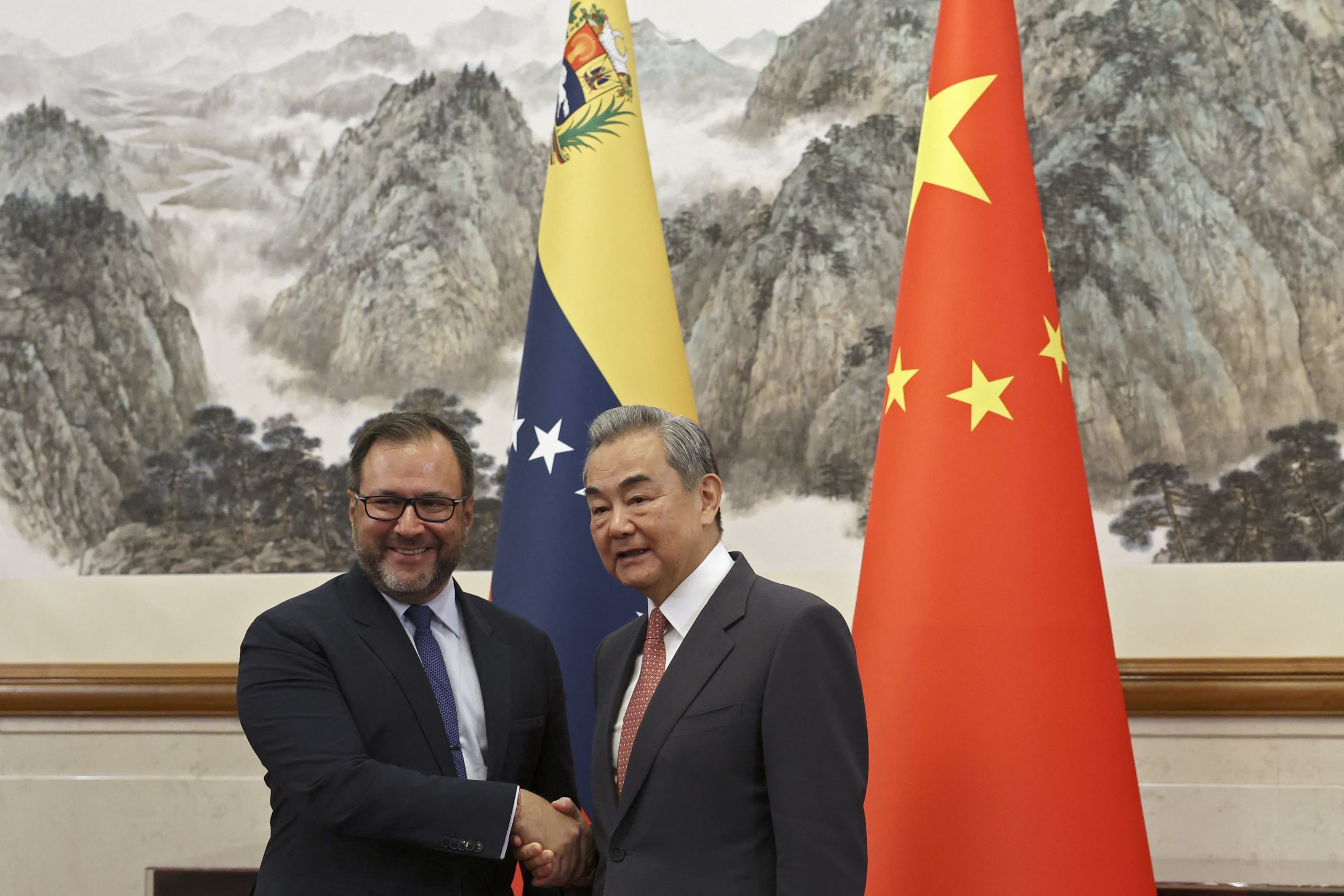
The sudden and dramatic escalation of U.S. military action in Venezuela has sent shockwaves through the international community, forcing Beijing into a delicate balancing act between its ideological commitment to "non-interference" and the urgent need to protect billions of dollars in sovereign investments. Following the weekend’s high-stakes operation that led to the ouster of President Nicolás Maduro, China has moved swiftly to condemn Washington’s maneuvers, even as its state-owned enterprises and diplomats scramble to ensure that decades of economic engagement in Caracas do not vanish in the vacuum of a regime change.
On Monday, the halls of the Diaoyutai State Guesthouse in Beijing served as the backdrop for a high-level display of solidarity, as Chinese Foreign Minister Wang Yi met with his Venezuelan counterpart, Yván Gil. The meeting, punctuated by firm handshakes and stern rhetoric, underscored China’s official stance: a "shocked" condemnation of the U.S. strike and an immediate demand for the release of Maduro and his wife. For Beijing, the crisis is not merely a regional conflict in the Western Hemisphere; it is a direct challenge to the "force for stability" narrative that President Xi Jinping has carefully cultivated as a counterweight to what China describes as American "hegemony and bullying."
However, beneath the veneer of diplomatic outrage lies a far more pragmatic reality. China is currently the largest creditor and a primary trade partner for Venezuela, with exposure that spans the energy, infrastructure, and technology sectors. According to data from the Rhodium Group, Chinese state-owned enterprises have funneled approximately $4.8 billion in foreign direct investment (FDI) into Venezuela over the last two decades. Much of this capital was deployed during the height of the global financial crisis and the final years of Hugo Chávez’s presidency, cementing a "loans-for-oil" model that has defined the bilateral relationship.

The protection of these assets is now the paramount concern for the Chinese Ministry of Foreign Affairs. Spokesperson Lin Jian emphasized on Monday that while the political landscape in Caracas may be shifting, Beijing’s "positive communication and cooperation" with the Venezuelan state remains a constant. He asserted that Chinese interests would be protected under the law, regardless of the evolving security situation. This stance reflects a broader Chinese strategy in Latin America: a refusal to "draw ideological lines" while maintaining a laser focus on resource security and market access.
The energy sector remains the linchpin of this relationship. For years, China has been the primary destination for Venezuelan crude, a relationship that persisted even under the weight of previous U.S. sanctions. While Venezuela accounted for roughly 2% of China’s total crude oil and condensate imports in 2024—a figure dwarfed by imports from the Middle East and Russia—the strategic value of Venezuelan reserves cannot be overstated. Venezuela sits atop the world’s largest proven oil reserves, and Chinese refineries, particularly those owned by the China National Petroleum Corporation (CNPC), have been specifically configured to process the heavy, sour crude characteristic of the Orinoco Belt.
Recent months had even seen a resurgence in private Chinese interest. In August, China Concord Resources Corp. announced a rare $1 billion investment plan aimed at boosting production by 60,000 barrels per day by 2026. Such projects are now shrouded in uncertainty. Analysts suggest that while the 2% import figure implies a limited immediate impact on China’s energy security, the long-term loss of access to Venezuelan reserves would be a significant blow to Beijing’s efforts to diversify its energy portfolio away from the volatile Strait of Hormuz.
The economic stakes are further complicated by the sheer volume of sovereign debt. Between 2007 and 2016, China lent Venezuela upwards of $60 billion, much of which was intended to be repaid in oil shipments. While a significant portion of this has been serviced, billions remain outstanding. A transition to a U.S.-backed administration in Caracas raises the specter of debt repudiation or a messy restructuring process that could see Chinese claims sidelined in favor of Western creditors.

Beyond the balance sheets, the Venezuela crisis serves as a critical test for China’s broader geopolitical ambitions in Latin America. Over the past twenty years, Beijing has successfully eroded traditional U.S. influence in the region, persuading nations such as Panama, Costa Rica, the Dominican Republic, and El Salvador to sever diplomatic ties with Taiwan in favor of the People’s Republic. By positioning itself as a "partner that does not interfere in internal affairs," China has gained a foothold in a region once governed by the Monroe Doctrine.
The U.S. military strike, therefore, provides Beijing with a potent rhetorical weapon. By framing the intervention as a violation of sovereignty, China aims to appeal to other Global South nations that harbor historical grievances against Western interventionism. "China never seeks spheres of influence, nor does it target any third party," Lin Jian remarked, a pointed jab at Washington’s historical role in Latin American politics.
Yet, there is a palpable sense of caution within the Chinese leadership. Yue Su, a principal economist for China at The Economist Intelligence Unit, notes that Beijing is wary of being dragged into a direct military or high-stakes diplomatic confrontation over a country that, while symbolically important, carries limited relative economic weight compared to China’s trade with the West. "Rather than choosing sides decisively, China’s priority has been to protect its interests, so long as partner countries do not take an explicit stance on Taiwan," Su observed.
The "Taiwan factor" remains the subtext of every Chinese move on the global stage. Some analysts suggest that the U.S. justification for the strike on Venezuela—citing drug trafficking charges against Maduro—is being closely scrutinized in Beijing. There is a growing concern that Washington is establishing a new legal and military framework for regime change that could, in theory, be applied to other contexts. Conversely, the Venezuela episode may prompt Beijing to accelerate the development of its own legal frameworks for regional "stabilization" efforts, potentially mirroring the U.S. playbook while maintaining the language of international law.

Even as the crisis in Venezuela unfolds, Beijing has been careful to demonstrate that its global diplomatic machine remains in high gear. On the same day the Foreign Ministry was fielding questions about the strikes in Caracas, President Xi Jinping was hosting Michael Martin, the first Irish leader to visit China in 14 years. Meetings were also scheduled with South Korean President Lee Jae Myung. This "business as usual" approach is a calculated display of power, intended to show that China is a global pole of gravity that cannot be distracted by regional fires.
The economic shift over the last decade supports this confidence. As noted by financial thinkers like Nassim Nicholas Taleb, China’s share of world GDP (PPP) has surged from 6% to over 20% in a remarkably short window. This economic weight is increasingly translating into a demand for a greater say in how global crises are resolved. In the future, as Taleb suggests, the decisive discussions regarding international conflict may well shift from Washington to Beijing.
For now, the immediate road ahead for China in Venezuela is fraught with risk. The safety of Chinese nationals and the security of physical infrastructure—ranging from oil rigs to telecommunications hubs—remain the most pressing concerns. While the Chinese Foreign Ministry reported no casualties among its citizens following the strikes, the potential for prolonged civil unrest or a counter-insurgency could threaten the "stability" that Beijing prizes above all else.
Ultimately, the Venezuela crisis highlights the fundamental tension in 21st-century Chinese foreign policy. Beijing aspires to be the world’s preeminent champion of sovereign rights and a "force for stability," yet it is increasingly tethered to the world’s most volatile regions through its vast economic "Belt and Road" footprint. As the smoke clears in Caracas, the world will be watching to see if China’s "non-interference" policy can survive the reality of having billions of dollars, and its global reputation, at stake in a changing world order.