

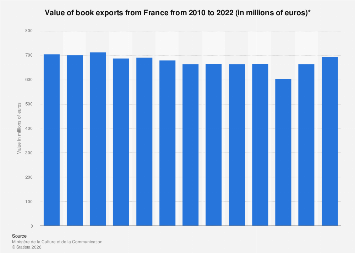
France, a nation renowned for its rich cultural heritage and literary prowess, has experienced a dynamic evolution in the global value of its book exports between 2010 and 2022. This period, marked by profound technological shifts, changing consumer habits, and fluctuating international trade landscapes, offers a compelling case study in the resilience and adaptability of a key cultural industry. While precise year-on-year figures for the entire period are complex to delineate due to data aggregation and reporting methodologies, a comprehensive analysis of available trends reveals a sector grappling with both headwinds and emergent opportunities.
The early part of the decade, from 2010 onwards, saw the book industry in many developed nations, including France, still navigating the initial waves of digital disruption. The rise of e-books and online retail presented both a challenge to traditional print sales and a new avenue for distribution. For French publishers, the challenge was to maintain the value of their physical book exports while also embracing digital formats. The inherent quality and perceived prestige associated with French literature and publishing houses likely provided a degree of insulation, allowing for a more gradual adaptation compared to some other markets. During this period, the value of exports would have been influenced by a complex interplay of factors: currency exchange rates, the economic health of key importing countries, and the success of major French literary releases on the international stage.
As the decade progressed, several macro-economic and cultural trends began to shape the export landscape. The global economic recovery following the 2008 financial crisis, albeit uneven, would have provided a more stable environment for international trade. However, the increasing prominence of digital platforms, including global e-commerce giants and specialized online booksellers, fundamentally altered how books were bought and sold across borders. French publishers would have had to invest in robust digital distribution strategies and potentially forge new partnerships to ensure their titles reached a wider international audience. The appeal of French literature, encompassing genres from classic philosophy and contemporary fiction to specialized academic works and children’s books, remained a significant export driver. The "soft power" of French culture, often amplified by successful film adaptations of French novels or the international acclaim of French authors, played a crucial role in sustaining demand.
Statistical data, where available for specific years within this timeframe, often points to a general trend of resilience, with periods of modest growth punctuated by potential plateaus or slight declines depending on prevailing global economic conditions and specific market demand. For instance, examining trends in the broader European book market, a key destination for French exports, can offer indicative insights. Countries like Germany, the United Kingdom, and Spain have historically been significant importers of French literary works, driven by shared cultural ties and established distribution networks. The value of these exports would be influenced by the purchasing power within these economies and their specific appetite for translated French literature.
The latter half of the decade, leading up to 2022, witnessed further significant shifts. The continued maturation of the e-book market meant that publishers had to optimize their strategies for both print and digital formats, often seeing a dual revenue stream. The rise of audiobooks also presented a new frontier for export, requiring different production and distribution models. Furthermore, the increasing interconnectedness of global markets meant that the success of a French book in one region could quickly generate interest in others, facilitated by digital marketing and social media.
The COVID-19 pandemic, impacting the final years of this period, presented unprecedented challenges and, paradoxically, some opportunities. Lockdowns and restrictions on physical retail initially led to a surge in online book sales globally, benefiting publishers with strong digital presence. However, disruptions in global supply chains, shipping delays, and reduced international travel also posed significant hurdles to the physical export of books. The value of French book exports during this period would have been a complex calculation, reflecting the surge in online demand offset by logistical nightmares and the economic uncertainty experienced by many importing countries. Despite these challenges, the enduring appeal of French culture and intellectual output likely ensured that demand for its literary products remained robust, albeit with potential fluctuations in the total export value.
Beyond direct sales, the value of French book exports is also intrinsically linked to the licensing of translation rights. French authors and publishers are highly sought after for their intellectual property, and the sale of rights to translate and publish works in languages such as English, Spanish, German, Chinese, and many others represents a significant, albeit often less visible, component of the industry’s international economic contribution. This aspect of the market is driven by the perceived quality and originality of French creative output, making it a consistent source of value for the nation’s cultural industries.
Looking at broader economic indicators, the cultural and creative industries in France are a significant contributor to the national economy, and the book sector plays a vital role within this. The export value of books is not merely a reflection of sales but also signifies France’s position as a global cultural influencer. The ability to successfully export intellectual and creative content contributes to a positive trade balance in services and enhances the country’s international image. When analyzing the economic impact, it’s important to consider the ripple effects: job creation within publishing houses, translation services, printing, distribution, and related logistics.
Global comparisons further illuminate France’s position. While countries like the United States and the United Kingdom often lead in overall book market size due to their sheer economic scale and extensive English-language publishing industries, France consistently ranks among the top European exporters, particularly in terms of the cultural significance and artistic merit of its literary output. The focus on high-quality translation and the nurturing of distinct literary voices allows France to carve out a strong niche in the global marketplace, even against larger linguistic blocs.
In conclusion, the period from 2010 to 2022 has been a transformative era for France’s book export market. Navigating the digital revolution, global economic fluctuations, and the unprecedented disruption of the pandemic, the sector has demonstrated remarkable adaptability. While precise financial figures require access to specialized data, the overarching trend suggests a sustained effort to maintain and, where possible, grow the international value of its literary exports. The enduring appeal of French literature, coupled with strategic adaptations to new distribution channels and licensing opportunities, positions the sector as a crucial component of France’s cultural and economic influence on the global stage. The ongoing evolution of consumer preferences and technological advancements will undoubtedly continue to shape this dynamic market in the years to come.