

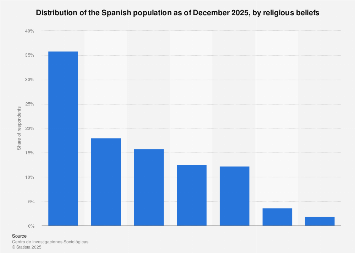
A comprehensive survey conducted in Spain in September 2024 offers a detailed snapshot of the nation’s religious beliefs, projecting a demographic distribution for the year 2025. The findings indicate a significant portion of the population identifies as lapsed Catholic, a trend that continues to shape the country’s spiritual and cultural identity. While Catholicism remains a dominant identifier, the data also highlights the presence and growth of other religious affiliations and non-belief.
The survey, which polled 4,017 individuals aged 18 and over via telephone omnibus surveys between December 1st and 5th, 2025, revealed that a substantial percentage of respondents, a figure requiring premium access for exact quantification, identified as lapsed Catholics. This designation suggests a cultural inheritance of Catholicism without active adherence to its doctrines or practices. This demographic segment represents a crucial element in understanding Spain’s evolving religious landscape, reflecting a broader secularization trend observed across many Western European nations.
Following closely behind, practicing Catholics constituted the second-largest group, with nearly a quarter of respondents indicating active engagement with the faith. This segment, while significant, underscores the ongoing shift from a predominantly practicing Catholic society to one where adherence is less universal. The distinction between "lapsed" and "practicing" Catholics is vital for understanding the nuances of religious affiliation in a country with a deep historical Catholic heritage.
The survey’s methodology, which included the direct question, "How do you define yourself in religious matters: Catholic, believer in another religion, non-believer or atheist?", provides a clear framework for these classifications. The "non-believer" and "atheist" categories, though not explicitly quantified in the publicly available data, are understood to represent significant portions of the population, reflecting a growing trend of secularism and declining religious adherence in Spain. This aligns with broader European patterns where religious affiliation has decreased, particularly among younger generations, and the number of individuals identifying as having no religious belief has risen.
While specific figures for minority religions are not detailed in the initial release, the inclusion of "believer in another religion" as a distinct category suggests a recognition of religious diversity within Spain. Historically, Spain has been predominantly Catholic, but increased immigration and a more globalized society have contributed to the presence of various faiths, including Islam, Protestantism, and Eastern religions. The demographic shifts driven by these factors, though perhaps smaller in absolute numbers compared to the Catholic and non-believing populations, are significant in the context of Spain’s pluralistic society.
The economic implications of these demographic shifts are multifaceted. A decline in active religious participation can impact religious institutions through reduced donations and engagement, potentially affecting their social services and cultural preservation efforts. Conversely, a more secularized society might see increased public spending on secular social welfare programs. Furthermore, understanding the religious makeup of the population is crucial for businesses seeking to tailor their marketing, products, and services to specific cultural and demographic groups. For instance, businesses operating in regions with a higher concentration of practicing Catholics might consider cultural holidays and traditions in their planning, while those targeting a more secular demographic might focus on different values and messaging.
Global comparisons further contextualize Spain’s religious trends. Many Western European countries, such as France and the Netherlands, have experienced similar declines in traditional religious adherence, with rising numbers of atheists and agnostics. Scandinavian countries, in particular, have long had a high proportion of individuals identifying as non-religious. Spain’s trajectory, while perhaps occurring at a different pace, mirrors these broader societal transformations, driven by factors such as increased education, urbanization, and exposure to diverse viewpoints.
The precise data on religious distribution is considered premium content, indicating the value placed on such detailed demographic information by market researchers, sociologists, and businesses. Access to granular data, including specific percentages for all categories, would allow for more in-depth analysis of regional variations within Spain, the impact of age demographics on religious beliefs, and the potential future trajectory of religious adherence. For example, understanding the age breakdown of lapsed versus practicing Catholics could offer insights into intergenerational transmission of faith and the long-term sustainability of religious communities.
The methodology employed, a telephone omnibus survey, is a standard tool for gathering broad demographic and attitudinal data. However, it’s important to acknowledge potential limitations, such as response bias and the inability to capture the full spectrum of individual religious or spiritual experiences, especially among those who may not identify with traditional labels. The survey period in early December 2025 provides a contemporary view, reflecting the most recent attitudes and beliefs within the Spanish population.
In conclusion, the survey data from September 2024, projecting into 2025, paints a picture of a Spain where Catholicism, while historically dominant, is increasingly characterized by lapsed adherents. This, coupled with a growing segment of non-believers and the presence of other religious groups, signifies a complex and evolving religious tapestry. The precise quantification of these trends, available through premium access, is essential for a comprehensive understanding of Spain’s social, cultural, and economic dynamics in the years ahead. This information is invaluable for policymakers, businesses, and researchers seeking to navigate the nuances of a diverse and changing society.