

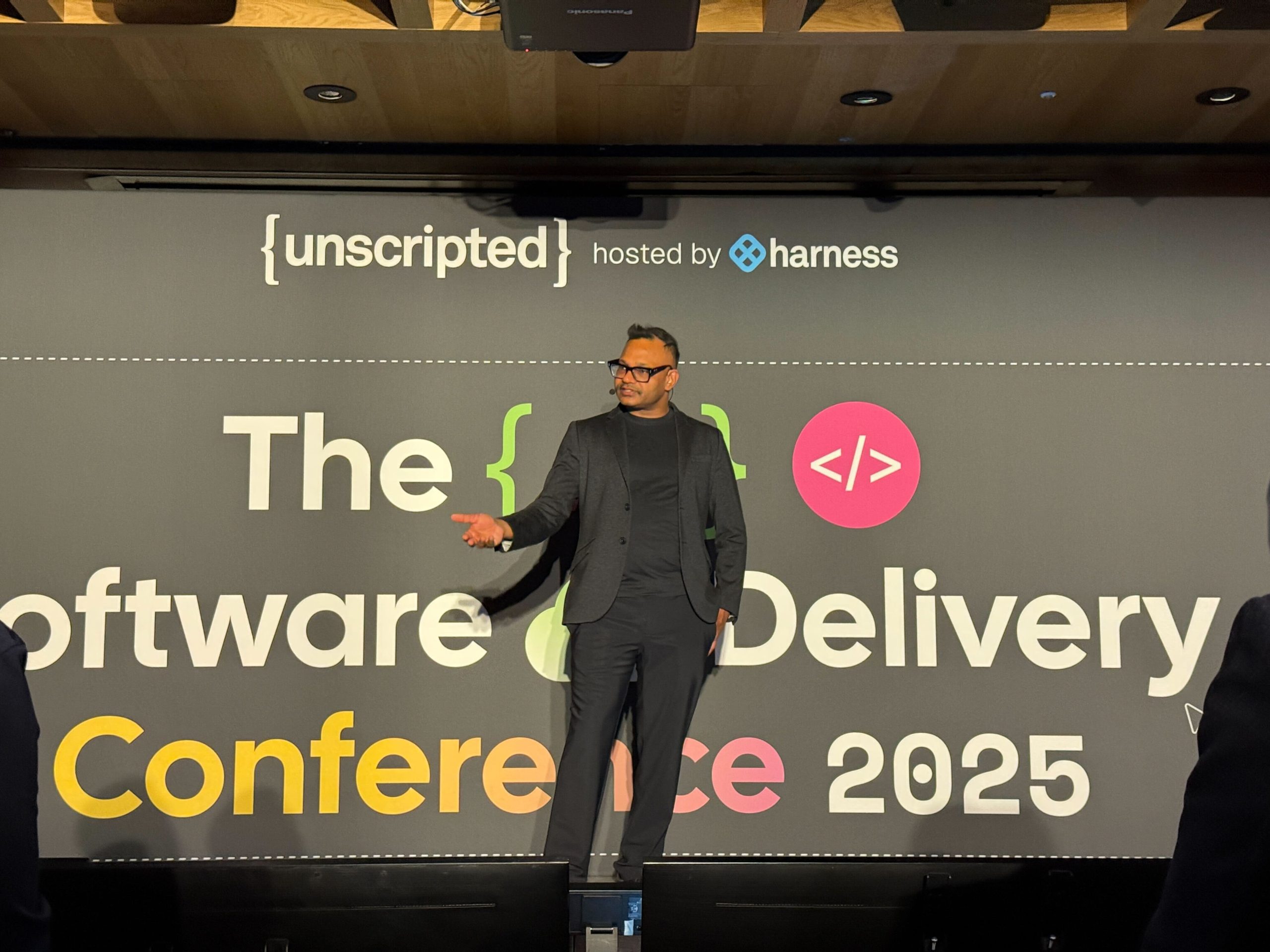
The rapidly evolving intersection of generative artificial intelligence and software development has reached a new milestone with Goldman Sachs leading a $200 million investment round in Harness, a San Francisco-based software delivery platform. This capital infusion vaults the company’s valuation to $5.5 billion, signaling a robust institutional appetite for the "picks and shovels" of the AI era. As organizations increasingly rely on large language models (LLMs) to generate code—a trend colloquially known as "vibe coding"—the demand for rigorous governance, security, and deployment infrastructure has moved from a back-office concern to a boardroom priority.
For Jyoti Bansal, the co-founder and CEO of Harness, this latest valuation represents a significant personal and professional evolution. Nearly a decade ago, Bansal made headlines when he sold his previous venture, AppDynamics, to Cisco for $3.7 billion just hours before the company was scheduled to price its initial public offering. While that exit remains a legendary "unicorn" success story in Silicon Valley, Harness has already eclipsed that figure in private market valuation. The trajectory suggests that Bansal is positioning Harness for a different finale: a long-term future as a public entity that serves as the backbone of the modern software lifecycle.
The core of the Harness value proposition lies in its ability to bring order to the potential chaos of AI-accelerated programming. The rise of generative AI has democratized software creation, allowing developers to use natural language prompts to generate complex code blocks. While this "vibe coding" movement has drastically increased the speed of production, it has also introduced significant risks. AI-generated code can be prone to "hallucinations," security vulnerabilities, and inefficiencies that lead to massive cloud-computing cost overruns. Harness provides the automated guardrails necessary to monitor, test, and deploy this code, ensuring that the speed of AI does not compromise the stability of enterprise systems.
This investment comes at a time of intense activity in the venture capital space regarding developer tools. In recent months, investors have funneled hundreds of millions of dollars into startups like Cursor, Lovable, and Kilo Code—the latter founded by former GitLab CEO Sid Sijbrandij. These platforms focus on the creative side of the equation, providing the AI interfaces that write the code. Harness, conversely, focuses on the operational integrity of that code. By leveraging models from industry leaders such as Anthropic and OpenAI, Harness has integrated AI into its own platform to automate the most tedious aspects of the software delivery pipeline, such as debugging and performance monitoring.
The economic implications of this technological shift are profound. In the traditional software model, the "developer experience" (DevEx) was limited by human bandwidth. Today, the bottleneck is no longer how fast code can be written, but how quickly and safely it can be integrated into production environments. As businesses across every sector—from finance to healthcare—race to become "AI-first," the infrastructure provided by companies like Harness becomes essential infrastructure. The $5.5 billion valuation reflects a market consensus that the management of AI-driven output is just as valuable, if not more so, than the AI models themselves.
Strategic consolidation has also played a role in Harness’s recent ascent. Earlier this year, Bansal merged Harness with Traceable, another startup he co-founded that specialized in cybersecurity and API protection. This merger was a calculated move to address one of the primary anxieties of the modern enterprise: the security of AI-generated applications. By combining software delivery with advanced security monitoring, the unified entity—which now employs approximately 1,300 people—offers a comprehensive suite that addresses the entire "DevSecOps" lifecycle. This vertical integration makes the company a formidable competitor against legacy players and younger startups alike.
Financial performance metrics provided by the company underscore its readiness for the public markets. Harness is reportedly on track to surpass $250 million in annualized revenue, maintaining a growth rate of over 50% year-over-year. In the current high-interest-rate environment, where "growth at any cost" has been replaced by a demand for "efficient growth," these figures are particularly striking. The company’s revenue is already higher than that of AppDynamics at the time of its acquisition, suggesting that the market for software delivery and observability has expanded significantly in the intervening years.

The inclusion of a $40 million tender offer as part of the funding round also highlights a growing trend in the late-stage startup ecosystem. By allowing long-term employees to sell a portion of their shares, Harness is providing liquidity in an era where IPO windows have been notoriously difficult to predict. This move serves as both a reward for the workforce that built the company and a retention strategy in a highly competitive market for engineering talent. In San Francisco’s "AI gold rush," keeping seasoned engineers is often as difficult as securing capital.
From a global economic perspective, the rise of Harness and its peers signals a shift in the labor dynamics of the technology sector. As AI takes over the rote tasks of coding, the role of the software engineer is evolving into that of a "system architect" or "orchestrator." The economic value is moving away from the manual labor of writing syntax toward the high-level management of automated systems. This transition requires a new class of tools that can handle the volume of code being produced. If a human developer writes 100 lines of code a day, an AI agent might write 10,000. Without a platform like Harness to vet those 10,000 lines, the risk of a systemic failure becomes an existential threat to a business.
Goldman Sachs’ leadership in this round also points toward a broader institutional confidence in the resilience of the enterprise software market. While consumer AI applications often capture the public’s imagination, the "boring" back-end infrastructure is where sustainable B2B revenue is often found. For Goldman Sachs, an investment in Harness is a bet on the fundamental plumbing of the digital economy. As more legacy industries undergo digital transformation, the reliance on automated software delivery platforms is expected to grow exponentially.
Looking ahead, the path for Harness appears to be a march toward the New York Stock Exchange or Nasdaq. Bansal has been vocal about his desire to operate as a public company, citing the benefits of long-term stability and transparency. Unlike the 2017 exit with AppDynamics, which was a strategic acquisition by a hardware giant, a Harness IPO would represent a pure-play bet on the future of the AI-augmented developer. The company’s ability to maintain its 50% growth rate while integrating its recent security acquisitions will be the key metric watched by analysts in the coming quarters.
The broader "vibe coding" trend, while currently a buzzword in Silicon Valley circles, represents a permanent shift in how software is conceptualized. It moves the industry closer to a "low-code" or "no-code" reality for the masses, while simultaneously making the requirements for professional-grade deployment tools more stringent. As the barrier to entry for creating software drops, the barrier to entry for creating reliable and secure software rises.
In the competitive landscape, Harness faces pressure from both ends of the spectrum. On one side are the cloud titans—Amazon Web Services, Microsoft Azure, and Google Cloud—which offer their own native deployment tools. On the other are agile startups focusing on niche aspects of the AI pipeline. However, by remaining cloud-agnostic and offering a unified platform that spans from code integration to security and cost management, Harness has carved out a unique "neutral" position that appeals to multi-cloud enterprises.
The $200 million raised will likely be deployed toward further R&D in agentic AI—autonomous software agents that can not only identify problems in a delivery pipeline but also fix them without human intervention. This "self-healing" infrastructure is the logical next step for the industry. As the complexity of modern software environments exceeds human cognitive limits, the software itself must become intelligent enough to manage its own lifecycle.
Ultimately, the story of Harness is a reflection of the current state of the global technology market: a mix of intense innovation, strategic consolidation, and a return to fundamental business metrics. With a $5.5 billion valuation and the backing of one of the world’s most influential financial institutions, Harness is no longer just a startup; it is a critical player in the global effort to harness the power of artificial intelligence for the enterprise. The transition from "vibe coding" as a experimental trend to a professionalized, industrial-scale operation is well underway, and Harness is positioned at the very center of that transformation.