
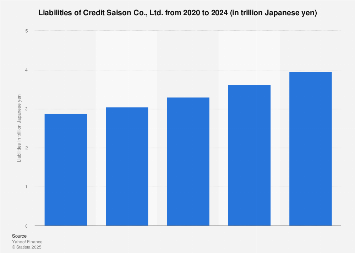
In the dynamic realm of global finance, understanding the intricate liabilities of major corporations is paramount for investors, analysts, and policymakers alike. Credit Saison Co., Ltd., a prominent Japanese financial services group, stands as a key player whose financial stewardship warrants close examination. While precise, real-time liability figures often reside behind proprietary data walls, the broader context of its financial health and the economic forces shaping its balance sheet offer significant insights into its operational resilience and strategic direction for 2024 and beyond.
The financial structure of any large corporation is a complex tapestry woven from various forms of debt, deferred payments, and contractual obligations. For a company like Credit Saison, which operates across a spectrum of financial services including credit cards, consumer loans, leasing, and factoring, its liabilities represent the bedrock upon which its lending and investment activities are built. These liabilities are not merely a snapshot of current obligations but are indicative of past financing decisions, future growth strategies, and the company’s ability to manage financial risk in a volatile economic climate.
Globally, 2024 has been characterized by a confluence of economic challenges, including persistent inflation, rising interest rates in many major economies, geopolitical uncertainties, and evolving regulatory landscapes. These factors exert considerable pressure on the cost of capital and the overall financial leverage of companies. For Credit Saison, a significant portion of its liabilities likely comprises wholesale funding, interbank borrowings, and the issuance of corporate bonds. As central banks continue to grapple with inflation, the cost of servicing these debts can escalate, impacting profitability and potentially necessitating adjustments to lending rates or a more cautious approach to new business origination.
Examining the composition of Credit Saison’s liabilities would typically involve scrutinizing categories such as short-term borrowings, long-term debt, accounts payable, and other financial commitments. Short-term borrowings, often used to manage day-to-day liquidity needs and fund immediate lending opportunities, are particularly sensitive to fluctuations in short-term interest rates. Conversely, long-term debt, while generally carrying fixed or hedged interest rates, represents a more significant commitment that impacts the company’s capital structure and its ability to undertake long-term investments or acquisitions.
The broader Japanese economic environment also plays a crucial role. While Japan has historically maintained a low-interest-rate regime, the global trend towards monetary tightening, even if more gradual in Japan, can still influence borrowing costs and investor sentiment. Furthermore, domestic consumption patterns, corporate investment, and the overall health of the Japanese economy directly affect the demand for Credit Saison’s services and, consequently, the volume and risk profile of its loan portfolio, which in turn influences its funding requirements and liability management.
Beyond domestic considerations, Credit Saison’s international operations, if any, would expose it to a wider array of economic conditions and currency fluctuations. Managing liabilities across different jurisdictions involves navigating diverse regulatory frameworks, varying interest rate environments, and potential exchange rate risks. Companies with global footprints often employ sophisticated hedging strategies to mitigate these exposures, but their effectiveness can be tested during periods of significant market volatility.
The criticality of these liabilities is underscored when one considers the profitability and solvency metrics of a financial institution. A high level of debt relative to equity can amplify returns during good times but can also magnify losses during downturns, increasing financial risk. Analysts often look at leverage ratios, debt-to-equity ratios, and interest coverage ratios to assess a company’s financial health. For Credit Saison, maintaining a prudent level of leverage while ensuring access to sufficient and cost-effective funding is a continuous balancing act.
Moreover, the nature of the liabilities themselves is important. For a financial services firm, liabilities are intrinsically linked to its assets – primarily its loan and investment portfolios. The quality of these assets, their repayment prospects, and their potential for default directly influence the perceived risk of the company’s liabilities and its ability to secure future funding. Robust risk management frameworks, including stringent credit assessment processes and effective non-performing loan management, are therefore essential to maintaining the confidence of creditors and the market.
In the context of 2024, the increasing focus on Environmental, Social, and Governance (ESG) factors by investors and regulators might also indirectly influence how companies like Credit Saison manage their liabilities. Lenders and bondholders may increasingly favor companies with strong ESG credentials, potentially leading to more favorable borrowing terms. Conversely, companies with weaker ESG performance might face higher funding costs or limited access to capital markets. This growing emphasis on sustainability is becoming an integral part of corporate financial strategy, influencing long-term capital planning and liability management.
The competitive landscape within the financial services sector also plays a part. In Japan, Credit Saison competes with established banks, other non-bank lenders, and increasingly, with fintech companies that are disrupting traditional lending models. This competition can put pressure on lending margins, potentially impacting the company’s ability to generate sufficient profits to service its debt obligations. Furthermore, the digital transformation of financial services necessitates continuous investment in technology, which may require additional funding and thus influence liability structures.
While specific figures for Credit Saison’s liabilities in 2024 are proprietary, the general economic headwinds and industry trends provide a framework for understanding the challenges and strategic imperatives it faces. The company’s ability to adapt to evolving interest rate environments, manage credit risk effectively, maintain strong relationships with its funding providers, and embrace technological advancements will be crucial in navigating the complexities of its financial obligations and ensuring sustained growth and profitability. The strategic decisions made regarding its capital structure and liability management will be a key determinant of its success in the coming years, reflecting its resilience in an ever-changing global economic panorama.