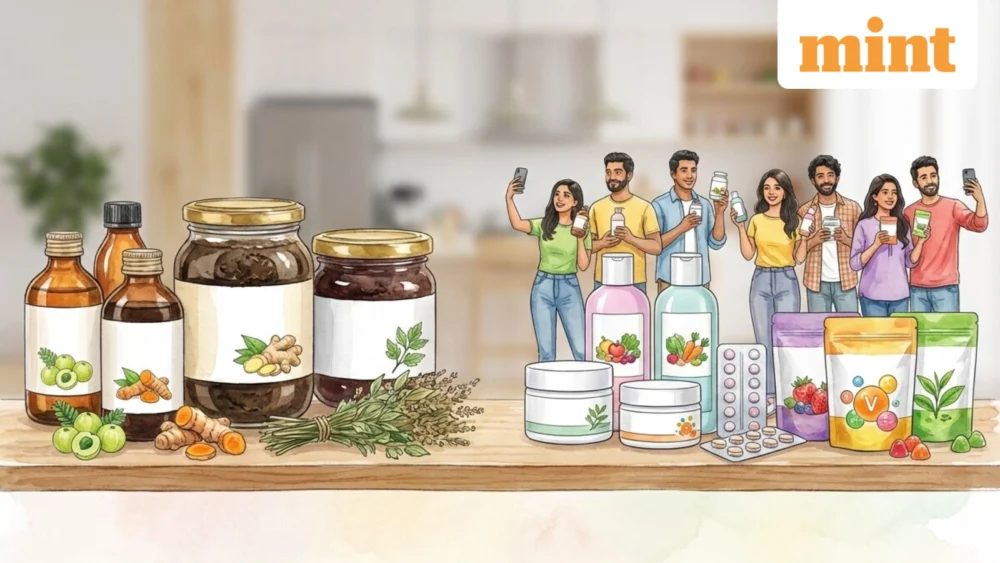
India’s burgeoning health and wellness sector is undergoing a profound transformation, marked by an intense strategic battle for the loyalty of the nation’s next generation of consumers. At its heart lies a contest between established legacy companies, steeped in decades, sometimes centuries, of trust and extensive distribution networks, and agile, digital-native brands championing science-backed outcomes, transparent "clean labels," and lifestyle-integrated consumption. The outcome of this contest is poised to fundamentally redefine one of India’s most dynamic Fast-Moving Consumer Goods (FMCG) categories.
The stakes are unequivocally high. The Indian health and wellness market was estimated to be valued at approximately $40 billion in 2024, according to a comprehensive report by the consulting firm Kearney. Within this expansive landscape, the nutraceuticals segment—encompassing dietary supplements, functional foods, and fortified beverages—stands out, contributing roughly $8 billion and exhibiting a robust compound annual growth rate (CAGR) of 11% projected between 2023 and 2027. This growth trajectory is fueled by rising disposable incomes, increasing health consciousness, and a demographic shift towards younger, digitally-savvy consumers who are proactive about their well-being.
For years, a palpable pressure has been mounting on India’s traditional wellness brands, primarily due to product portfolios perceived as catering to an older demographic and often concentrated in specific regional markets. Dr. Kiran Mahasuar, Assistant Professor of Strategy at SPJIMR, Mumbai, observes that traditional companies have experienced sluggish growth over the past three to four years. Their offerings, he notes, are largely tailored for an older generation and, in the case of major players like Dabur and Hamdard, have historically found their strongest consumer base in North and Central India. Prominent brands forming the backbone of Dabur’s sales, each generating over ₹500 crore (approximately $60 million) in annual revenue, such as Dabur Red Paste, Dabur Amla hair oil, Dabur Honey, and Chyawanprash, are widely considered "boomer brands."
The evolving consumer landscape, particularly the preferences of Generation Z, presents a significant challenge. "Gen Z is exceptionally discerning about ingredients, aesthetic appeal, and, crucially, demands visible, demonstrable results," Dr. Mahasuar emphasized. This generation’s expectations have particularly impacted segments like skincare and haircare, where traditional players, once sustained by robust rural demand, now find themselves unable to rely solely on this segment as other areas stagnate or decline. The global shift towards personalized wellness, preventative health, and transparent sourcing amplifies these demands, pushing Indian brands to innovate at an unprecedented pace.
In response to these market shifts, leading legacy players acknowledge that wellness is no longer an episodic or age-restricted pursuit. Instead, it has evolved into an "everyday behavior," necessitating fundamental changes in both product formulation and market positioning. Durga Prasad, Ethics and Marketing Head at Dabur India Ltd., articulated this shift: "Consumers today seek science-backed efficacy rooted in tradition, but presented in formats and language that seamlessly integrate with modern lifestyles." This means translating centuries-old wisdom into contemporary relevance, a task that requires careful balance between innovation and authenticity.
Dabur’s strategic pivot is evident in its product innovation. Chyawanprash, a classic Ayurvedic health tonic long associated with its thick, often sugar-laden consistency, is now available in convenient tablet form. Furthermore, a growing number of Dabur’s newer launches are explicitly sugar-free or low-sugar, reflecting a broader consumer trend. Prasad underscored this, stating, "Clean-label and no-added-sugar claims are no longer premium attributes; they are baseline expectations for today’s health-conscious consumer." Beyond formats, the deeper challenge lies in the "translation" of Ayurvedic concepts. Traditional ideas, often abstract or unfamiliar to younger consumers, require reinterpretation rather than dilution. Dabur has addressed this by reframing classical principles into outcome-led language—focusing on benefits like immunity, gut health, and stress relief—while rigorously maintaining the integrity of traditional formulations. "Our role is to remain true to classical principles while articulating their benefits in accessible, everyday terms," Prasad affirmed. "These are not novel ideas; rather, they are modern expressions of the enduring Ayurvedic intent."
A similar, albeit more cautious, transition is underway at Hamdard Laboratories Ltd., a venerable 117-year-old company rooted in Unani medicine. Hamdard’s product portfolio remains heavily skewed towards syrups, a format increasingly at odds with Gen Z’s pronounced aversion to sugar and strong medicinal tastes. Abdul Majeed, Chairman & Trustee at Hamdard Laboratories, noted, "Gen Z is exceptionally conscious about what they consume. Sugar content, taste profiles, and convenience hold far greater importance today than even a decade ago." In response, Hamdard has initiated the introduction of sugar-free tablet and capsule versions of select flagship products, including Safi, its well-known blood-purification tonic. This shift, however, is deliberately gradual. "We cannot abandon the loyal consumers who have trusted us for decades," Majeed explained, emphasizing the necessity of a measured, phased transition to avoid alienating its established customer base.
Beyond product reformulation, communication presents an even greater hurdle. Traditional Unani concepts, such as "blood purification," carry little resonance for a younger generation conversant in the modern lexicon of "detox," "metabolism," and "inflammation." "Explaining these in traditional terms takes too long," Majeed acknowledged, underscoring the imperative to "speak their language" to forge a meaningful connection. This cultural and linguistic bridge-building is paramount for traditional brands seeking to expand their appeal beyond their core demographic.
The urgency for these transformations is underscored by starkly diverging growth trajectories within the market. Dabur’s healthcare segment, while a significant contributor to its domestic FMCG portfolio, has shown steady but relatively modest performance. In Q4 FY25, healthcare revenue stood at ₹536 crore (approximately $64 million), representing 30% of domestic sales. This figure rose to ₹591 crore (approximately $71 million) in Q1 FY26, a 2.7% year-on-year increase, and further to ₹603 crore (approximately $72 million) in Q2 FY26, marking a 1.3% increase. While consistent, this growth pales in comparison to the meteoric rise of digital-native wellness brands. Wellbeing Nutrition, for instance, saw its revenue skyrocket from a mere ₹2 crore (approximately $240,000) in FY20 to ₹72 crore (approximately $8.6 million) in FY24. Similarly, Kapiva expanded from ₹42 crore (approximately $5 million) in FY21 to a staggering ₹349 crore (approximately $42 million) in FY25.
This seismic shift in consumer behavior has been adeptly leveraged and monetized by Direct-to-Consumer (D2C) brands, which are meticulously built around online discovery, influencer-led education, and rapid quick-commerce distribution channels. These digital-first entities have attracted substantial interest from both investors and larger corporate players. Bengaluru-based Kapiva successfully raised over $60 million in a Series D funding round in September, led by 360 ONE Asset and Vertex Growth. In a testament to this trend, Hindustan Unilever Ltd. (HUL), a global FMCG behemoth, acquired Oziva, a plant-based nutrition and wellness brand, for ₹264 crore (approximately $31.6 million) in 2022. Concurrently, HUL also secured a 19.8% minority stake in supplement company Wellbeing Nutrition for ₹70 crore (approximately $8.4 million).
Ameve Sharma, founder of Kapiva, articulates the core appeal of these new-age brands: "Today’s consumers do not want to contort their lives around supplements; they seek solutions that integrate naturally into their daily routines and feel culturally resonant." Sharma further explains that D2C brands inherently benefit from being designed for online marketplaces, social media engagement, and quick-commerce platforms, environments where clarity, speed, and transparency are paramount. Ingredients, precise dosages, and expected outcomes are communicated upfront, often through engaging content rather than traditional authoritative messaging.
Avnish Chhabria, founder of Wellbeing Nutrition, underscores the fundamental difference in approach. "Legacy brands were engineered for sheer distribution reach," he stated. "Digital brands, conversely, are built for fostering belief and ensuring adherence." Chhabria argues that many of the format shifts undertaken by legacy players, such as converting syrups into tablets, are merely "cosmetic" without a deeper re-evaluation of formulation or absorption mechanisms. "Real innovation," he contends, "is fundamentally science-led and outcome-driven." This perspective highlights the need for a holistic reimagining of product development rather than superficial adjustments.
Legacy companies, however, staunchly counter that their long-standing trust, unparalleled scale, and rigorous regulatory compliance remain formidable advantages, particularly as scrutiny over the efficacy and safety of dietary supplements intensifies globally. Dabur, for instance, emphasizes its profound R&D capabilities, extensive clinical validation processes, and robust supply-chain control as enduring strengths that nascent startups cannot replicate overnight. Prasad, from Dabur, posited a vision of collaboration rather than outright competition: "The wellness market is not a zero-sum game between legacy players and startups. It is, in fact, a convergence of strengths." This outlook suggests a future where strategic alliances, acquisitions, and mutual learning could shape the industry, combining the heritage and reach of traditional brands with the agility and consumer-centric innovation of digital disruptors. The ultimate success will likely hinge on which entities can best synthesize authentic traditional wisdom with modern scientific validation, convenience, and compelling, contemporary communication.