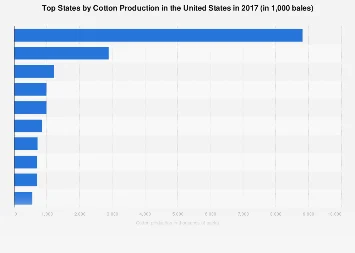
The United States, a global agricultural powerhouse, consistently ranks among the world’s leading cotton producers, with its output significantly influencing international fiber markets. While the overall scale of U.S. cotton cultivation is substantial, the geographical distribution of this production reveals distinct regional strengths and economic dependencies. Analyzing cotton production by state provides crucial insights into the agricultural landscape, supply chain dynamics, and the economic vitality of rural communities. This deep dive into state-level data, particularly focusing on the 2017 growing season, illuminates the intricate web of factors that shape America’s cotton output.
In 2017, the U.S. cotton crop was predominantly concentrated in a few key states, underscoring the importance of specific climatic conditions, soil types, and established agricultural infrastructure. Texas, historically the undisputed king of U.S. cotton, once again led the nation in planted acreage and total production. The vast expanse of West Texas, characterized by its semi-arid climate and extensive irrigation systems, has long been the heartland of American cotton farming. The sheer scale of operations in Texas allows it to absorb fluctuations in yield more effectively than smaller producing regions, often setting the pace for national trends. Following Texas, states such as Georgia, Mississippi, Arkansas, and Alabama form the core of the Southeastern cotton-growing region. This area benefits from a more humid subtropical climate, offering different challenges and advantages compared to the High Plains of Texas.
The economic significance of cotton production extends far beyond the farm gate. For these states, cotton is not merely a crop but a foundational element of their agricultural economies. It supports a complex ecosystem of related industries, including ginning facilities, textile manufacturing (though significantly reduced in recent decades domestically), logistics and transportation networks, and agricultural input suppliers. The revenue generated from cotton sales directly impacts farm incomes, stimulates local spending, and contributes to state tax revenues. Furthermore, the employment opportunities created by cotton farming and its associated industries are vital for maintaining rural populations and preventing economic decline in agricultural communities.
Examining the 2017 figures, the dominance of Texas was evident, accounting for a substantial portion of the national total. This concentration in one state, while efficient in some respects, also introduces a degree of systemic risk. A severe weather event, such as a prolonged drought, an early frost, or a major hurricane, impacting Texas could disproportionately affect the entire U.S. cotton supply, leading to price volatility and potential disruptions in the global market. The interconnectedness of agricultural markets means that such events can have ripple effects across international borders, impacting textile industries and consumers worldwide.
The Southeastern states, while individually smaller producers than Texas, collectively represent a significant segment of U.S. cotton output. Their production is often characterized by different varieties of cotton and farming practices, reflecting their unique environmental conditions. For instance, the Delta region, encompassing parts of Mississippi, Arkansas, and Louisiana, is known for its fertile alluvial soils, which can support high yields under optimal conditions. However, this region is also susceptible to excessive rainfall and humidity, posing challenges for pest management and harvest. Georgia, another major player in the Southeast, has seen a resurgence in cotton production in recent years, driven by favorable market conditions and technological advancements in farming.
The global context of U.S. cotton production is also critical. The United States competes with major cotton-producing nations such as India, China, Brazil, and Australia. While the U.S. often holds a leading position in terms of export volume, its market share can be influenced by global supply and demand dynamics, trade policies, and the production levels in these other countries. The quality of U.S. cotton, particularly its staple length and purity, is highly regarded in international markets, often commanding premium prices. However, factors like the cost of production, including labor, land, and inputs, play a crucial role in determining the competitiveness of U.S. cotton on the world stage.
Technological advancements have played a transformative role in U.S. cotton production, enabling farmers to increase yields, improve efficiency, and manage resources more effectively. Precision agriculture, including the use of GPS-guided tractors, variable rate application of fertilizers and pesticides, and advanced irrigation techniques, has become increasingly prevalent. These technologies not only enhance productivity but also contribute to more sustainable farming practices by optimizing resource utilization and minimizing environmental impact. Genetically modified (GM) cotton varieties, engineered for traits such as insect resistance and herbicide tolerance, have also been instrumental in boosting yields and reducing crop losses, although their adoption and regulation vary across different countries.
The economic impact of cotton production is multifaceted. Beyond the direct revenue for farmers, the industry supports a wide array of ancillary services. Ginners, who separate cotton fiber from seeds, are crucial intermediaries. Their operations often represent significant capital investments and provide stable employment in rural areas. Transportation companies, from local haulers to major rail and shipping lines, are essential for moving the harvested crop from farms to gins and then to domestic or international markets. The demand for agricultural machinery, chemicals, and seed further fuels economic activity in these producing states.
Furthermore, the financial sector plays a vital role, providing credit and insurance services that enable farmers to manage the inherent risks of agriculture. Fluctuations in commodity prices, weather patterns, and global trade can significantly impact farm profitability, making access to capital and risk management tools indispensable. Government agricultural policies, including subsidies, crop insurance programs, and trade agreements, also exert a considerable influence on the viability and competitiveness of U.S. cotton production.
The 2017 data, while a snapshot in time, reflects ongoing trends in U.S. agriculture. The consolidation of land into larger farming operations, the increasing reliance on technology, and the ongoing challenge of managing input costs are all factors that shape the cotton industry. While specific production figures by state can vary year to year due to weather and market conditions, the fundamental geographic distribution of cotton cultivation has remained relatively consistent, highlighting the enduring importance of the traditional cotton-growing regions. The future of U.S. cotton production will likely be shaped by continued innovation, evolving consumer demand for textiles, global trade dynamics, and the ongoing imperative for sustainable agricultural practices.