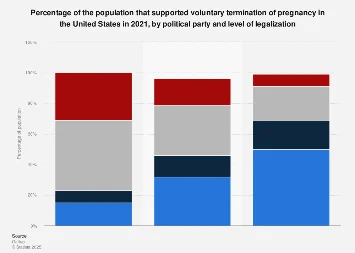
The United States in 2021 presented a starkly divided landscape regarding abortion access and legality, with public opinion deeply entrenched on opposing sides. This division was not merely a matter of political affiliation but reflected fundamental differences in moral, ethical, and religious beliefs that permeated societal discourse and influenced legislative battles. As the nation navigated this complex terrain, the implications for reproductive healthcare, economic participation, and social equity became increasingly pronounced.
Data from the period consistently showed a near-even split in public sentiment. Roughly half of American adults expressed the view that abortion should be legal in most or all cases, while a comparable proportion believed it should be illegal in most or all cases. This persistent parity suggested that neither viewpoint held a decisive majority, leading to a political stalemate and a constant flux in policy at both state and federal levels. This demographic parity underscored the challenge of finding consensus and the likelihood of continued legal and social friction.
The intensity of these opposing views was a critical factor. While the overall numbers might have appeared balanced, the conviction with which individuals held their positions often meant that compromise was elusive. Pro-choice advocates emphasized bodily autonomy, reproductive freedom, and the potential negative socioeconomic consequences for individuals and families if abortion access were restricted. They pointed to disparities in access based on income, race, and geography, arguing that restrictive laws disproportionately harmed marginalized communities. Their concerns often centered on the ability of individuals to control their reproductive lives, pursue education and career opportunities, and achieve economic stability.
Conversely, anti-abortion proponents, often referred to as pro-life advocates, prioritized the moral status of the fetus, viewing it as a human life with a right to protection from conception. Their arguments were frequently rooted in religious doctrine and a belief in the sanctity of life. They advocated for policies that would limit or ban abortion, framing it as a moral imperative to safeguard the unborn. The economic arguments from this side often focused on the value of every life and the potential societal benefits of supporting families through alternative means, such as adoption.
These differing perspectives had significant economic ramifications. Restrictions on abortion access can impact workforce participation, particularly for women, by limiting their ability to complete education or maintain employment. Studies have indicated that access to reproductive healthcare, including abortion, is linked to improved economic outcomes for women and their families. When individuals can decide if and when to have children, they are better positioned to invest in their education, secure stable employment, and contribute more fully to the economy. Conversely, unintended pregnancies and the inability to access abortion can lead to increased reliance on social services and a reduction in earning potential.
The global context further illuminated the American situation. Many developed nations, particularly in Western Europe, have legalized abortion with fewer restrictions than were present in significant portions of the United States. Countries like Canada, France, and the United Kingdom generally permit abortion on demand up to a certain gestational limit, reflecting a different societal consensus on reproductive rights. These nations often have robust social safety nets and healthcare systems that support individuals through various life stages, potentially influencing their approach to reproductive policy. In contrast, some developing nations have much stricter laws, often reflecting deeply ingrained cultural or religious norms. The United States, with its complex federalist system and diverse population, occupied a unique space, characterized by a patchwork of state laws that created vastly different realities for reproductive healthcare access across the country.
The legal framework surrounding abortion in the U.S. in 2021 was largely shaped by the landmark Supreme Court decision in Roe v. Wade (1973), which established a woman’s constitutional right to an abortion. However, subsequent court rulings and legislative actions had incrementally chipped away at this right, leading to a situation where access varied dramatically from state to state. Some states had enacted stringent laws, such as mandatory waiting periods, parental consent requirements, and bans on certain abortion procedures, while others maintained more permissive policies. This legal uncertainty and the potential for significant shifts in policy created an environment of anxiety and instability for both healthcare providers and individuals seeking reproductive care.
The economic impact of these varying laws was substantial. States with more restrictive abortion laws often faced challenges in attracting and retaining a skilled workforce, particularly among women. Businesses expressed concerns about the potential for reduced economic productivity and a less competitive labor market if access to reproductive healthcare was curtailed. Conversely, states with more liberal abortion access often saw themselves as more attractive to businesses and individuals who valued reproductive freedom as a component of overall quality of life and economic opportunity.
Furthermore, the debate over abortion intersected with broader discussions about healthcare access and economic inequality. For many low-income individuals and women of color, the cost and availability of abortion services represented significant barriers, even in states where it was legal. This highlighted how reproductive rights were intertwined with issues of social justice and economic fairness. Without adequate support systems, including affordable childcare, paid family leave, and comprehensive healthcare, the decision to carry a pregnancy to term could have profound and lasting economic consequences.
As 2021 drew to a close, the future of abortion access in the United States remained highly uncertain. The composition of the Supreme Court and the political landscape suggested that the legal status of abortion could be subject to further significant changes. This ongoing legal and political contestation had a tangible impact on the economic projections and social policies of the nation, underscoring the deeply embedded nature of the abortion debate within the fabric of American society and its economy. The persistent division in public opinion meant that any resolution, if one were to occur, would likely be contentious and would have far-reaching consequences for individuals, families, and the broader economic health of the country. The data from 2021 served as a snapshot of a nation grappling with fundamental questions about life, liberty, and the pursuit of happiness, with reproductive autonomy emerging as a central, and deeply divisive, battleground.