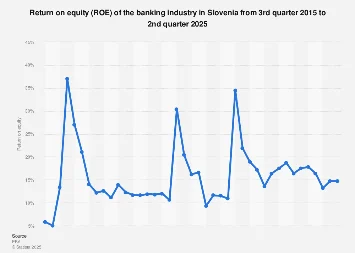
Slovenia’s banking industry is on track for a significant uptick in profitability, with projected returns on equity (ROE) indicating a robust performance throughout 2025. This anticipated improvement is underpinned by a confluence of factors, including a resilient macroeconomic environment, strategic adjustments within financial institutions, and a gradual easing of interest rate pressures that have historically impacted net interest margins. Analysts and industry observers are closely monitoring these trends, as a sustained rise in ROE is a critical indicator of financial health, investor confidence, and the sector’s overall contribution to national economic growth.
The return on equity metric, a key barometer for financial performance, measures a company’s profitability in relation to its shareholders’ equity. For banks, a healthy ROE signifies their ability to generate profits efficiently from the capital invested by their shareholders. In the Slovenian context, the projected upward trajectory for 2025 suggests that commercial banks are successfully navigating the evolving financial landscape, adapting to regulatory shifts, and capitalizing on emerging opportunities. This positive outlook contrasts with periods of greater uncertainty, where factors such as prolonged low-interest-rate environments or heightened credit risk concerns had previously tempered profitability.
Several macroeconomic forces are contributing to this optimistic outlook. Slovenia’s economy has demonstrated a degree of resilience, characterized by steady GDP growth, a relatively low unemployment rate, and a stable political climate. These conditions create a favorable operating environment for banks, fostering demand for credit and reducing the likelihood of significant non-performing loan (NPL) write-offs. Furthermore, inflation, while a global concern, has shown signs of moderation in Slovenia, allowing for more predictable monetary policy decisions and a less volatile interest rate environment. This stability is crucial for banks, as it allows for more accurate forecasting of funding costs and lending revenues.
Beyond the broader economic backdrop, specific strategic initiatives undertaken by Slovenian banks are also playing a pivotal role. Many institutions have focused on enhancing operational efficiency through digital transformation, streamlining processes, and reducing overhead costs. Investment in advanced analytics and artificial intelligence is enabling better risk assessment, personalized customer offerings, and more effective fraud detection, all of which contribute to improved profitability. Moreover, a strategic re-evaluation of business models, with a greater emphasis on fee-based income streams such as wealth management, advisory services, and transaction banking, is diversifying revenue sources and reducing reliance solely on traditional lending margins.
The global banking landscape offers a valuable point of comparison. Many European banks, for instance, have faced similar challenges in recent years, including the impact of negative interest rates and increased regulatory scrutiny. However, a global trend towards higher interest rates, albeit with varying paces of implementation and subsequent moderation, has generally provided a tailwind for bank profitability across developed economies. Slovenia’s banking sector appears to be benefiting from this broader trend, while also carving out its own path through localized economic strengths and targeted strategic maneuvers. The projected ROE figures for Slovenia in 2025 are expected to place its banking sector competitively within the Central and Eastern European region, and potentially on par with or exceeding some Western European peers that have grappled with structural challenges for longer.
The implications of a rising ROE for Slovenia’s banking sector extend beyond the financial statements of individual institutions. A more profitable banking system translates into increased capacity for lending to businesses and individuals, fueling investment, consumption, and job creation. This, in turn, supports broader economic expansion. Furthermore, strong bank performance can attract foreign investment, enhance the country’s credit rating, and contribute to fiscal stability through increased tax revenues. For shareholders, a higher ROE signifies a greater return on their investment, potentially leading to increased dividends and a higher stock valuation.
While the outlook for 2025 is predominantly positive, potential headwinds remain. The pace of interest rate adjustments by the European Central Bank will continue to be a significant factor, as will any unforeseen geopolitical or global economic shocks. Regulatory changes, particularly those related to capital requirements or consumer protection, could also influence profitability. Nevertheless, the current trajectory suggests that Slovenian banks are well-prepared to manage these risks. Their proactive approach to digitalization, diversification of revenue, and prudent risk management positions them favorably to capitalize on the projected economic conditions throughout the coming year. The consistent monitoring of key performance indicators, including ROE, will be essential for understanding the ongoing evolution and sustained success of Slovenia’s vital financial sector.