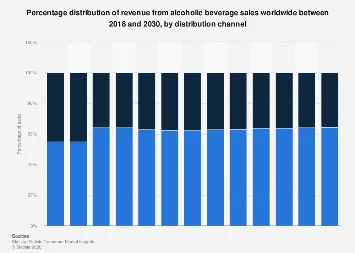
The global alcoholic beverage market is experiencing a significant and enduring shift, with sales for home consumption now firmly established as the dominant revenue stream, a trend significantly accelerated by the COVID-19 pandemic. While certain categories like wine have historically seen robust off-premise sales, the broader alcoholic beverage industry has now embraced this model across the board. Data indicates that for home consumption, primarily through supermarkets, hypermarkets, convenience stores, and similar retail channels, accounted for a substantial 64.1% of global revenue in 2020. This share has remained remarkably consistent, hovering above 60% and projected to stay there for the foreseeable future, with nearly 62.3% of sales expected to be for domestic consumption in 2024. This represents a substantial increase from the 54.98% recorded in 2018, underscoring a profound and lasting change in consumer purchasing habits.
Historically, the out-of-home consumption channel, encompassing sales in hotels, restaurants, bars, and catering services (often referred to as the HORECA sector), represented a more balanced portion of the market. In 2018, this sector still commanded a considerable 45.02% of alcoholic beverage sales. However, the pandemic’s enforced lockdowns and restrictions on social gatherings dealt a severe blow to the hospitality industry. This led to a dramatic contraction in out-of-home sales, which fell to 35.9% in 2020. While there has been a partial recovery, with the out-of-home share rising to 37.76% in 2023, it has not recaptured its pre-pandemic levels and is not anticipated to surpass 35.65% by 2030.
The sustained strength of the at-home consumption channel can be attributed to several intertwined factors. Firstly, the convenience and perceived value offered by supermarkets and online retailers are highly attractive to consumers. The ability to purchase a wider variety of beverages, compare prices easily, and have them delivered directly to one’s doorstep has become a cornerstone of modern shopping habits. Secondly, the pandemic instilled new routines and preferences. Many consumers discovered or rediscovered the pleasure of enjoying alcoholic beverages in the comfort of their own homes, often coupled with home-cooked meals or virtual social gatherings. This behavioral shift appears to be deeply ingrained, with consumers continuing to prioritize these at-home experiences.
Economically, this channel shift has profound implications for beverage producers, distributors, and retailers. Producers are increasingly tailoring their product development and marketing strategies to cater to the at-home consumer. This includes developing larger formats, value packs, and products that are perceived as suitable for sharing or for specific home-based occasions. Distributors are also adapting their logistics and supply chains to optimize for retail and e-commerce fulfillment rather than solely focusing on the HORECA sector. Retailers, in turn, are investing in their alcoholic beverage aisles, expanding their selection, and enhancing their in-store and online shopping experiences to capture a larger share of this lucrative market.
The data also reveals nuances within the at-home consumption trend. While supermarkets and hypermarkets remain the primary pillars, the rise of e-commerce platforms and direct-to-consumer (DTC) sales channels has become increasingly significant. Online sales of alcoholic beverages have surged, offering consumers even greater choice and convenience. This digital transformation necessitates ongoing investment in robust online infrastructure, secure payment gateways, and efficient last-mile delivery solutions for beverage companies.
Conversely, the out-of-home sector, while diminished in its overall market share, remains a critical channel for premiumization and brand building. For many brands, bars, restaurants, and hotels serve as crucial touchpoints for consumers to experience higher-end products, discover new offerings, and engage with brand narratives in a curated environment. The recovery of this sector is intrinsically linked to the broader economic health of the hospitality industry, travel and tourism, and consumer confidence in social gatherings. Strategies for revitalizing out-of-home sales may involve innovative promotional activities, unique tasting experiences, and collaborations between beverage brands and hospitality establishments.
Looking ahead, the projections suggest a continued equilibrium favoring at-home consumption. By 2030, the share of domestic consumption is forecast to reach 64.35%, while out-of-home sales are expected to settle at 35.65%. This enduring trend highlights the need for the alcoholic beverage industry to maintain a dual focus: strengthening its retail and e-commerce presence while simultaneously finding creative ways to engage consumers and drive value within the hospitality sector.
The global comparison of these trends reveals varying degrees of impact and adaptation across different regions. Mature markets with well-developed retail infrastructures and strong online shopping cultures, such as North America and Western Europe, have seen a pronounced shift towards at-home consumption. Emerging markets, while still developing their retail landscapes, are also rapidly adopting e-commerce solutions, further accelerating this trend. However, cultural nuances and local regulations regarding alcohol sales and consumption can influence the pace and magnitude of these shifts.
The definition of "domestic consumption" in this context is broad, encompassing not only traditional supermarkets but also specialty liquor stores, online grocery platforms, and subscription services. The "out-of-home" segment, on the other hand, is more narrowly defined as sales within licensed hospitality venues. It is important to note that market valuations for the out-of-home segment are now based on retail prices, a change from previous methodologies that used wholesale prices. This adjustment provides a more direct comparison of consumer spending across both channels, though it means direct year-over-year comparisons for the out-of-home market may not be entirely consistent with historical data.
In conclusion, the alcoholic beverage industry is navigating a landscape irrevocably altered by consumer behavior and external shocks. The enduring preference for at-home consumption, solidified by recent global events, necessitates a strategic recalibration for all players in the value chain. Companies that can effectively leverage the convenience and accessibility of retail and digital channels, while simultaneously finding innovative ways to enhance the out-of-home experience, will be best positioned for sustained growth in this dynamic market. The future of alcoholic beverage sales will likely be characterized by a continued dual-pronged approach, balancing the convenience of home with the curated experiences of out-of-home consumption.