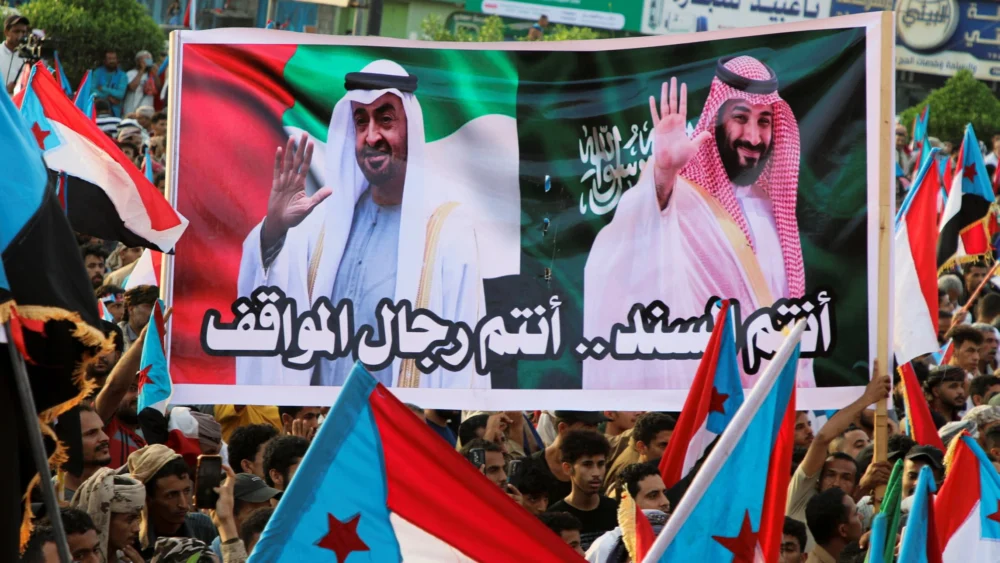
The reported military confrontation between Saudi-led forces and factions supported by the United Arab Emirates in Yemen marks a decisive and dangerous inflection point in the decade-long conflict, signaling that the once-solid partnership between the Arab world’s two largest economies has fundamentally fractured. While the war in Yemen began in 2015 as a unified intervention to restore the internationally recognized government and repel Houthi rebels, it has devolved into a complex proxy battleground where Riyadh and Abu Dhabi are now actively competing for long-term strategic dominance. This recent kinetic friction underscores a broader regional divorce, where the personal and political ambitions of Saudi Crown Prince Mohammed bin Salman and UAE President Sheikh Mohammed bin Zayed Al Nahyan are increasingly at odds over everything from oil production quotas to the future of global logistics hubs.
The immediate catalyst for this latest escalation involves the territorial control of southern Yemen, specifically the resource-rich and strategically positioned provinces that overlook the Bab el-Mandeb Strait. Saudi Arabia has recently accelerated the deployment of the "Nation Shield" forces—a military unit directly funded and trained by Riyadh—into areas previously considered the exclusive sphere of influence for the UAE-backed Southern Transitional Council (STC). This move is a transparent attempt by Saudi Arabia to curb the STC’s separatist ambitions and secure its own land bridge to the Indian Ocean, bypassing the volatile Strait of Hormuz. The resulting skirmishes represent more than just local tactical disagreements; they are the physical manifestation of a "Cold War" between two Gulf powers that are no longer aligned on the endgame of the Yemeni crisis.
From a macroeconomic perspective, the rift reflects a fierce competition for regional hegemony in a post-oil era. Saudi Arabia’s Vision 2030, a multi-trillion-dollar economic transformation plan, requires a stable and unified Yemen to ensure the success of the Kingdom’s massive Red Sea tourism and logistics projects. Conversely, the UAE’s strategy has focused on maritime dominance, securing a string of ports and naval bases from the Horn of Africa to the Gulf of Aden. For Abu Dhabi, a fragmented or independent South Yemen provides a unique opportunity to control the port of Aden and the island of Socotra, cementing DP World’s status as the premier global port operator. When Saudi interests favor a centralized Yemeni state and Emirati interests favor a decentralized or separatist South, military friction becomes an almost inevitable byproduct of their divergent economic blueprints.
The economic stakes are further heightened by the shifting dynamics within OPEC+. Over the past three years, the UAE has increasingly pushed for higher production baselines, arguing that its massive investments in oil infrastructure must be monetized before global demand peaks. Saudi Arabia, as the de facto leader of the cartel, has prioritized price stability and production cuts to fund its domestic "giga-projects," such as the $500 billion futuristic city, Neom. This tension in Vienna has bled into the sands of Yemen. When Riyadh perceives Abu Dhabi as an obstacle to its oil policy, it exerts pressure in the Yemeni theater; when the UAE feels sidelined in regional diplomacy, it doubles down on its support for southern Yemeni militias that challenge Saudi-backed authorities.
Expert analysis suggests that the Saudi-UAE relationship is moving from "strategic integration" to "transactional competition." In 2019, the UAE’s unilateral decision to withdraw the bulk of its conventional forces from Yemen without fully coordinating with Riyadh left the Saudi military to bear the brunt of the Houthi insurgency’s costs, which are estimated to exceed $5 billion per month at the height of the conflict. This perceived abandonment forced Saudi Arabia to open direct back-channel negotiations with the Houthis in Oman, a move that the UAE views with suspicion, fearing a deal that might empower Iranian-aligned groups at the expense of southern security.
The humanitarian and developmental cost of this internal Gulf rift is staggering. Yemen’s GDP has contracted by more than 50% since the start of the war, and the dual-track governance in the south—where the Saudi-backed Presidential Leadership Council (PLC) and the UAE-backed STC ostensibly share power—has led to a paralyzed bureaucracy. Currency fluctuations in the Yemeni rial are often driven by which Gulf patron is injecting liquidity into which faction’s central bank branch. While Saudi Arabia recently pledged a $1.2 billion grant to stabilize the PLC’s budget, the lack of coordination with the UAE means that these funds often act as a band-aid on a wound caused by political infighting rather than a catalyst for genuine recovery.
Global comparisons can be drawn to the historical "Great Game" of the 19th century, but with a modern, high-stakes financial twist. The rivalry is no longer just about territory; it is about who will be the gateway between East and West. Saudi Arabia’s "Regional Headquarters" program, which mandates that multinational corporations must move their Middle East hubs to Riyadh or risk losing lucrative government contracts, is a direct assault on Dubai’s long-standing status as the region’s commercial capital. As the UAE seeks to protect its trade-based economy, it views its influence in Yemen as a vital defensive flank to ensure that Saudi Arabia does not achieve a monopoly on Red Sea trade routes.
The security implications of this rift extend far beyond the borders of Yemen. The Red Sea is a vital artery for global trade, carrying approximately 12% of all international maritime traffic and 10% of the world’s seaborne oil. A destabilized southern Yemen, fueled by competition between its two primary benefactors, creates a power vacuum that extremist groups and non-state actors are eager to exploit. Furthermore, the lack of a unified Gulf front emboldens the Houthi rebels, who have successfully pivoted from a local insurgency to a regional actor capable of disrupting global shipping through targeted drone and missile strikes. By fighting amongst themselves, Riyadh and Abu Dhabi are inadvertently providing the Houthis with the leverage needed to demand even greater concessions in peace talks.
Washington’s role in this dynamic remains complicated. The United States has traditionally relied on the Saudi-UAE axis as a pillar of its Middle East policy. However, the Biden administration’s efforts to end the war in Yemen have been frustrated by the fact that there is no longer a single "coalition" to negotiate with. U.S. diplomats now find themselves in the awkward position of mediating between two of their closest security partners. While the U.S. shares Saudi Arabia’s goal of a unified Yemen to counter Iranian influence, it also values the UAE’s counter-terrorism cooperation in the southern provinces. The inability of the U.S. to bridge the gap between MBS and MBZ has created a diplomatic stalemate that favors China, which recently brokered a detente between Saudi Arabia and Iran, further complicating the regional calculus.
Looking ahead, the economic trajectory of the Gulf Cooperation Council (GCC) will be defined by whether these two giants can find a way to compete without causing systemic instability. The "Yemen model" of competition—using military proxies to secure economic assets—is a high-risk strategy that could eventually lead to a full decoupling of the Saudi and Emirati economies. If the current trend continues, the GCC could see a formalization of two distinct blocs: a Saudi-led northern tier and a UAE-led maritime tier. Such a division would fundamentally alter the flow of capital, the security of energy markets, and the geopolitical landscape of the Middle East for decades to come.
In conclusion, the strikes in Yemen are a symptom of a much deeper malaise in Gulf relations. What began as a joint venture to project power has turned into a zero-sum game where every gain for Riyadh is viewed as a loss for Abu Dhabi. As both nations race to diversify their economies and secure their legacies, Yemen has become the unfortunate laboratory for their competing visions. Without a high-level diplomatic intervention that addresses the underlying economic anxieties of both capitals, the rift will likely deepen, leaving Yemen fractured, the Red Sea volatile, and the dream of a unified Gulf leadership in tatters. The world must now watch closely, as the friction in the sands of Yemen could very well dictate the price of oil and the security of global trade routes for the foreseeable future.