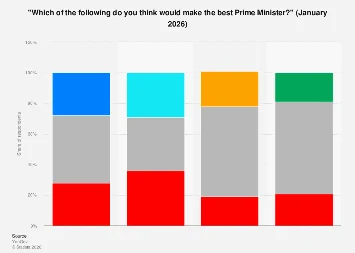
As the United Kingdom navigates the complex landscape of contemporary politics, public perception of its potential leaders remains a crucial barometer of the nation’s mood and future direction. A recent snapshot in January 2026 reveals a deeply divided electorate when presented with a hypothetical choice between the incumbent Prime Minister, Keir Starmer, and the Leader of the Opposition, Kemi Badenoch. Each garnered precisely 28 percent of public preference, signaling an even split in the perceived suitability for the nation’s highest office. This parity is significant, particularly when contrasted with broader electoral polling trends. While the Reform Party, under the leadership of Nigel Farage, has shown strength in recent election intention surveys, Starmer, despite this parliamentary positioning, still holds a discernible advantage when directly compared to Farage as a preferred Prime Minister, with 36 percent favoring Starmer versus 29 percent for Farage. This suggests that while tactical voting patterns or party allegiances might favor smaller parties in polls, the personal trust in Starmer’s leadership capabilities remains a more potent factor for a significant portion of the electorate.
The trajectory of Rishi Sunak’s premiership offers a stark illustration of the volatile nature of public opinion. Upon assuming office in late 2022, following the tumultuous resignation of Liz Truss, Sunak initially commanded a respectable 30 percent of public approval as the preferred candidate for Prime Minister, a mere four percentage points adrift of Keir Starmer at that juncture. However, the intervening twenty months, culminating in the run-up to the 2024 general election, witnessed a significant erosion of his standing. By the eve of that pivotal election, only 19 percent of the public considered Sunak the optimal choice for Prime Minister, a sharp decline from his initial figures and considerably lower than Starmer’s 35 percent. Despite a New Year’s 2023 pledge to tackle the nation’s most pressing issues, Sunak struggled to translate his policy pronouncements into tangible voter confidence. Although the inflationary pressures that peaked in 2022 began to recede throughout 2023, the pervasive cost of living crisis continued to cast a long shadow over households across the UK. Furthermore, progress in addressing the deeply ingrained challenges facing the National Health Service (NHS) proved elusive. These headwinds contributed to a decisive electoral defeat for the Conservative Party in the 2024 general election, with the party securing a mere 121 seats, a dramatic fall from the 365 seats won in the 2019 contest. This electoral outcome underscores the profound disconnect that had developed between the government’s performance and the public’s expectations.
The political landscape leading up to the 2024 election was also shaped by a series of significant scandals and economic missteps that severely undermined the credibility of previous administrations. Boris Johnson’s tenure as Prime Minister, which began in late 2019, was ultimately derailed by a succession of controversies that chipped away at his public support and precipitated his departure. The "Partygate" scandal, which exposed a pattern of social gatherings held at Downing Street during periods of strict COVID-19 lockdown, proved to be the most damaging episode. While Johnson initially weathered the political storm, including surviving a vote of no-confidence, a wave of resignations from senior ministers in early July 2022 proved to be the final straw, forcing his resignation. His successor, Liz Truss, who emerged victorious from the subsequent Conservative leadership contest, presided over the shortest premiership in British history. Her brief tenure was irrevocably marked by an unconventional fiscal policy approach, encapsulated in a "mini-budget," which triggered a severe economic crisis, leading to her resignation after less than 50 days in office. This period of instability and policy turbulence significantly eroded public trust in the Conservative Party’s ability to provide stable and effective governance, creating an environment ripe for electoral change.
The current political climate, as evidenced by the January 2026 polling, suggests a nation in search of decisive leadership and tangible solutions. The narrow split between Starmer and Badenoch highlights the electorate’s willingness to consider alternative leadership, but also their caution in fully committing to either. The ongoing economic challenges, from the lingering effects of the cost of living crisis to the broader global economic headwinds, continue to be central concerns for voters. Furthermore, the state of public services, particularly the NHS, remains a critical determinant of political success. The performance of any future government will undoubtedly be measured against its ability to deliver demonstrable improvements in these areas. The recent electoral history, marked by significant shifts in power and the rapid downfall of leaders, underscores the high stakes involved in navigating these complex policy challenges. As the political parties gear up for future electoral contests, the ability to connect with the concerns of the electorate, demonstrate a clear vision for the country, and deliver on promises will be paramount in securing and retaining public confidence. The statistical data points to a populace that is discerning, perhaps even weary, and actively evaluating which leader or party is best equipped to steer the United Kingdom through its current and future challenges. The continued focus on economic stability, public services, and ethical governance will likely remain at the forefront of public discourse, shaping the choices presented at the ballot box and the ultimate composition of the nation’s leadership.