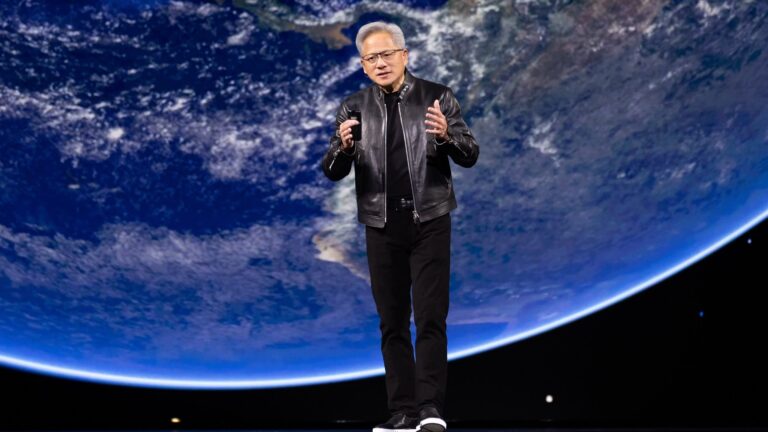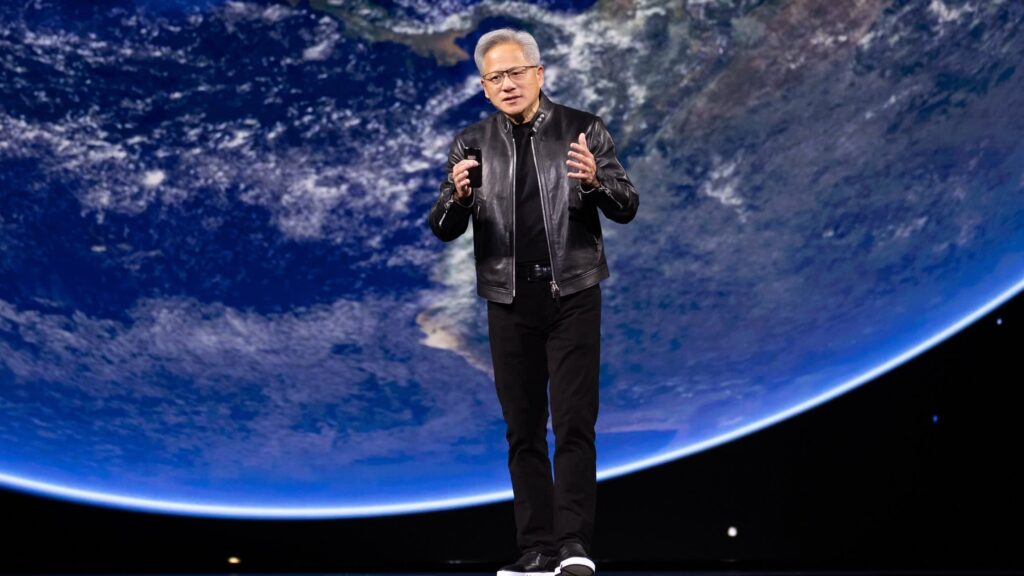



The global computing infrastructure is currently undergoing a tectonic shift, one that Nvidia CEO Jensen Huang predicts will catalyze a staggering $1 trillion in spending on data center hardware over the next two years. This forecast is not merely an optimistic projection from a market leader; it represents a fundamental re-evaluation of how the digital economy functions. As the world transitions from general-purpose computing to accelerated computing and generative artificial intelligence, the very architecture of the modern world is being rewritten. This transition marks the end of a sixty-year era dominated by the central processing unit (CPU) and the beginning of an age where the graphics processing unit (GPU) serves as the engine of global productivity.
At the heart of Huang’s $1 trillion thesis is the concept of "technological obsolescence." For decades, the global data center footprint—valued at approximately $1 trillion in installed base—has been built around CPUs. These processors were designed for sequential tasks, such as running spreadsheets, hosting websites, and managing databases. However, the emergence of Large Language Models (LLMs) and deep learning has rendered this traditional infrastructure inefficient. Accelerated computing, which uses parallel processing to handle massive datasets simultaneously, offers a leap in performance and energy efficiency that makes traditional methods look archaic. According to Huang, the existing trillion-dollar worth of data centers will need to be recycled and replaced with accelerated hardware to meet the insatiable demands of the AI era.
This massive capital expenditure cycle is already visible in the quarterly reports of the world’s largest technology companies, often referred to as "Hyperscalers." Microsoft, Alphabet, Meta, and Amazon have collectively signaled a dramatic increase in their capital expenditure (CapEx) budgets, with a significant portion earmarked for AI infrastructure. For instance, Meta has aggressively increased its spending to secure hundreds of thousands of Nvidia’s H100 and Blackwell-class chips, viewing the build-out as a defensive necessity as much as an offensive opportunity. The logic is clear: in a world where AI models are the primary drivers of user engagement, ad targeting, and cloud services, having the most robust compute capacity is a prerequisite for survival.
The economic implications of this $1 trillion shift extend far beyond Silicon Valley. We are witnessing the birth of "Sovereign AI," a movement where nation-states recognize that compute power is as vital to national security and economic prosperity as energy independence or food security. Countries like Singapore, Japan, France, and various nations in the Middle East are investing billions of dollars to build domestic AI clouds. Their goal is to ensure that their national data—be it in healthcare, finance, or culture—is processed on infrastructure they control, using models trained in their own languages and within their own legal frameworks. This diversification of the customer base from a few American tech giants to entire nations provides a resilient floor for the demand for high-end silicon.
However, the path to a trillion-dollar revenue cycle is not without its structural bottlenecks. The semiconductor supply chain is currently operating at the limits of physics and logistics. Nvidia’s reliance on Taiwan Semiconductor Manufacturing Company (TSMC) for its advanced chip fabrication and CoWoS (Chip on Wafer on Substrate) packaging underscores a critical geopolitical vulnerability. Furthermore, the performance of AI chips is increasingly dependent on High Bandwidth Memory (HBM), a specialized component produced by a handful of players like SK Hynix, Samsung, and Micron. The scarcity of these components has created a "supply-constrained" environment where demand continues to outstrip production capacity, leading to extended lead times and premium pricing.
From a market perspective, the scale of Huang’s prediction has ignited a debate among economists regarding the sustainability of the "AI bubble." Skeptics point to the dot-com era, where massive overinvestment in fiber-optic cables led to a market crash when the anticipated demand failed to materialize immediately. Yet, proponents of the current shift argue that the "return on investment" (ROI) for AI is already tangible. Unlike the early internet, where monetization models were speculative, AI is already driving cost savings in software development, drug discovery, and customer service. For a modern enterprise, the cost of an AI-driven inference task is orders of magnitude cheaper than the human labor it supplements or replaces, creating a powerful economic incentive for rapid adoption.
Nvidia’s dominance in this space is protected by a "moat" that is as much about software as it is about hardware. The CUDA (Compute Unified Device Architecture) platform, which Nvidia has spent two decades developing, is the industry standard for writing software that runs on GPUs. Millions of developers are trained in CUDA, and a vast ecosystem of libraries and tools has been built around it. While competitors like AMD with its Instinct line and Intel with its Gaudi accelerators are making strides, they face the monumental task of convincing developers to migrate away from an established, optimized ecosystem. Furthermore, the rise of custom silicon—such as Google’s TPUs or Amazon’s Trainium chips—poses a challenge, yet Nvidia’s rapid release cycle, moving from the Hopper architecture to Blackwell in record time, keeps the company a generation ahead of most internal efforts.
The macro-economic impact of this infrastructure boom is expected to ripple through global GDP. Goldman Sachs and other financial institutions have estimated that generative AI could eventually drive a 7% increase in global GDP (nearly $7 trillion) over a ten-year period by streamlining workflows and sparking innovation. If Nvidia’s $1 trillion revenue prediction holds true, it suggests that the "investment phase" of this economic transformation is accelerating much faster than previously anticipated. We are moving from a world of "retrieval-based" computing—where we ask a computer to find a file or a webpage—to "generative" computing, where the computer creates the solution, the code, or the design in real-time.
This transition also brings the issue of energy consumption to the forefront of the economic discussion. Data centers are notoriously power-hungry, and the shift to AI-intensive workloads threatens to strain global power grids. However, Huang argues that accelerated computing is actually an "environmental win." Because GPUs can complete tasks significantly faster than CPUs, they use less total energy to process the same amount of data. The "energy-efficient data center" is becoming a primary focus for developers, leading to innovations in liquid cooling and the co-location of data centers with renewable energy sources like nuclear or geothermal power.
As we look toward the next two years, the realization of a $1 trillion market for AI chips will depend on the continued evolution of the software layer. For the hardware cycle to sustain its momentum, businesses must move from the "experimentation" phase to the "deployment" phase of AI. This means moving beyond chatbots to autonomous agents that can execute complex business processes. If the software ecosystem can deliver on the promise of increased productivity, the demand for Nvidia’s silicon will likely remain insatiable.
In summary, Jensen Huang’s vision of a $1 trillion pivot is a bold claim that reflects a fundamental change in the nature of computation. It is a transition from a world where computers were tools for storage and calculation to one where they are engines of intelligence. This shift is attracting the largest concentration of capital in the history of the technology industry, involving not just corporations but sovereign nations. While supply chain constraints and energy requirements present significant hurdles, the sheer economic momentum of the AI revolution suggests that the data center of the future will look nothing like the data center of the past. Nvidia stands at the center of this transformation, acting as the primary architect of a new industrial era.