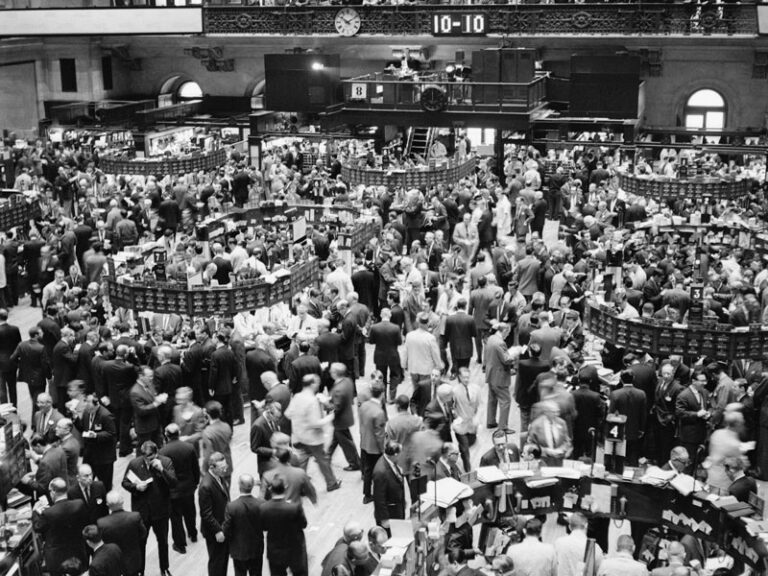


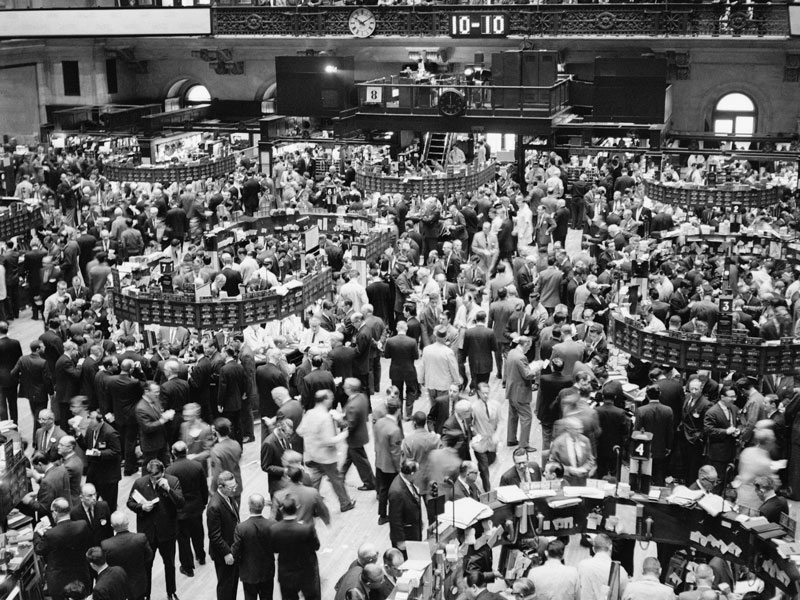
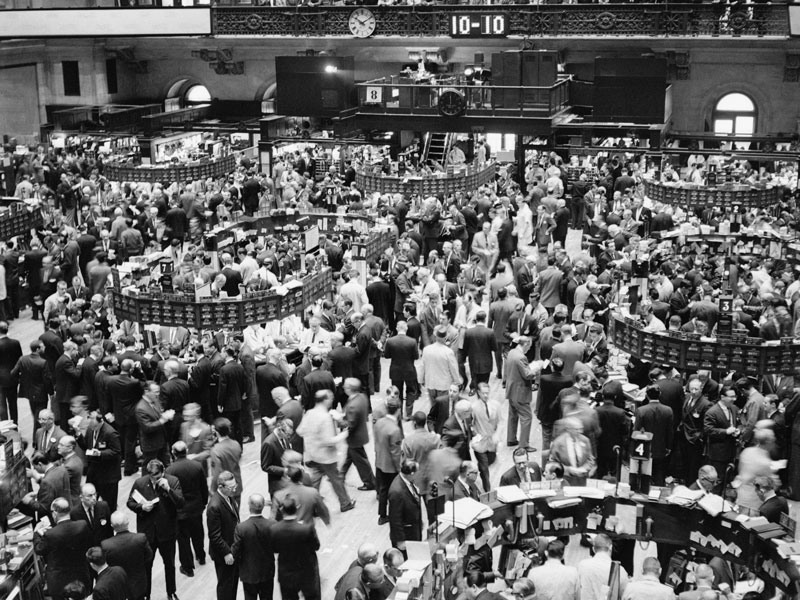
The trading floor of the New York Stock Exchange in 1966
The genesis of modern investment strategies can be traced back to a confluence of radical academic thinking, burgeoning technological capabilities, and a willingness to challenge deeply entrenched industry orthodoxies. A seminal period in the 1960s and early 1970s, primarily centered at the University of Chicago, witnessed a group of economists and finance scholars fundamentally alter the landscape of global financial markets. Their work not only redefined how investment professionals approached their craft but also profoundly influenced the financial planning and future outlook for countless individuals worldwide. This intellectual upheaval, captured in Errol Morris’s recent documentary "Tune Out the Noise," underscores how abstract theories, when rigorously tested and practically applied, can reshape entire industries.
For decades preceding this era, the prevailing wisdom in investing was rooted in intuition and the pursuit of exceptional stock-picking prowess. Markets were largely viewed as arenas where skilled professionals could exploit perceived inefficiencies, uncovering hidden gems or predicting market movements with uncanny accuracy. The notion of "beating the market" was the ultimate aspiration. However, this paradigm began to erode with the emergence of the Efficient Market Hypothesis (EMH), a groundbreaking concept co-developed by Nobel laureate Eugene Fama. The EMH posited that asset prices, in an efficient market, already incorporate all available information, rendering the idea of consistently outperforming the market through active stock selection a futile endeavor. According to this theory, price fluctuations are primarily driven by the arrival of new, unanticipated information. Consequently, success in investing shifts from speculative foresight to a disciplined approach emphasizing diversification and robust risk management.
This intellectual shift coincided with a critical technological advancement: the computational revolution of the 1960s. The advent of computers provided investors with the unprecedented ability to process vast quantities of stock prices and company data, enabling a more scientific and analytical approach to market assessment. Intuition gradually ceded ground to data-driven strategies, laying the foundational principles for passive investing. As Fama articulated, "Markets work; prices are right." This perspective suggests that while outperforming the market consistently is improbable, an investor can achieve market-aligned returns by embracing the market’s overall performance rather than attempting to outmaneuver it.
Aaron Brask, a seasoned Wall Street professional and finance educator at the University of Florida, corroborates the heightened efficiency of contemporary markets. "Markets were not nearly as efficient when Eugene Fama published his foundational research in the 1960s," Brask observes. "If they had been, it would imply that legendary investors like Warren Buffett, Charlie Munger, Walter Schloss, Philip Fisher, and Seth Klarman were simply fortunate. Fast forward sixty years, and we now have an immense concentration of capital, intellectual talent, and computational power dedicated to identifying investment opportunities. This significantly intensifies the challenge of outperforming the market. The pool of less informed capital has diminished, and markets are demonstrably more efficient."
Fama’s revolutionary ideas paved the way for the widespread adoption of passive investment strategies, leading to the development of the index fund. These funds, driven by data and algorithms rather than speculative hunches, have become a cornerstone of modern portfolio construction. Wells Fargo pioneered the first index fund in 1971, and John Bogle, a visionary in low-cost investing, launched the first index mutual fund accessible to individual investors in 1976. While the argument for passive investing remains compelling for the majority of investors, Brask acknowledges that a select group of active managers can still achieve market-beating returns. "Buffett and other value investors meticulously estimate a stock’s intrinsic value based on its fundamental financial health," Brask explains. "They then compare this intrinsic value to its current market price. This value investing approach essentially involves acquiring stocks at a significant discount to their perceived worth. In certain instances, superior fundamental quality or growth prospects can justify higher valuations."
A particularly enduring contribution from the University of Chicago’s research was the profound emphasis on diversification. Departing from the traditional focus on identifying a single high-conviction investment for substantial gains, the Chicago scholars advocated for a strategy of spreading risk across a broad array of assets. Their research demonstrated that combining stocks from established, stable companies with those of smaller, high-growth potential firms could effectively reduce portfolio volatility without necessarily sacrificing returns. This principle became a cornerstone of Modern Portfolio Theory (MPT), a fundamental framework in contemporary finance. Among the early proponents of MPT were David Booth and Rex Sinquefield, who went on to establish Dimensional Fund Advisors, an investment firm that successfully translated the EMH into a highly effective investment vehicle.
Booth is a prominent figure in Morris’s documentary, which, at times, can be perceived as a subtle endorsement of Dimensional, one of its financial backers. However, the Oscar-winning filmmaker, Errol Morris, navigates the subject matter with his characteristic nuance. His interview style, characterized by disarmingly simple yet insightful questions, allows the narrative of finance’s evolution from intuition to evidence-based decision-making to unfold organically. "The film effectively highlights the human element," notes Matthew Garrott, Director of Investment Research at Fairway Wealth Management. "The academics featured are presented as humble and relatable. It was invaluable to hear these titans of finance discuss their work in their own words."
The film also underscores the significant role of chance and randomness in shaping financial markets. These complex systems are often influenced by unpredictable events rather than purely rational actions. The serendipitous convergence of brilliant minds at the University of Chicago, who spearheaded the passive investment revolution, is also a recurring theme. The establishment of the Center for Research in Security Prices (CRSP) by economist James Lorie in 1960 was a pivotal moment, marking the confluence of financial innovation and technological advancement, and providing an invaluable repository of historical stock and bond data for researchers.
Chance also played a role in the personal trajectories of key figures. Eugene Fama’s academic path at the University of Chicago was nearly derailed, with a last-minute scholarship ultimately altering his career trajectory. Myron Scholes, another distinguished Chicago alumnus and Nobel laureate, and an early advocate for computerized trading, found his way into deciphering financial data somewhat serendipitously. In 1963, he accepted a programming role with limited prior experience. When the other six programmers failed to materialize, Scholes was tasked with assisting academics in their financial research, a fortunate turn of events that set his professional journey in motion.
The partnership between David Booth and Rex Sinquefield exemplifies the translation of academic theory into practical application through their founding of Dimensional Fund Advisors. In 1969, Booth narrowly avoided military conscription in Vietnam due to a deferment granted by a sympathetic officer, allowing him to pursue his Ph.D. at the University of Chicago. Sinquefield, who served in the army, was spared combat duty due to poor eyesight. Today, Dimensional manages nearly $800 billion in assets, and the University of Chicago’s esteemed business school bears Booth’s name.
Despite the profound impact of these theories, their unintended consequences are also a subject of discussion. Critics argue that the very principles that democratized investing may have also contributed to market excesses. The EMH, while elegant, has been accused of fostering an overreliance on market infallibility, potentially leading investors and regulators to underestimate the risks associated with asset bubbles and the necessity of robust oversight. Some argue that the pervasive success of passive investing has paradoxically begun to undermine market efficiency, as a shrinking pool of active participants is left to inject new information into asset prices.
Proponents, however, maintain the enduring validity of the EMH. Robert Jarrow, an advisor at SAS and Professor of Investment Management at Cornell University, contends, "Numerous skilled traders exist, and behavioral biases are not more or less prevalent than in the past. Consequently, the impact of irrational traders on market efficiency remains constant. It can also be demonstrated that asset bubbles are not inconsistent with an efficient market. Markets exist on a spectrum from less efficient to more efficient. Markets with a higher frequency of price discovery, such as U.S. large-cap stocks, tend to be more efficient. Conversely, the market for selling a house is considerably less efficient. While the U.S. stock market is not perfectly efficient, it is sufficiently efficient to place active managers at a significant disadvantage," notes Garrott.
Even the mathematical models underpinning investment strategies have faced scrutiny. The Black-Scholes model, a seminal contribution by Scholes, provided a sophisticated framework for risk management and portfolio diversification. While a theoretical triumph, it also became a justification for a surge in speculative trading in derivatives. Originally conceived as hedging instruments, derivatives evolved into highly leveraged bets, contributing to market instability and culminating in the 2008 financial crisis. As one observer noted at the time, the model became "an ingredient in a rich stew of financial irresponsibility, political ineptitude, perverse incentives, and lax regulation."
Ultimately, "Tune Out the Noise" transcends a mere discussion of financial mechanics. It presents a compelling portrait of an America capable of self-examination, a quality that some believe is diminishing. The embrace of passive investing, with its acceptance of average returns, challenges what Rex Sinquefield wryly observes as the traditional "American way" of striving for exceptional individual success. David Booth’s personal narrative further illustrates this tension. A former shoe salesman, he recounts in the film a desire "to feel good about myself" at the end of the day. His words evoke a bygone era of American values prizing diligence, integrity, and modest achievement, now seemingly overshadowed by the speculative allure of cryptocurrencies and the pursuit of rapid wealth accumulation.
At its core, the film explores the nature of information itself: the deluge of data, the promise of efficiency, and the perennial human challenge of discerning signal from noise. The EMH is predicated on the belief that data is objective and truthful. However, in an era dominated by algorithmic trading, this certainty feels increasingly fragile. Markets now operate at machine speed, and the rise of artificial intelligence systems poses an existential threat to traditional active management. "Tune Out the Noise" leaves audiences with a lingering reflection: even the most ostensibly rational systems are ultimately built upon human assumptions, and the next paradigm shift in investment may involve a rediscovery of human judgment.