


The financial services industry is on the cusp of a profound transformation, driven by the accelerating adoption of artificial intelligence (AI). Within this rapidly evolving landscape, "agentic AI"—systems capable of autonomous decision-making and complex task execution—is emerging as a particularly disruptive force. A recent survey of global financial institutions, conducted in the third quarter of 2025, reveals a significant strategic focus on leveraging agentic AI, with portfolio management identified as a key area for its application in the coming years. This forward-looking perspective suggests a seismic shift in how investment firms will operate, from the front office client interactions to the intricate back-office operations.
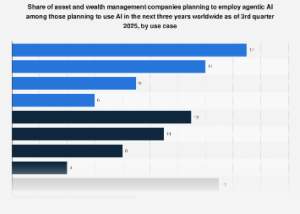
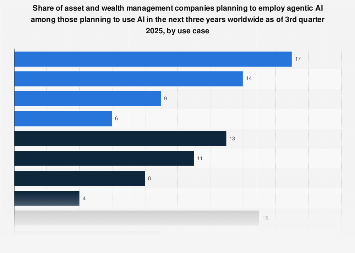
The survey data, which polled 500 wealth and asset management executives across major investment markets, indicates that agentic AI is set to play a pivotal role in portfolio management. While specific percentages remain proprietary for deeper access, the research points to portfolio management as the leading use case for agentic AI among firms planning to integrate AI technologies within the next three years. This points towards a future where AI-powered agents will not merely assist human managers but will actively and autonomously construct, monitor, and rebalance investment portfolios, potentially leading to enhanced efficiency, greater customization, and more dynamic risk management.
Beyond portfolio management, the survey highlights the breadth of agentic AI’s potential impact across various financial functions. Trade processing and reconciliation are identified as the second most anticipated use case for agentic AI, signaling a move towards automating complex, data-intensive back-office tasks. This suggests a future where AI agents will meticulously track trades, reconcile discrepancies, and ensure compliance with regulatory frameworks, thereby reducing operational risks and freeing up human capital for more strategic endeavors. The implications for efficiency and accuracy are substantial, potentially leading to significant cost savings and a more streamlined operational environment.
The strategic allocation of agentic AI resources is expected to span the entire financial value chain, encompassing front, middle, and back-office operations. In the front office, agentic AI could revolutionize client advisory services, offering hyper-personalized investment recommendations, real-time market insights, and proactive client engagement. Imagine AI agents acting as sophisticated financial advisors, understanding individual client risk appetites, financial goals, and market sentiments to provide bespoke solutions. This could democratize access to sophisticated financial advice, typically reserved for high-net-worth individuals.
The middle office, responsible for risk management, compliance, and performance analysis, is also poised for significant AI-driven enhancements. Agentic AI could be deployed to conduct sophisticated scenario analyses, identify emerging risks with unprecedented speed, and automate compliance checks, ensuring adherence to a complex and ever-changing regulatory landscape. This proactive approach to risk and compliance could mitigate potential financial losses and enhance the overall stability of investment firms. Furthermore, AI agents could provide granular performance attribution and insights, enabling fund managers to make more informed decisions.
In the back office, the impact of agentic AI is expected to be equally profound, particularly in areas like settlement, clearing, and regulatory reporting. The automation of these often labor-intensive and error-prone processes could lead to substantial operational efficiencies, reduced costs, and a significant decrease in the incidence of human error. This streamlining of back-office functions is crucial for maintaining competitiveness in an increasingly demanding financial environment.
The projected timeline for these advancements, with a strong emphasis on the period between 2025 and 2028, suggests that the financial industry is not merely exploring AI but is actively planning its integration into core operational strategies. This rapid adoption pace is driven by several factors, including the relentless pursuit of competitive advantage, the need to manage increasing volumes of data, and the growing demand for personalized and efficient financial services. The increasing sophistication of AI algorithms, coupled with advancements in computing power and data availability, has created a fertile ground for agentic AI to flourish.
Globally, the adoption of agentic AI is likely to vary based on regulatory environments, technological infrastructure, and the competitive intensity within different financial markets. Developed economies with mature financial sectors and a strong technological base are expected to lead the charge in adopting these advanced AI solutions. However, emerging markets are also likely to embrace agentic AI as a means to leapfrog traditional development stages and enhance their financial capabilities. The potential for agentic AI to level the playing field by providing sophisticated tools and insights to a wider range of market participants is significant.
The economic implications of widespread agentic AI adoption in investment firms are multifaceted. On one hand, it promises substantial productivity gains, cost reductions, and the creation of new, high-skilled jobs related to AI development, deployment, and oversight. On the other hand, there are legitimate concerns about job displacement in roles that are susceptible to automation. Financial institutions will need to strategically manage this transition, investing in reskilling and upskilling their workforce to adapt to the evolving demands of an AI-augmented financial ecosystem.
Expert insights suggest that the key to successful agentic AI implementation lies in a phased approach, starting with clearly defined use cases and robust testing protocols. The integration of AI into financial decision-making processes requires a deep understanding of not only the technology but also the underlying financial principles and ethical considerations. Building trust in AI systems will be paramount, necessitating transparency in their operations and clear accountability frameworks. The "black box" nature of some AI models remains a challenge, and ongoing research is focused on developing more interpretable and explainable AI (XAI) solutions.
The long-term vision for agentic AI in finance extends beyond mere automation. It envisions a future where AI agents collaborate with human professionals, augmenting their capabilities and enabling them to focus on higher-value, strategic tasks. This symbiotic relationship between humans and AI could unlock new levels of innovation, efficiency, and client satisfaction within the investment management sector. As firms gear up for this AI-driven future, strategic planning, investment in talent, and a commitment to ethical AI deployment will be critical determinants of success. The period leading up to 2028 is likely to be a defining era for agentic AI’s impact on the global financial landscape, reshaping the very fabric of investment management.