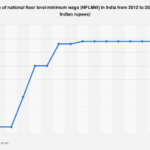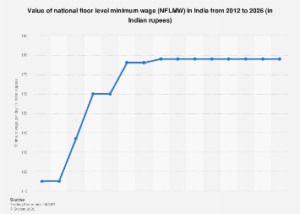


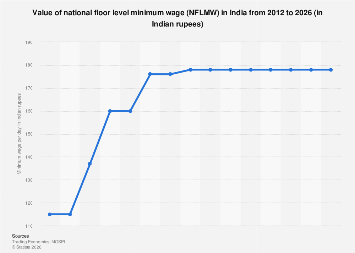
The national floor level minimum wage in India, a critical benchmark set by the central government below which no state can legally mandate lower wages, has remained unchanged for several years, reportedly standing at a nominal figure in Indian Rupees per day, according to available data. This static figure, established in 1996, has become a focal point of economic discussion, particularly as the nation grapples with evolving labor market dynamics and a stated ambition to transition towards a more comprehensive living wage system. The National Floor Level Minimum Wage (NFLMW) serves as a foundational safety net, intended to prevent exploitation by ensuring a baseline compensation for all workers. However, its prolonged stagnation raises pertinent questions about its effectiveness in reflecting the current economic realities faced by a vast segment of the Indian workforce.
The Ministry of Labour and Employment is constitutionally mandated to review and revise the NFLMW every two years. However, the last official revision appears to have occurred several years ago, leading to a significant disconnect between the statutory floor and the escalating cost of living across the country. This inertia in policy adjustment has drawn criticism from economists and labor rights advocates alike. They argue that the unrevised NFLMW disproportionately impacts workers in sectors historically characterized by lower wages and higher proportions of female employment. Industries such as bidi manufacturing, agricultural plantations, and other informal agricultural and artisanal trades, which often fall under the purview of state-level minimum wage notifications that are capped by the NFLMW, are particularly susceptible to this effect. The absence of periodic upward adjustments means that the real purchasing power of the minimum wage erodes over time, rendering it increasingly inadequate for a decent standard of living.
The gap between the concept of a minimum wage and a living wage has become increasingly pronounced in the Indian context. While the minimum wage is legally defined as the lowest remuneration an employer is required to pay for work performed, a living wage, as defined by international bodies like the International Labour Organization (ILO), represents a more aspirational and comprehensive benchmark. A living wage is understood as the income level necessary for a worker to afford a safe and decent standard of living for themselves and their family, encompassing not just basic necessities like food and shelter, but also healthcare, education, and modest savings, all within the specific socio-economic context of a given country. India’s commitment, announced in recent years, to transition from its current minimum wage regime to a living wage system by 2025, underscores a significant policy shift. This ambitious undertaking aims to provide a more robust economic foundation for millions of citizens, particularly those engaged in the unorganized sector, which comprises a substantial portion of India’s labor force and often operates with less regulatory oversight.
The International Labour Organization has been consulted to assist in developing a robust framework for this transition. This collaboration is crucial for establishing scientifically sound methodologies to calculate a living wage that is relevant to diverse regional economic conditions across India. The objective is to move beyond a purely statutory minimum to a wage that genuinely enables workers to meet their essential needs and participate more fully in the economy. Such a transition has the potential to significantly alleviate poverty, improve health and educational outcomes, and boost overall domestic consumption, thereby contributing to more sustainable and inclusive economic growth.
The economic implications of a stagnant national minimum wage are multifaceted. For businesses, particularly small and medium-sized enterprises (SMEs), a prolonged period without an increase might offer short-term cost advantages. However, this can also lead to reduced employee morale, lower productivity, and higher employee turnover, ultimately impacting long-term competitiveness. Furthermore, a wage floor that fails to keep pace with inflation and cost of living increases can exacerbate income inequality, as low-wage earners struggle to maintain their purchasing power. This can suppress aggregate demand, as a significant portion of the population has limited disposable income, hindering the growth of domestic markets.
Conversely, the proposed shift to a living wage, while potentially posing initial adjustment challenges for some employers, is widely expected to yield substantial long-term economic benefits. Increased disposable income among a larger segment of the population can stimulate demand for goods and services, creating a virtuous cycle of economic growth. Studies on living wage implementation in other developing economies have demonstrated positive impacts on worker productivity, health, and educational attainment, leading to a more skilled and motivated workforce. The focus on the unorganized sector is particularly vital, as a significant portion of India’s labor force operates in this segment, often characterized by precarious employment and inadequate social protection. Ensuring a living wage for these workers can formalize labor practices, improve working conditions, and enhance overall economic security.
Global comparisons offer valuable insights into the impact of minimum wage policies. Many developed nations regularly adjust their minimum wages to reflect inflation and economic growth, often through automatic indexation mechanisms. For instance, countries in the European Union have various national minimum wage systems, with regular reviews and adjustments based on economic indicators. The United States also has a federal minimum wage, though many states and cities have set their own higher minimums. The experience of these economies suggests that while adjustments can be a subject of debate, a regular recalibration process is essential for maintaining the relevance and efficacy of minimum wage policies. The prolonged freeze on India’s NFLMW stands in contrast to these more dynamic approaches, highlighting a need for greater policy responsiveness.
The challenge for India lies in the practical implementation of a living wage. Calculating a universally applicable living wage across a country as diverse as India, with significant regional disparities in cost of living, income levels, and economic development, is a complex task. It requires sophisticated data collection and analysis, robust stakeholder consultation involving employers, employees, and government bodies, and a clear mechanism for regular updates. The success of this transition will hinge on the government’s ability to develop a framework that is both economically sustainable and socially equitable, ensuring that it genuinely lifts workers out of poverty without stifling business growth. The engagement with the ILO is a positive step, leveraging international expertise to navigate these complexities.
The current situation underscores the critical need for a more dynamic and responsive approach to minimum wage policy in India. While the aspiration to move towards a living wage by 2025 is commendable, the immediate concern is the continued stagnation of the national floor. Addressing this immediate issue through timely revisions of the NFLMW, even as the longer-term living wage framework is developed, would provide much-needed relief to low-wage earners and help mitigate the growing disconnect between statutory wages and the cost of living. The economic well-being of millions of Indian workers, especially those in vulnerable sectors, depends on a proactive and adaptable labor policy that aligns with the evolving economic landscape.