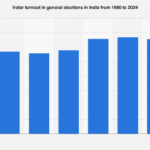
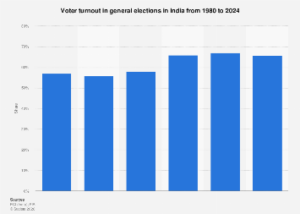


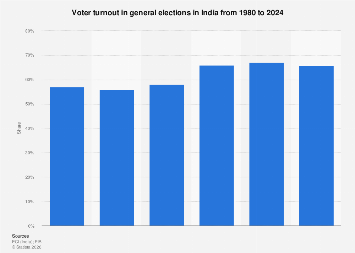
India’s 2024 general election, a colossal undertaking involving the world’s largest democracy, saw a significant voter turnout, continuing a trend of robust civic engagement that has characterized the nation’s electoral history. While the precise final percentage is subject to ongoing tabulation and verification, preliminary figures indicate a participation rate that, while substantial, represents a marginal dip from the record-breaking figures observed in the previous 2019 general election. This slight decrease, however, should not overshadow the sheer scale of democratic participation, with an estimated electorate exceeding 960 million individuals eligible to cast their ballots across the vast and diverse nation.
The electoral landscape of India has witnessed a remarkable evolution in voter turnout since the early 1980s. In 1980, participation stood at approximately 57 percent. Over the subsequent decades, this figure has seen a consistent upward trajectory, punctuated by significant leaps. The 2019 general election marked a watershed moment, achieving the highest-ever recorded turnout, a testament to increased political awareness, improved electoral infrastructure, and a heightened sense of democratic responsibility among the Indian populace. The 2024 election, therefore, is being analyzed not just as a singular event but as part of this ongoing narrative of democratic consolidation and active citizenry.
Understanding the nuances of voter turnout in India requires a multi-faceted approach, considering demographic, geographic, and socio-economic factors. While national averages provide a broad overview, turnout often varies considerably between urban and rural constituencies, and across different states and regions, each with its unique political dynamics and historical voting patterns. For instance, states like West Bengal and Kerala have historically reported very high turnouts, often exceeding 80 percent, driven by deeply entrenched political cultures and active civil society engagement. Conversely, certain areas, particularly those facing security challenges or with dispersed populations, may exhibit lower participation rates.
The sheer logistical challenge of conducting elections in India is unparalleled. The Election Commission of India (ECI) deploys millions of polling officials, secures millions of electronic voting machines (EVMs), and establishes hundreds of thousands of polling stations, many of which are in remote or challenging terrains. The efficiency and integrity of this massive operation are crucial for maintaining public trust in the democratic process. The ECI’s efforts to enhance voter accessibility, including measures to facilitate the participation of senior citizens, persons with disabilities, and those working away from their registered constituencies, play a vital role in boosting overall turnout.
The economic implications of high voter turnout are manifold. A robust electoral process, reflecting broad-based participation, contributes to political stability and policy predictability, which are essential for attracting domestic and foreign investment. When citizens actively participate in choosing their representatives, it fosters a sense of ownership and accountability, potentially leading to governance that is more responsive to public needs. This, in turn, can drive economic growth through more effective policy implementation in areas such as infrastructure development, education, healthcare, and social welfare programs.
Furthermore, the electoral process itself generates economic activity. The campaigns involve significant expenditure by political parties and candidates, stimulating demand for advertising, event management, transportation, and other services. The ECI’s operational needs also create employment opportunities, albeit temporary, for election officials, security personnel, and support staff.
Economists often view high voter turnout as an indicator of a healthy democracy, which is intrinsically linked to economic development. Countries with strong democratic institutions and high levels of citizen participation tend to exhibit more equitable income distribution and a greater focus on human capital development. This is because elected governments, facing the prospect of re-election, are incentivized to address the concerns of a broad electorate, including social upliftment and economic empowerment.
However, the marginal decline in turnout compared to 2019 warrants closer examination. Factors such as voter fatigue, the intensity of local political rivalries, weather conditions on polling days, and the perceived impact of specific candidates or issues can all play a role. In a country where elections are a continuous cycle, with state-level elections occurring between general polls, maintaining sustained voter enthusiasm can be a challenge.
The global context also provides valuable insights. While India stands out for its sheer scale, many established democracies grapple with declining voter turnout. Countries like the United States have seen fluctuations, with turnout in presidential elections often ranging between 50-60 percent, and mid-term elections typically seeing lower participation. European nations, while generally maintaining higher turnouts than the US, also face concerns about disengagement among certain segments of the population. This highlights that the challenges of maintaining high civic participation are not unique to India but are a shared concern for democracies worldwide.
The future trajectory of voter turnout in India will likely be shaped by several factors. Continued efforts by the ECI to leverage technology for voter registration and information dissemination, alongside sustained political education campaigns by civil society organizations and political parties, will be crucial. The ability of political discourse to engage a diverse electorate on substantive policy issues, rather than solely on identity politics, will also be a key determinant.
Moreover, the perceived responsiveness of governance to citizens’ concerns is paramount. When voters feel that their participation genuinely influences policy outcomes and improves their quality of life, their motivation to vote is likely to be sustained or even enhanced. This creates a virtuous cycle where democratic engagement reinforces democratic outcomes.
In conclusion, while the precise figures for India’s 2024 general election turnout are still being finalized, the event underscores the nation’s enduring commitment to its democratic framework. The sustained high levels of participation, even with a slight dip from previous records, reflect a mature electorate actively shaping its political destiny. The economic ramifications of this democratic vitality are significant, fostering stability, predictability, and a governance framework that is, by design, accountable to the will of the people. As India continues its journey of economic development and democratic deepening, the role of an engaged and active citizenry remains central to its progress and prosperity on the global stage.