

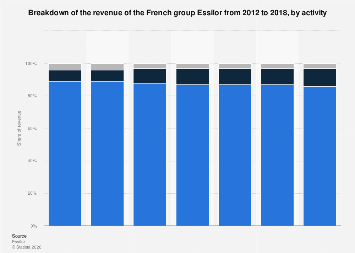
The global eyewear market, a dynamic and ever-evolving sector, has witnessed significant shifts in its revenue landscape over the past decade. For Essilor International, a dominant force in the industry and now a key component of the EssilorLuxottica conglomerate, understanding the granular breakdown of its income across various business segments is crucial for strategic planning and market positioning. A detailed examination of Essilor’s revenue share by sector between 2012 and 2018 reveals key trends, highlighting areas of growth, potential challenges, and the underlying drivers of its commercial success. This period predates the full integration of Essilor with Luxottica, offering a distinct perspective on Essilor’s standalone performance and strategic priorities before the monumental merger.
During the 2012-2018 timeframe, Essilor’s revenue streams were primarily categorized by its core product offerings and market segments. The company’s operations can broadly be divided into several key areas: lenses and optical equipment, frames and sunglasses (though less dominant for Essilor compared to Luxottica historically), and distribution and services. While specific, publicly available year-by-year percentage breakdowns for every single sub-sector are proprietary, the observable trends and reported segment performances provide substantial insight.
The largest and most consistently dominant contributor to Essilor’s revenue has historically been its lenses and related optical equipment division. This encompasses a vast array of products, from basic prescription lenses to advanced, high-performance ophthalmic lenses, including progressive lenses, anti-reflective coatings, and specialty lenses for specific visual needs like myopia control or blue light filtering. Within this broad category, the market for prescription lenses is intrinsically tied to global demographic trends, the increasing prevalence of refractive errors, and growing awareness about eye health. As populations age and digital device usage escalates, the demand for corrective and protective eyewear has seen a steady, upward trajectory. Essilor’s extensive research and development capabilities, coupled with a robust global manufacturing and distribution network, allowed it to capture a significant share of this expanding market. The company’s innovation in lens technology, such as the introduction of thinner, lighter, and more visually comfortable lenses, played a pivotal role in maintaining its market leadership and commanding premium pricing.
A significant portion of Essilor’s revenue also stemmed from its prescription lens manufacturing and wholesale operations. This segment involves supplying lenses to independent opticians, optical chains, and other eye care professionals. The company’s ability to offer a wide range of lens designs, materials, and treatments, coupled with efficient logistics and strong customer relationships, cemented its position as a preferred supplier. The consistent demand for prescription eyewear, driven by an aging global population and increased diagnosis rates for vision impairments, provided a stable and substantial revenue base for Essilor during this period.
Beyond standard prescription lenses, Essilor also invested heavily in the sun lens market. While Luxottica is more synonymous with branded fashion eyewear, Essilor’s involvement in sun lenses, particularly through its subsidiary Sun Solution, focused on high-quality, performance-oriented lenses for both prescription and non-prescription sunglasses. This segment benefited from growing consumer interest in fashion eyewear and the increasing recognition of UV protection’s importance for eye health. The outdoor lifestyle trend and the aesthetic appeal of sunglasses contributed to the sustained growth of this revenue stream.
Another critical, albeit sometimes less visible, revenue generator for Essilor was its equipment and services division. This includes the manufacturing and sale of lens-making equipment, diagnostic instruments for eye care professionals, and related services such as training and technical support. This segment is vital as it underpins the entire optical ecosystem, enabling laboratories and opticians to produce and fit Essilor’s lenses efficiently and accurately. The adoption of advanced digital surfacing technologies and automated manufacturing processes by optical labs worldwide created a sustained demand for Essilor’s cutting-edge equipment, thereby generating recurring revenue and fostering strong partnerships within the industry.
The period from 2012 to 2018 also saw Essilor actively expanding its distribution and retail presence, albeit through various models. While not directly manufacturing frames in the same way as Luxottica, Essilor often partnered with frame manufacturers or acquired retail optical chains in specific markets to ensure its lenses reached end consumers effectively. Acquisitions of regional optical chains or wholesale distributors played a strategic role in broadening Essilor’s market reach and securing direct access to consumers, thereby capturing a greater share of the value chain. These strategic moves allowed the company to influence lens selection at the point of sale and gain valuable consumer insights.
Globally, the eyewear market is characterized by significant regional variations in purchasing power, healthcare infrastructure, and consumer preferences. Developed markets in North America and Europe have historically represented the largest share of revenue due to higher disposable incomes, greater awareness of eye health, and established optical retail networks. However, emerging markets in Asia, Latin America, and Africa presented the most significant growth opportunities. Essilor’s strategy during this period involved a dual approach: consolidating its leading position in mature markets through innovation and premium offerings, while simultaneously investing in expanding its footprint and accessibility in high-growth emerging economies. This often involved adapting product portfolios and pricing strategies to suit local market conditions and developing partnerships with local distributors and healthcare providers.
Looking at the broader economic context, the period between 2012 and 2018 was marked by a gradual global economic recovery following the 2008 financial crisis. This recovery, though uneven, generally supported consumer spending on non-essential goods and services, including eyewear. Factors such as increasing disposable incomes, particularly in emerging economies, and a growing emphasis on personal well-being and appearance, contributed to a favorable market environment for the eyewear industry. Furthermore, heightened awareness of the importance of regular eye examinations, driven by public health campaigns and the increasing incidence of age-related eye conditions, further bolstered demand for ophthalmic lenses and related products.
Expert analysis of the eyewear sector during this time consistently pointed to several key drivers of growth. The increasing adoption of digital technologies, leading to prolonged screen time, has been a significant factor contributing to visual fatigue and the need for vision correction. Essilor’s focus on developing blue light filtering lenses and ergonomic lens designs directly addressed these emerging consumer needs. Moreover, the demographic shift towards an aging global population meant a larger cohort of individuals requiring corrective lenses for presbyopia and other age-related vision issues. Essilor’s comprehensive range of progressive and multifocal lenses catered directly to this demographic.
The competitive landscape within the eyewear industry remained intense, with Essilor facing competition from other major lens manufacturers, smaller regional players, and, increasingly, direct-to-consumer online retailers. However, Essilor’s significant investment in R&D, its strong brand equity, and its extensive distribution network provided formidable competitive advantages. The company’s strategic acquisitions also played a crucial role in consolidating market share and expanding its technological capabilities.
In summary, Essilor’s revenue structure between 2012 and 2018 was predominantly driven by its core business of ophthalmic lenses and optical equipment. The company successfully leveraged global demographic trends, technological advancements, and increasing consumer awareness of eye health to maintain its market leadership. While the precise percentage share of each sub-sector remains proprietary, the overarching narrative is one of consistent growth and strategic expansion, particularly in the high-margin prescription lens market, supported by investments in innovation and a robust global distribution strategy. This period laid a strong foundation for the company’s subsequent integration into EssilorLuxottica, a merger that aimed to create an unparalleled powerhouse across the entire eyewear value chain.