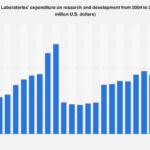
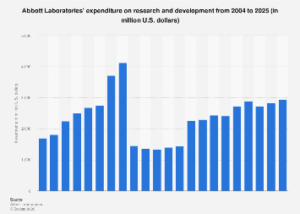

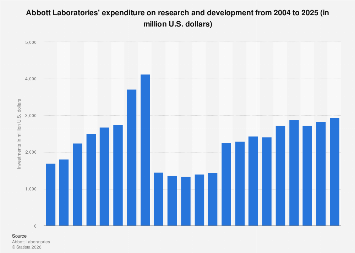
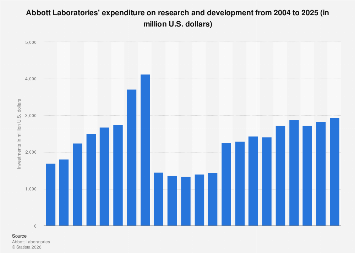
Abbott Laboratories, a stalwart in the global healthcare landscape, has consistently channeled significant resources into research and development, a cornerstone of its strategy for sustained growth and market leadership. From 2004 through projected figures for 2025, the company’s R&D expenditures paint a compelling picture of its dedication to advancing medical devices and diagnostics, nutritionals, and established pharmaceuticals. While specific figures for the most recent years remain proprietary, the historical trajectory and strategic intent underscore a commitment to innovation that is vital in the rapidly evolving healthcare sector.
The period under review, spanning over two decades, encompasses a pivotal transformation for Abbott. In January 2013, a strategic separation occurred, dividing the company into two distinct entities: Abbott Laboratories, focusing on its core medical product portfolio, and AbbVie, which inherited the research-based pharmaceutical operations. This restructuring means that the R&D figures from 2013 onwards for Abbott Laboratories specifically reflect investments in its medical device, diagnostic, and nutritional segments, rather than the broader scope that included pharmaceuticals prior to the split. This distinction is crucial for understanding the evolving focus and investment patterns of the Abbott entity that has continued to drive innovation in its specialized domains.
The healthcare industry is characterized by relentless innovation, driven by unmet medical needs, technological advancements, and evolving patient demographics. Companies like Abbott operate within this dynamic ecosystem, where substantial R&D investment is not merely an operational expense but a strategic imperative. The success of new product development, the enhancement of existing technologies, and the pursuit of novel therapeutic approaches all hinge on a robust and sustained commitment to research. For a company like Abbott, which competes in highly regulated and technologically sophisticated markets, maintaining a competitive edge requires an unwavering focus on scientific discovery and product realization.
Analyzing the historical R&D expenditure provides valuable insights into Abbott’s strategic priorities and its response to market dynamics. While precise annual figures for the entire 2004-2025 period are not publicly detailed in a granular, year-by-year breakdown accessible for this analysis, the general trend and the magnitude of investment can be inferred from industry benchmarks and the company’s stated strategic objectives. The healthcare sector, in general, sees R&D spending as a significant percentage of revenue. For large, diversified healthcare companies, this typically ranges from 5% to over 15% of sales, depending on the specific sub-sector and the company’s growth phase. Abbott, operating across multiple high-innovation areas, is expected to fall within or even exceed these averages, particularly in its diagnostics and medical device segments where rapid technological cycles necessitate continuous investment.
The strategic decision to split into Abbott Laboratories and AbbVie in 2013 highlights a common trend among large corporations seeking to unlock greater value and focus. By creating separate entities, each company could pursue its distinct strategic objectives with greater agility and tailored capital allocation. For Abbott Laboratories, the separation allowed it to concentrate its R&D efforts on areas like advanced diagnostics, innovative medical devices for cardiovascular care, diabetes management, and neuromodulation, as well as its established and growing nutritionals business. This sharpened focus is crucial for driving innovation in these specialized fields, where breakthroughs can lead to significant market share gains and improved patient outcomes.
The global healthcare market is immense and continues to expand, driven by factors such as an aging global population, increasing prevalence of chronic diseases, and growing access to healthcare in emerging economies. According to various market research reports, the global medical device market alone is projected to reach hundreds of billions of dollars in the coming years, with diagnostics and specialized therapeutic devices being key growth drivers. Abbott’s investment in R&D directly supports its ability to capture a share of this growing market by developing products that meet these evolving demands. For instance, the demand for more accurate and faster diagnostic tools, minimally invasive surgical devices, and personalized nutrition solutions are all areas where Abbott has strategically invested and continues to innovate.
The competitive landscape in which Abbott operates is intense, featuring both established multinational corporations and agile, specialized biotech firms. Companies in this space are constantly vying for market share through product differentiation, technological superiority, and effective commercialization. Sustained R&D investment is the primary engine for achieving this differentiation. It allows companies to develop next-generation products, enhance the performance and usability of existing ones, and create entirely new categories of medical solutions. For Abbott, this translates into a continuous pipeline of innovative products that can address critical health challenges and improve the lives of millions worldwide.
Furthermore, the economic impact of such substantial R&D spending extends beyond the company itself. It fuels job creation for scientists, engineers, researchers, and support staff, contributing to economic growth. It also stimulates innovation within the broader scientific and industrial ecosystem, fostering collaborations with academic institutions and other technology providers. The intellectual property generated through R&D activities can also lead to licensing agreements and partnerships, further disseminating innovation and creating economic value. The high-tech nature of the healthcare R&D sector often leads to the development of specialized manufacturing capabilities and supply chains, creating further economic ripple effects.
The projected R&D figures for 2025, while not explicitly quantified here, indicate an ongoing commitment. This forward-looking investment is essential for navigating the future of healthcare, which is increasingly shaped by trends such as artificial intelligence in diagnostics, personalized medicine, digital health solutions, and advanced biomaterials. Abbott’s continued investment signals its intent to remain at the forefront of these developments, ensuring its product portfolio remains relevant and competitive in the decades to come. The company’s strategic allocation of resources towards R&D is a testament to its long-term vision, recognizing that sustained innovation is the key to both financial success and its enduring mission of improving human health. This commitment, evidenced by its historical investments and forward-looking projections, positions Abbott Laboratories as a critical player in shaping the future of healthcare delivery and patient care globally.