

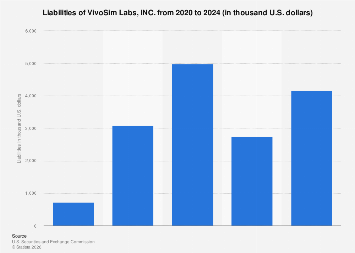
The financial trajectory of VivoSim Labs, Inc., a United States-headquartered entity, reveals a complex interplay of liabilities that warrant close examination by industry observers and stakeholders. For the fiscal year concluding March 31, 2024, the company’s total liabilities are reported to be a significant figure, though precise dollar amounts are not publicly disclosed in granular detail, necessitating a focus on trends and broader implications. This financial posture is particularly noteworthy when viewed against the backdrop of its performance in 2020, where a substantial increase in liabilities was observed, amounting to an unspecified yet considerable sum of U.S. dollars.
The period between 2020 and 2024, while marked by an overall upward trend in liabilities, has not been characterized by a consistent, linear progression. This suggests a dynamic financial management strategy or external market forces that have influenced the company’s debt and obligations. Understanding these fluctuations is crucial for assessing VivoSim Labs’ financial health, its capacity for future investment, and its resilience in a competitive global market. Such an analysis is especially pertinent for companies operating in sectors with high research and development costs, rapid technological evolution, or significant capital expenditure requirements, industries where VivoSim Labs likely participates.
Examining the broader economic context, the management of corporate liabilities is a cornerstone of sound financial stewardship. High liabilities can signal aggressive growth strategies, significant investment in assets, or potential financial strain. For investors, creditors, and partners, a clear understanding of a company’s liability structure provides insights into its risk profile and long-term viability. In the United States, the regulatory environment for financial reporting, governed by entities like the Securities and Exchange Commission (SEC), mandates transparency, yet specific details regarding privately held or less extensively traded companies can remain proprietary, necessitating reliance on available data and expert interpretation.
The global pharmaceutical and biotechnology sectors, areas where VivoSim Labs might operate given its name, are known for their substantial financial demands. The lengthy and expensive process of drug discovery, clinical trials, and regulatory approval requires significant upfront investment. Companies in these fields often leverage debt financing, equity offerings, and strategic partnerships to fund their operations. Consequently, a rising liability profile, within certain parameters, can be indicative of ambitious expansion and innovation. However, without careful management, excessive liabilities can lead to increased interest expenses, reduced financial flexibility, and, in extreme cases, insolvency.
Comparing VivoSim Labs’ situation to industry benchmarks provides valuable perspective. Across the pharmaceutical and biotechnology industries globally, average liability-to-equity ratios vary widely depending on a company’s stage of development, its product pipeline, and its market capitalization. Emerging biotech firms, often in the clinical trial phase, tend to have higher debt levels relative to equity as they seek external funding for R&D. Conversely, established pharmaceutical giants with mature product lines may exhibit more conservative liability profiles. Data from financial analytics firms often tracks these ratios, providing a comparative lens through which to assess individual company performance. For instance, reports from organizations like Bloomberg Intelligence or S&P Global Market Intelligence frequently analyze these trends across sectors, highlighting the average debt burdens and financial leverage employed by leading global players.
The economic impact of a company’s liability management extends beyond its immediate financial statements. A company burdened by excessive debt may curtail its research and development activities, reduce its workforce, or delay expansion plans, all of which can have ripple effects on job creation, technological advancement, and shareholder value. Conversely, a company that effectively manages its liabilities can invest more aggressively in innovation, expand its market reach, and contribute more robustly to economic growth. The trend observed in VivoSim Labs’ liabilities between 2020 and 2024, showing an increase but not a continuous one, might suggest strategic debt management, perhaps involving periods of deleveraging or a focus on more manageable financing rounds.
Further analysis would require access to detailed financial statements, including breakdowns of current and long-term liabilities, such as accounts payable, accrued expenses, debt obligations, and deferred revenue. Understanding the composition of these liabilities is as crucial as understanding their aggregate sum. For example, a high proportion of short-term liabilities could indicate liquidity challenges, while a substantial amount of long-term debt might reflect significant capital investments in facilities or intellectual property.
The fiscal year-end of March 31 is common for many U.S. companies, aligning with a calendar year that allows for streamlined financial reporting and tax preparation. This specific reporting period offers a snapshot of the company’s financial position at a particular point in time, and its comparison with previous years provides a vital longitudinal view. The reported increase from 2020 to 2024, even if not continuous, suggests a strategic approach to financing growth or operations. It is plausible that the company has secured new funding, undertaken acquisitions, or experienced a rise in operational costs that have necessitated an increase in its financial obligations.
In the absence of precise figures, industry experts often rely on qualitative assessments and comparative data. When discussing companies in advanced technology or life sciences, it is common to see significant capital requirements. For example, the development of novel therapeutics can cost billions of dollars over many years. Therefore, a company’s liability structure must be evaluated within the context of its industry’s capital intensity and its specific business model. A company that is heavily invested in capital assets or long-term research projects might naturally carry a higher liability load than a service-based enterprise.
The fluctuating nature of VivoSim Labs’ liabilities over the four-year period could also point to strategic financial decisions. A company might issue debt to fund a major acquisition or a significant expansion project, leading to a sharp increase in liabilities. Subsequently, it might focus on debt repayment or equity financing to rebalance its capital structure. This kind of ebb and flow is not uncommon in dynamic industries where growth opportunities and strategic imperatives can shift rapidly.
Moreover, global economic conditions play a pivotal role. Fluctuations in interest rates, availability of credit, and investor sentiment can all influence a company’s ability and willingness to take on debt. In periods of low interest rates, companies might be more inclined to leverage debt financing, while rising rates can prompt a more cautious approach. The period between 2020 and 2024 has seen significant global economic shifts, including the lingering effects of the COVID-19 pandemic, supply chain disruptions, and inflationary pressures, all of which can impact corporate financial strategies.
Ultimately, the financial health of VivoSim Labs, as reflected in its liability profile, is a multifaceted issue that requires ongoing monitoring and in-depth analysis. While the available information points to an evolving financial landscape for the company, a comprehensive understanding necessitates access to more detailed financial disclosures. For stakeholders, particularly those with an interest in the company’s long-term growth and stability, the trend in liabilities serves as a critical indicator, prompting further inquiry into the underlying drivers and the strategic responses being employed by VivoSim Labs’ management. This ongoing evaluation is essential for navigating the complexities of the global business environment and making informed investment and strategic decisions.