


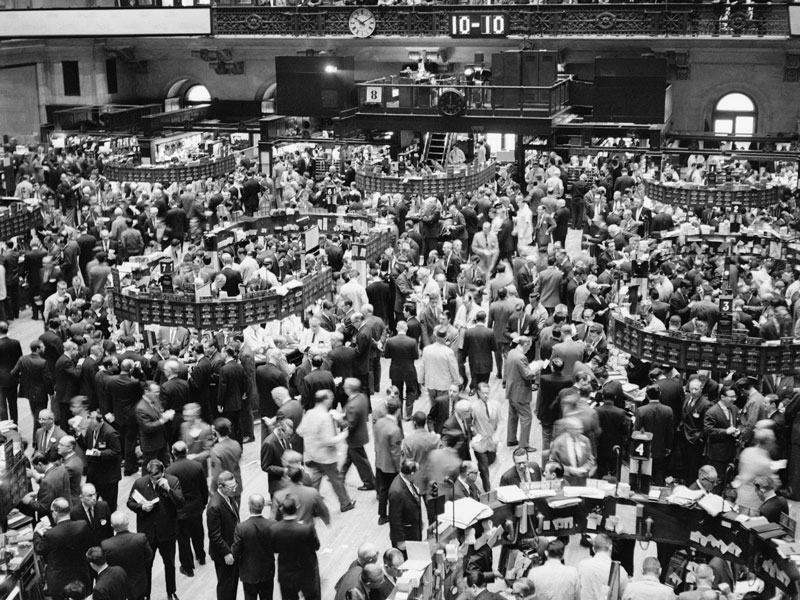
The trading floor of the New York Stock Exchange in 1966.
The genesis of modern investment strategies, a paradigm shift that redefined financial markets, can be traced back to a seminal period in the 1960s and early 1970s at the University of Chicago. It was there that a cadre of economists, armed with burgeoning computational power and a willingness to challenge established norms, laid the intellectual groundwork for a revolution that would not only alter the trajectory of the global investment industry but also fundamentally change how ordinary individuals approach their financial futures. This intellectual awakening, documented in Errol Morris’s film "Tune Out the Noise," illustrates how a confluence of radical ideas, academic rigor, technological advancements, and a touch of serendipity can permanently reshape an entire sector.
For decades prior, the world of investing operated largely on intuition and the belief that skilled professionals could consistently "beat the market." This era viewed investment as more of an art form, reliant on the acumen of individuals who could identify undervalued assets or predict market movements before others. The prevailing wisdom, as articulated by Nobel laureate Eugene Fama, a key figure in this intellectual movement, centered on the idea that success was achievable through superior stock-picking abilities. However, this deeply ingrained perspective began to erode with the emergence of the efficient-market hypothesis (EMH). Fama’s pioneering work posited that asset prices already incorporate all available information, rendering attempts to consistently outperform the market futile. In an efficient market, price movements are driven by the arrival of new, unexpected information, rather than by the predictive prowess of individual investors. The logical implication was that instead of seeking to outsmart the market, investors should focus on diversification and disciplined risk management.
This theoretical leap coincided with a technological revolution. The 1960s witnessed a significant increase in the accessibility and affordability of computing power, providing investors with the tools to analyze vast datasets of stock prices and corporate performance. This marked a transition from investment decisions based on hunches and gut feelings to data-driven strategies. The rise of quantitative analysis and computational modeling began to lay the foundation for what would become passive investing. As Fama himself famously asserted, "Markets work; prices are right." This sentiment suggested that while outperforming the market might be an elusive goal, achieving success was possible by embracing the market’s inherent efficiency through a passive approach.
Aaron Brask, a seasoned Wall Street professional and finance educator at the University of Florida, concurs with the enduring relevance of these ideas. He notes that while markets were less efficient when Fama first developed his theories, the landscape has dramatically shifted. "Sixty years ago, markets weren’t nearly as efficient as they are today," Brask explains. "If they were, it would imply that legendary investors like Warren Buffett, Charlie Munger, Walter Schloss, Philip Fisher, and Seth Klarman were simply lucky. Today, an immense amount of capital, intellectual prowess, and computational power is dedicated to uncovering investment opportunities. This intensifies the challenge of beating the market, as ‘dumb money’ is increasingly scarce, and markets are demonstrably more efficient."
Fama’s theoretical contributions catalyzed a significant shift, propelling passive investing into the mainstream and making it a cornerstone for millions of investors. This intellectual movement directly led to the development of the index fund, an investment vehicle designed to mirror the performance of a specific market index, powered by data and algorithms rather than speculative trading. Wells Fargo pioneered the first index fund in 1971, and a few years later, in 1976, John Bogle, a titan of the low-cost investing movement, introduced the first index mutual fund accessible to individual investors. While the evidence continues to favor passive investing for the majority, Brask acknowledges that a select group of active managers still possess the capacity to outperform. "Buffett and other active value investors meticulously assess a stock’s intrinsic value based on its fundamentals and compare it to its current market price," he says. "Their strategy often involves acquiring stocks at a significant discount to their perceived worth. In certain instances, superior or growth-oriented fundamentals may justify higher valuations."
The principle of diversification emerged as one of the most profound and lasting insights from the University of Chicago’s research. In stark contrast to the traditional investor’s pursuit of a single, monumental win, the Chicago economists advocated for a strategy of spreading risk across a multitude of assets. Their findings demonstrated that combining the stocks of established, stable companies with those of smaller, high-growth potential firms could effectively reduce portfolio volatility without compromising potential returns. This principle became the bedrock of Modern Portfolio Theory (MPT), a concept that is now integral to contemporary finance. Among the early proponents and practitioners of MPT were David Booth and Rex Sinquefield, who would go on to co-found Dimensional Fund Advisors (DFA). DFA, headquartered in Austin, Texas, transformed the academic tenets of EMH into a highly successful investment management firm.
Booth plays a significant role in "Tune Out the Noise," and at times, the film’s narrative leans towards celebrating DFA’s achievements, as the firm was one of its financial backers. Nevertheless, the Oscar-winning filmmaker Errol Morris imbues the subject matter with his characteristic subtlety. His conversational interview style, employing deceptively simple yet incisive questions such as "Why did you get sick of French?" or "You failed in air-conditioning?" allows the complex narrative to unfold organically. The result is a thoughtful examination of finance’s evolution from an intuitive art to an evidence-based discipline. Matthew Garrott, Director of Investment Research at Fairway Wealth Management, a US-based firm, praised the documentary’s focus. "The film highlights the human element, portraying the interviewed academics as humble and relatable figures. It was truly valuable to hear these giants of finance discuss their work in their own words."
A recurring theme in the film is the pervasive influence of randomness in shaping financial markets. The documentary posits that these markets are inherently chaotic systems, driven more by chance than by purely rational decision-making. The convergence of brilliant minds at the University of Chicago, who pioneered passive investment, can also be attributed, in part, to sheer luck, although the university’s esteemed reputation in economics undoubtedly played a role. A pivotal development was the establishment of the Center for Research in Security Prices (CRSP) in 1960 by economist James Lorie. CRSP served as a crucial nexus, bringing together financial and technological revolutions and providing researchers with an unprecedented repository of long-term stock and bond data.
Serendipity also shaped the trajectories of the individuals involved. Eugene Fama nearly missed his opportunity to study at the University of Chicago, securing a last-minute scholarship that proved life-altering. Myron Scholes, another Chicago luminary and Nobel laureate, who was an early advocate for computerized trading, stumbled into the realm of financial data analysis almost by accident. In 1963, he accepted a programming position despite his limited experience. When the six other programmers assigned to the project failed to appear, Scholes found himself assisting academics with their financial research, a twist of fate that set his career on its remarkable course.
The partnership of David Booth and Rex Sinquefield, who translated academic theory into practical application by founding Dimensional Fund Advisors, is another testament to fortunate circumstances. In 1969, Booth narrowly avoided mandatory military service in Vietnam when a sympathetic officer deferred his conscription, allowing him to pursue a PhD at the University of Chicago. Sinquefield, who did serve in the army, was spared from potentially dangerous combat due to his poor eyesight. Today, DFA manages nearly $800 billion in assets, and the University of Chicago’s prestigious business school bears the Booth name.
Despite its transformative impact, the intellectual revolution in finance is not without its critics, and the documentary touches only lightly on its unintended consequences. Some argue that the very theories that democratized investing also inadvertently sowed the seeds of financial excess. Proponents of EMH have faced accusations of fostering a blind faith in market infallibility, leading investors and regulators to underestimate the risks associated with asset bubbles and the necessity of robust oversight. A prevailing criticism suggests that the very success of the efficient market hypothesis has, paradoxically, undermined market efficiency due to the sheer volume of passive investing, leaving a dwindling number of active investors to provide the price discovery function.
However, proponents maintain that the core tenets of the theory remain valid. Robert Jarrow, an advisor at SAS and a Professor of Investment Management at Cornell University, argues, "Many skilled traders exist, and behavioral biases are no more or less prevalent than in the past, suggesting the impact of irrational traders on market efficiency remains constant. Furthermore, bubbles can be demonstrably consistent with an efficient market." He elaborates, "Markets exist on a spectrum of efficiency. Markets with frequent pricing events, such as US large-cap stocks, tend to be more efficient, while the market for selling a house is considerably less so. The US stock market may not be perfectly efficient, but it is sufficiently efficient to place active managers at a significant disadvantage."
Even the sophisticated mathematical models that underpin many investment strategies have faced intense scrutiny. The Black-Scholes model, a seminal contribution by Myron Scholes to financial economics, provided a framework for advanced risk management and portfolio diversification. While a theoretical triumph, it also became instrumental in fueling an explosion of speculative trading in derivatives. Initially conceived as tools for hedging risk, derivatives evolved into highly leveraged instruments, creating complex chains of interconnected bets. While these financial innovations generated substantial wealth for traders, they also contributed to market instability, culminating in the 2008 credit crunch and the near collapse of the global banking system. As one observer noted at the time, the model became "an ingredient in a rich stew of financial irresponsibility, political ineptitude, perverse incentives, and lax regulation."
Ultimately, "Tune Out the Noise" transcends a mere chronicle of financial history; it offers a poignant reflection on a particular era of American ingenuity and its capacity for self-examination, a quality some argue is diminishing. The embrace of passive investing, which entails accepting average market returns, was not, as Rex Sinquefield wryly notes in the film, initially perceived as "the American way." Yet, it eventually gained widespread acceptance. David Booth’s personal narrative further underscores this evolving ethos. A former shoe salesman, Booth recalls in the film his desire to "feel good about myself" at the end of each day. His words evoke a bygone America that valued diligence, integrity, and modest achievement, a spirit now often overshadowed by the speculative fervor of cryptocurrency trading and the relentless pursuit of rapid wealth.
At its heart, the film is also a profound exploration of information itself – the overwhelming influx of data, the promise of efficiency, and the enduring human challenge of discerning signal from noise. The efficient market hypothesis is predicated on the belief that data provides an objective truth. However, in the age of high-frequency and algorithmic trading, that certainty feels increasingly precarious. As markets operate at machine speed and artificial intelligence systems assume greater prominence, the role of active management faces an existential question. "Tune Out the Noise" leaves viewers with a subtle, yet persistent, disquiet: the realization that even the most rigorously constructed rational systems are built upon human assumptions, and that the next transformative wave in investment may involve a rediscovery of human judgment.