

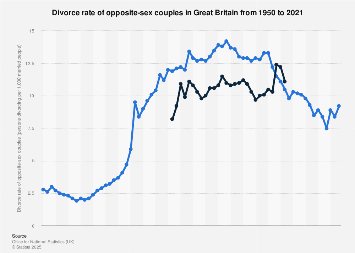
The year 2021 marked a significant inflection point in the long-term trend of marital dissolutions across England and Wales, with the divorce rate per thousand married couples exhibiting a notable uptick compared to the preceding years. While specific figures for 2021 remain subject to detailed analysis, available data indicates a deviation from the consistent decline observed since the early 2000s. This shift, however, must be viewed within the broader historical context, which has seen dramatic fluctuations in divorce rates over the past seven decades, influenced by evolving social norms, legal reforms, and economic conditions.
Historically, the mid-20th century witnessed a period of relative stability in marriage and divorce. However, the latter half of the century, particularly from the 1960s onwards, saw a marked liberalization of divorce laws and a concurrent rise in marital breakdowns. This era was characterized by a societal re-evaluation of marriage, with greater emphasis placed on individual happiness and fulfillment. The Divorce Reform Act of 1969 in England and Wales, for instance, is widely acknowledged as a watershed moment, significantly easing the grounds for divorce and contributing to a surge in applications throughout the 1970s and into the 1980s. This period saw divorce rates reach their historical peaks, reflecting profound societal changes.
The turn of the millennium, however, ushered in a period of sustained decline. From the early 2000s, divorce rates in England and Wales embarked on a steady downward trajectory. This trend was attributed to a confluence of factors, including a rising average age of marriage, increased cohabitation rates, and a growing societal emphasis on marital stability and commitment. Data from the early 2000s, specifically around 2003 and 2004, indicated a considerably higher rate of divorces per thousand married couples than what was observed in more recent pre-pandemic years. This sustained fall suggested a strengthening of marital bonds or, alternatively, a greater reluctance to formalize marital dissolution, perhaps due to economic considerations or evolving family structures.
The most recent available data for Scotland, while from an earlier period (2008), indicated a divorce rate that was also a significant point of reference. While direct year-on-year comparisons with England and Wales are complicated by differing data collection methodologies and reporting schedules, the Scottish figures contribute to the overall understanding of the marital dissolution landscape within Great Britain. The absence of updated marital status estimates for Scotland since 2008, as noted in supplementary information, highlights the challenges in maintaining comprehensive and consistent pan-British statistical coverage.
The uptick observed in 2021, even with the data still being refined, warrants deeper economic and sociological examination. Several hypotheses can be posited for this reversal of the long-term downward trend. The COVID-19 pandemic, with its unprecedented disruptions to daily life, undoubtedly played a significant role. Extended periods of lockdown, increased proximity, and heightened stress levels within households may have exacerbated existing marital tensions or brought latent issues to the fore. Economic uncertainty, while a potential deterrent to divorce in some circumstances, could also have acted as a catalyst for others, particularly if financial precarity was already a source of marital strain.
Furthermore, the legislative landscape continues to evolve. The introduction of "no-fault divorce" in England and Wales in April 2022, though occurring just after the period under review, reflects a broader societal and governmental push towards making the process of divorce less adversarial. While the 2021 data predates this specific reform, the discussions and societal readiness for such changes might have already been influencing attitudes towards marital dissolution.
Analyzing the economic implications of divorce rates is multifaceted. Higher divorce rates can impact various sectors of the economy. The legal profession, particularly family law specialists, often sees increased activity. The property market can be affected as couples divide assets, leading to the sale of joint residences and the purchase of new, often smaller, properties. The retail sector may experience shifts in demand as individuals establish separate households, requiring new furnishings, appliances, and consumer goods. Moreover, the financial implications for individuals, particularly in terms of asset division, child maintenance, and spousal support, can have long-term consequences on their economic well-being and consumption patterns.
Globally, divorce rates exhibit considerable variation, influenced by cultural norms, religious beliefs, legal frameworks, and socio-economic development. Many Western European countries have historically experienced higher divorce rates than some Asian or African nations, although this is a generalization subject to numerous exceptions. For instance, countries with more liberal divorce laws and greater gender equality tend to report higher rates. Conversely, societies with strong traditional family structures and stricter divorce regulations often exhibit lower rates. The UK’s position within this global spectrum is important for understanding its unique trajectory. Trends in the United States, for example, have often mirrored those in the UK, with a surge in the latter half of the 20th century followed by a more recent decline, although the specifics of these trends can differ.
The long-term implications of the 2021 uptick, if it proves to be a sustained trend rather than a pandemic-induced anomaly, could be significant. A sustained rise in divorce rates might signal a return to the societal dynamics of previous decades, with potential repercussions for family structures, child well-being, and the broader social fabric. Economically, it could translate into increased demand for related services and a redistribution of wealth and assets. However, it is crucial to await more comprehensive data and longitudinal studies to ascertain the true nature and durability of this observed shift. The interaction of social, economic, and legal factors will continue to shape the future of marriage and divorce in Great Britain, making the ongoing monitoring of these trends essential for policymakers, social scientists, and the public alike. The period from 2003-2004 stands as a historical benchmark for peak decline, with the subsequent rise in 2021 suggesting a complex interplay of forces reshaping the institution of marriage in the United Kingdom.