

For over six decades, the landscape of American presidential election participation has been marked by a discernible, albeit fluctuating, trend: as citizens age, their propensity to cast a ballot generally increases. This demographic pattern, observed consistently since the mid-1980s, reveals a stark contrast between the youngest eligible voters and their more senior counterparts, offering critical insights into civic engagement and the potential for political mobilization across different generations.
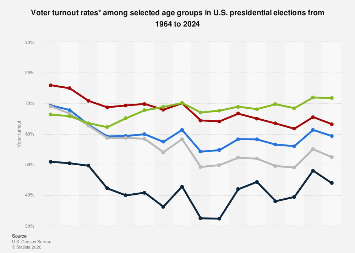
Analysis of voter turnout data in U.S. presidential elections from 1964 to 2024 illustrates this persistent age-related correlation. While national turnout rates have experienced periods of ascent and decline, notably reaching a historical low in 1996 before a resurgence in the ensuing two decades, the age distribution of voters has remained a consistent factor. The youngest cohort, typically defined as those aged 18-24, has consistently exhibited the lowest participation rates among all eligible age brackets. In some instances, such as the 2000 and 1996 elections, fewer than one-third of eligible voters in this age group exercised their right to vote. This stands in sharp contrast to the over two-thirds of eligible voters aged 65 and older who participated in those same elections.
Examining the most recent data available, for the 2024 presidential election, this trend continues. The national average turnout among eligible voters is projected at 59.3%. However, this figure masks significant generational disparities. The 18-24 age group is estimated to have a turnout of 43.9%, while the 25-44 demographic shows a participation rate of 52.4%. As age increases, so does turnout: the 45-64 group is projected at 63.2%, and the 65+ demographic leads with 71.7%. This pattern has been remarkably stable over the years. For instance, in the pivotal 2020 election, the 18-24 turnout was 48%, compared to 71.9% for those 65 and older. The 2016 election, marked by significant political upheaval, saw similar patterns, with 39.4% turnout for the youngest voters and 68.4% for the oldest.
The implications of these demographic voting patterns are profound for the American political system and the formulation of public policy. A consistent underrepresentation of younger voters can lead to policies that may not adequately reflect their concerns or future aspirations. Political campaigns, often resource-constrained, tend to focus their efforts on demographics that have a proven track record of high turnout, potentially marginalizing the voices of younger generations.
Several factors are believed to contribute to the lower turnout among younger voters. These often include lower rates of homeownership, less established community ties, greater mobility, and potentially less exposure to or engagement with political institutions. Furthermore, the financial pressures and life transitions common in early adulthood, such as pursuing higher education, entering the workforce, or establishing independent households, can divert time and energy away from civic participation.
Conversely, older demographics often exhibit higher turnout due to a greater sense of stability, established routines, and a longer history of engagement with the electoral process. They may also feel a stronger sense of investment in the long-term stability and policy direction of the country, driven by factors such as retirement planning, healthcare concerns, and family legacies.
The period between 1964 and the late 1980s saw more volatile turnout figures across age groups. In 1964, for example, the 18-24 cohort (with some regional variations in the exact age definition due to the 26th Amendment’s ratification in 1971) saw a participation rate of 50.9%, and the 25-44 group was at 69%. The 65+ group then stood at 66.3%. Similarly, the 1968 election, a period of significant social and political unrest, saw robust turnout among younger voters, with the 18-24 group at 50.4%. However, the national average turnout was considerably higher in these earlier years, reaching 67.8% in 1968 and a peak of 69.3% in 1964.
The dip in national turnout to 54.2% in 1996, the lowest point in the observed period, was mirrored across all age demographics, though the relative differences persisted. The 18-24 group saw a turnout of 32.4%, while the 65+ group remained significantly higher at 67%. This period highlights that while age is a strong predictor, broader societal and political factors can influence participation across the board.
The subsequent rise in turnout since the late 1990s, particularly evident in elections like 2008 and 2020, has seen increased engagement from various age groups, but the age gradient has largely remained intact. The 2008 election, energized by a historic presidential campaign, saw a notable uptick in participation among younger voters, with the 18-24 group reaching 44.3%. This suggests that targeted mobilization efforts and compelling candidates can indeed drive engagement among historically less-participatory demographics. The 2020 election, influenced by the COVID-19 pandemic and a highly polarized political climate, also saw a significant increase in overall turnout, with the 18-24 group reaching 48%.
Globally, the relationship between age and voter turnout is a common phenomenon, though the specific rates and trends can vary significantly depending on a country’s electoral system, political culture, and demographic composition. In many established democracies, older citizens tend to vote at higher rates than younger ones. However, some nations have implemented measures to boost youth participation, such as lowering the voting age, introducing civic education programs, or adopting automatic voter registration.
The economic implications of differential voter turnout are also noteworthy. Policymakers are more likely to respond to the needs and demands of groups that vote in higher numbers. If younger generations are underrepresented at the polls, their economic priorities – such as student debt relief, affordable housing, and job creation – might receive less attention compared to issues prioritized by older voters, such as social security and healthcare. This can create a feedback loop where political systems appear unresponsive to the needs of young people, potentially further dampening their enthusiasm for civic participation.
Understanding these trends is crucial for electoral reform advocates, political strategists, and policymakers alike. Efforts to increase voter registration among young adults, simplify the voting process, and foster a stronger sense of civic duty from an early age could help bridge the generational divide in political participation. Furthermore, examining the specific barriers faced by different age groups, beyond general assumptions, is essential for designing effective interventions. The consistent correlation between age and turnout in U.S. presidential elections underscores a persistent challenge in ensuring truly representative democracy and highlights the ongoing need to engage all segments of the electorate.