

The digital landscape, long dominated by traditional search engine optimization (SEO) paradigms, is undergoing a profound and rapid transformation driven by generative artificial intelligence (GenAI), posing an existential challenge to brand visibility and market leadership. Businesses worldwide, many of whom were ill-prepared for this seismic shift, now face a critical juncture: adapt swiftly and strategically, or risk fading into obscurity, irrespective of past market dominance or marketing investment. This new era of AI-driven search doesn’t merely refine existing search mechanisms; it fundamentally redefines how consumers discover, evaluate, and engage with brands, presenting both immense opportunities for agile innovators and grave risks for those clinging to outdated practices.
The shift is palpable. Where once consumers navigated a labyrinth of links on traditional search engines like Google, they increasingly turn to conversational AI platforms such as ChatGPT, Google’s Gemini, Microsoft’s Copilot, and Perplexity AI for synthesized answers. These tools don’t just point to information; they actively process, summarize, and often recommend. This fundamental change alters the very fabric of the customer journey, moving from a "search and click" model to an "ask and receive" paradigm. Data from Statista indicates that global AI market revenue is projected to grow substantially, with AI integration into everyday tools, including search, being a primary driver. The implications for marketing spend are immense, as brands must now contend with algorithms that prioritize relevance, context, and authority in ways far more sophisticated than traditional keyword matching.
The examples of this disruption are already surfacing across industries. A major U.S. fitness brand, a significant player with substantial investment in conventional search marketing, was reportedly "shocked" when a test of AI platform searches revealed a smaller, local competitor in Houston outranking them. Similarly, a financial services executive recounted dismay at observing a consumer bypass Google entirely, opting for ChatGPT to seek top-rated options. Despite the executive’s firm holding the largest market share and allocating vast sums to traditional media, digital marketing, and SEO, it was a much smaller, lesser-known entity that appeared in the AI platform’s recommendations. These incidents are not anomalies; they are harbingers of a broader trend where established market share and historical advertising spend offer no guaranteed immunity from digital invisibility.

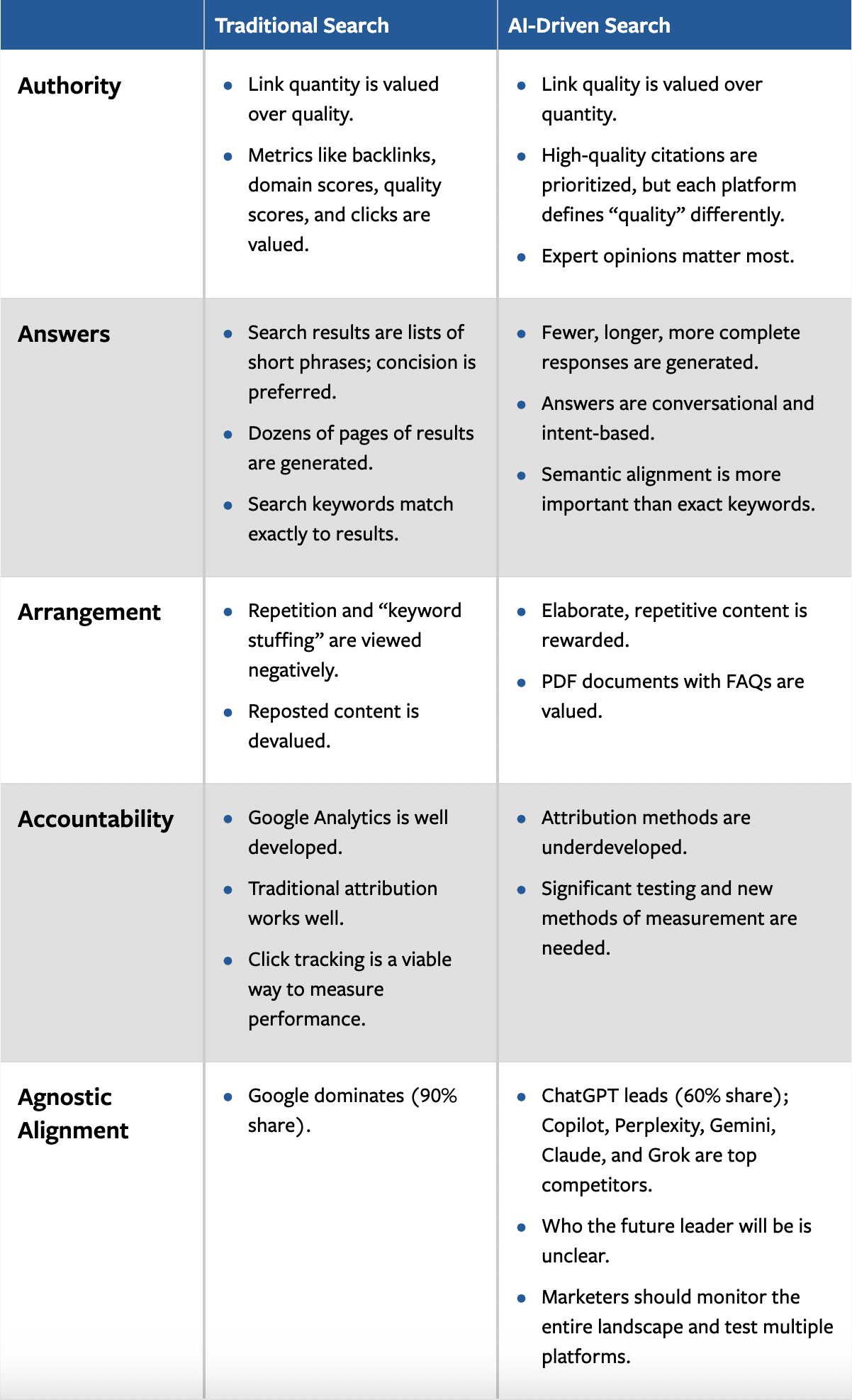
The core issue lies in the opaque and continually evolving nature of AI algorithms. Unlike traditional SEO, which often rewards factors like backlinks, keyword density, and page authority in a relatively predictable manner, GenAI models prioritize information differently. They excel at understanding natural language queries, discerning user intent, and synthesizing information from diverse sources to provide a direct answer or a concise summary. This capability fundamentally alters the ‘top-of-funnel’ experience, where consumers no longer need to click through multiple pages to gather information. For brands, this means their content must not only be discoverable by AI but also structured and authoritative enough to be prioritized and presented in a favorable light within these synthesized responses.
One of the most striking behavioral shifts accelerated by AI is the prevalence of "zero-click searches." In these instances, the AI platform provides a direct, comprehensive answer, eliminating the need for the user to visit any external website. While zero-click searches have been a growing phenomenon even in traditional search (studies estimated over 50% of Google searches were zero-click prior to widespread GenAI adoption), GenAI supercharges this trend. This has profound economic implications: reduced organic traffic to brand websites, fewer opportunities for direct engagement through owned media, and a significant challenge to traditional advertising models that rely on clicks and impressions. Brands must now consider their presence not just on search results pages, but within the AI-generated answers themselves, where the brand might be mentioned as a recommendation, a factual source, or not at all.
To navigate this new terrain, companies must fundamentally overhaul their information search marketing strategies, moving beyond a narrow focus on keywords and backlinks. The new playbook emphasizes several critical areas. Firstly, Content Strategy must evolve beyond mere SEO optimization. Brands need to produce highly authoritative, contextually rich, and verifiable content that directly answers complex user queries. This involves a shift towards semantic SEO, optimizing for concepts and topics rather than just individual keywords, ensuring that content is easily digestible and synthesizable by AI models. Structured data markup (Schema.org) becomes even more crucial, providing explicit signals to AI about the nature and context of the information presented. Content should be crafted not just for human readers but also for AI models, prioritizing clarity, accuracy, and depth.
Secondly, Brand Authority and Trust Signals are paramount. In an environment where AI synthesizes information, the perceived trustworthiness and expertise of a brand become critical determinants of its inclusion in AI-generated answers. This means cultivating an unimpeachable reputation, securing genuine expert endorsements, fostering positive customer reviews, and actively managing public perception across all digital channels. The E-E-A-T framework (Experience, Expertise, Authoritativeness, Trustworthiness) championed by Google for its quality raters takes on heightened importance, serving as a guiding principle for content creation and brand building. Brands that are consistently cited as reliable sources in their respective fields are more likely to be referenced favorably by AI.

Thirdly, Measurement and Resource Allocation require a complete rethinking. Traditional metrics like website traffic, click-through rates, and keyword rankings, while still relevant, no longer paint a complete picture. Marketers must now track brand mentions within AI-generated summaries, analyze the sentiment of AI recommendations, and assess the directness with which AI platforms answer queries related to their products or services. This necessitates a strategic reallocation of marketing budgets away from purely traditional digital advertising towards investment in AI-centric content creation, advanced data structuring, reputation management, and even exploring partnerships with AI platforms. The competitive advantage will lie with those who can swiftly adapt their internal capabilities and allocate resources to these emerging channels.
From a global perspective, the adoption and impact of AI-driven search will vary, but its trajectory is universally upwards. While markets with advanced digital infrastructure and high smartphone penetration might lead the charge, the fundamental shift in consumer behavior is borderless. For international brands, this means ensuring their content is culturally and linguistically nuanced, and that their authority signals resonate across diverse linguistic and cultural contexts. The rise of AI also offers a unique opportunity for smaller, agile brands to disrupt established hierarchies. By focusing on niche expertise, hyper-relevant content, and strong community engagement, they can potentially carve out significant visibility within specific AI search contexts, effectively leveling the playing field against larger, slower-moving competitors.
Ultimately, the advent of generative AI in search is not a temporary trend but a fundamental re-architecting of the digital information ecosystem. The challenge for businesses is no longer merely to be "found" but to be "understood" and "recommended" by intelligent algorithms that are increasingly the gatekeepers of consumer attention. This demands a proactive, experimental, and agile approach from the C-suite down, recognizing that the very definition of market leadership in the digital realm is being rewritten. Companies that embrace this paradigm shift, investing in deeply authoritative content, robust brand reputation, and innovative measurement strategies, are poised to thrive. Those that fail to adapt risk becoming digitally invisible, their market share eroding as consumers bypass them entirely in their quest for instant, AI-synthesized answers. The time for strategic re-evaluation and bold action is now, before the vortex of AI-driven search renders even the most established brands truly invisible.