

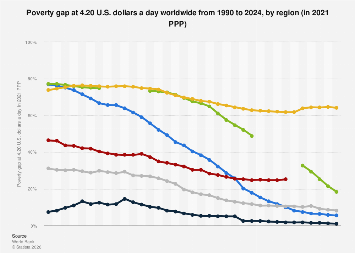
The world has made significant strides in poverty reduction over the past three decades, yet a substantial gap persists between the daily incomes of the poorest households and the established poverty line, a critical indicator of economic vulnerability. This disparity, measured in terms of the average distance below a defined poverty threshold, reveals not only the prevalence but also the intensity of poverty across different global regions. As of the most recent comprehensive data, the global poverty line is set at $4.20 per day, adjusted for 2021 Purchasing Power Parities (PPP), a standard used to compare economic well-being across countries by accounting for differences in the cost of living. While the overall trend points towards a narrowing of this gap, the pace of progress and the current levels of deprivation exhibit stark regional variations, highlighting persistent challenges in achieving equitable global development.
East Asia and the Pacific have demonstrated the most remarkable transformation in their poverty gap metrics. This region, once characterized by widespread poverty, has experienced a dramatic decline in the proportion of its population living significantly below the poverty line. From a substantial percentage in 1990, the poverty gap has been reduced to less than a minimal fraction by 2024. This impressive reduction is largely attributed to sustained economic growth, rapid industrialization, and targeted poverty alleviation programs implemented by governments in countries such as China and Vietnam. These initiatives often focused on boosting agricultural productivity, promoting manufacturing employment, and expanding access to education and healthcare, thereby lifting millions out of extreme deprivation. The economic dynamism of this region has not only reduced the number of people living in poverty but also narrowed the income deficit for those still struggling.
In stark contrast, Sub-Saharan Africa continues to grapple with the most significant poverty gap globally. As of 2024, the region registers the highest percentage, indicating that on average, poor households are furthest from the $4.20 daily income threshold. This persistent challenge is a complex interplay of factors, including historical legacies of colonialism, ongoing political instability, vulnerability to climate change and its impact on agriculture, and inadequate infrastructure. While there have been periods of economic growth, its benefits have not always translated into broad-based poverty reduction, and the intensity of poverty remains a critical concern. The region’s reliance on primary commodity exports makes it susceptible to global price fluctuations, further exacerbating economic vulnerabilities. Furthermore, widespread conflict and humanitarian crises in several countries within the region disrupt economic activity and displace populations, pushing them deeper into poverty.
Latin America and the Caribbean present a mixed picture, with a notable reduction in the poverty gap over the decades, yet still facing considerable challenges. While progress has been made in lifting many households above the poverty line and reducing the depth of poverty for others, structural inequalities, informal labor markets, and periods of economic recession have prevented a complete eradication of the problem. The region’s dependence on commodity exports and its vulnerability to global economic downturns mean that poverty levels can fluctuate. Efforts to address the poverty gap here often involve social welfare programs, conditional cash transfers, and investments in education and skills development, but the deep-seated nature of income inequality requires sustained and multifaceted policy interventions.
The Middle East and North Africa, alongside Afghanistan and Pakistan, present a complex regional dynamic. While data for this grouping can be influenced by geopolitical events and conflicts, there has been a general trend towards reducing the poverty gap. However, the region is susceptible to economic shocks, often linked to oil price volatility and regional instability. In countries like Afghanistan and Pakistan, protracted conflicts and political instability have significantly hampered development efforts and exacerbated poverty. The poverty gap in this region is influenced by a combination of economic reforms, social safety nets, and the impact of recurring crises.
Europe and Central Asia have generally maintained a lower poverty gap compared to other regions, reflecting a stronger emphasis on social welfare systems and more developed economies. However, the transition economies in Central Asia have faced their own set of challenges in post-Soviet economic restructuring, leading to periods of increased poverty and widening income disparities. While the overall poverty gap may be smaller, the intensity of poverty can still be a concern for vulnerable populations within these countries, particularly in rural areas or among specific demographic groups.
The global poverty gap, despite its downward trend, serves as a critical reminder of the work that remains to be done. The $4.20 per day poverty line, while a significant improvement in measurement, still represents a very low standard of living. The intensity of poverty, as captured by the poverty gap, underscores the need for policies that not only increase incomes but also address the structural barriers that keep people trapped in deprivation. These include investing in quality education and healthcare, promoting inclusive economic growth, ensuring access to essential services like clean water and sanitation, and building resilience against economic and environmental shocks.
The differential progress across regions highlights the importance of tailored development strategies. What works in East Asia, with its rapid industrialization, may not be directly applicable to Sub-Saharan Africa, where agriculture and resource management are more dominant. International cooperation, targeted aid, and knowledge sharing are crucial to support countries facing the most severe poverty challenges. Furthermore, the increasing impacts of climate change pose a significant threat to poverty reduction efforts, particularly in vulnerable regions. Extreme weather events can devastate agricultural livelihoods, destroy infrastructure, and displace populations, pushing them back into poverty.
The economic implications of a persistent poverty gap are far-reaching. High levels of deprivation can lead to social unrest, hinder economic productivity, and create a cycle of intergenerational poverty. Conversely, reducing the poverty gap can unlock significant economic potential by enabling more individuals to participate in the labor force, consume goods and services, and contribute to innovation. The World Bank and other international financial institutions continue to monitor these trends closely, adjusting their strategies and lending priorities to address the evolving landscape of global poverty. The ultimate goal remains not just to reduce the number of people living below a poverty line, but to ensure that everyone has the opportunity to achieve a decent standard of living, free from the debilitating effects of extreme deprivation. The journey towards eradicating poverty is ongoing, and the regional disparities in the poverty gap serve as a constant barometer for the efficacy and equity of global development efforts.