

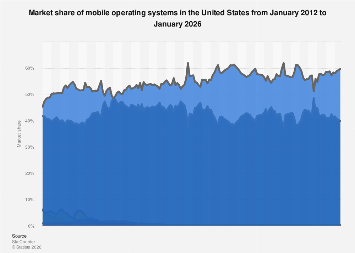
As the digital landscape continues its relentless evolution, the U.S. mobile operating system market remains firmly under the dominance of two titans: Apple’s iOS and Google’s Android. Projections indicate that by January 2026, these two platforms will collectively command an overwhelming share, leaving virtually no room for significant competition. This entrenched duopoly, a trend observed for over a decade, highlights the profound network effects and ecosystem lock-in that characterize the modern smartphone industry.
For years, the narrative of mobile operating systems in the United States has been a story of consolidation. While the early days of smartphones saw a more fragmented market, with players like BlackBerry OS and Windows Phone vying for consumer attention, the landscape has dramatically simplified. By early 2026, it is anticipated that iOS and Android will collectively represent almost 100 percent of the U.S. mobile OS market share. This near-total saturation underscores the difficulty any new entrant would face in challenging the established ecosystems of Apple and Google, which encompass not only the operating systems themselves but also their vast app stores, hardware integration, and cloud services.
The sustained dominance of iOS and Android is a testament to their respective strengths and strategic market positioning. Apple’s iOS, known for its user-friendly interface, robust security features, and tightly integrated hardware and software, appeals to a premium segment of the market. Its consistent performance, regular software updates, and strong brand loyalty contribute to its enduring appeal. The curated nature of the App Store also fosters a perception of quality and security among its users.
Conversely, Android’s open-source nature and broad hardware compatibility have allowed it to capture a diverse range of market segments, from budget-friendly devices to high-end flagships. Google’s ability to partner with numerous hardware manufacturers has facilitated widespread adoption across various price points and consumer preferences. The sheer volume of Android devices in the market, coupled with the flexibility and customization options it offers, has been a key driver of its success. The Android ecosystem, while vast, can sometimes present challenges in terms of fragmentation, with different versions and manufacturer skins coexisting, but its accessibility remains a significant advantage.
The long-term trend analysis reveals a remarkably stable, albeit intense, competition between these two platforms. From January 2012, when the mobile OS market was still relatively dynamic, to the projected figures for early 2026, iOS and Android have consistently held the lion’s share. While specific percentages fluctuate month-to-month and year-to-year, the overarching trend has been their combined near-monopoly. This stability is not accidental; it is the result of massive investments in research and development, strategic partnerships, and sophisticated marketing campaigns by both Apple and Google.
The economic implications of this duopoly are far-reaching. For app developers, the near-exclusive focus on iOS and Android means that resources can be concentrated on these two platforms, simplifying development and distribution strategies. However, it also means that any developer seeking significant reach in the U.S. market has no viable alternative but to cater to these two ecosystems. This can lead to increased competition for visibility within the App Store and Google Play Store, and a higher barrier to entry for developers with niche applications that might not fit the mainstream appeal of either platform.
For consumers, the duopoly generally translates to a choice between two high-quality, feature-rich mobile experiences. The competition between Apple and Google drives innovation, pushing both companies to continually improve their offerings, from user interface design and performance to privacy and security features. This constant innovation benefits consumers by providing access to cutting-edge technology and a wide array of applications and services. However, it also means that consumers are largely confined to these two walled gardens, with limited interoperability between them.
From a global perspective, while the U.S. market is a significant indicator, the mobile OS landscape varies in other regions. In some emerging markets, Android’s affordability and accessibility often lead to an even more pronounced dominance, with a smaller share for iOS. Conversely, in certain developed markets, iOS might exhibit slightly higher penetration rates due to strong brand affinity and premium product adoption. Nevertheless, the trend of a binary market, dominated by iOS and Android, is a near-universal phenomenon across most developed and many developing economies.
The sustainability of this duopoly hinges on several factors. For Apple, maintaining its premium brand image and continued innovation in hardware and software are crucial. For Google, its ability to adapt to evolving consumer demands, manage the fragmentation of the Android ecosystem, and leverage its vast data and AI capabilities will be key. The competitive pressure between them, while not resulting in market share shifts of significant magnitude, ensures that neither company can afford to become complacent.
Looking ahead, the possibility of a third major operating system emerging and challenging this entrenched order appears remote. The substantial barriers to entry, including the immense cost of developing and maintaining an OS, building a compatible hardware ecosystem, and cultivating a critical mass of app developers and users, are formidable. Furthermore, regulatory scrutiny over the market power of dominant tech companies could influence future market dynamics, but significant shifts in the fundamental OS duopoly by 2026 seem unlikely without a major disruptive event.
The U.S. mobile operating system market, as projected towards 2026, presents a clear picture of established dominance. The near-total capture by iOS and Android reflects the mature stage of the smartphone industry, where network effects, ecosystem integration, and brand loyalty have created a robust and stable duopoly. This reality shapes the strategies of developers, the choices of consumers, and the competitive landscape for the foreseeable future, underscoring the enduring power of platform economics in the digital age.