

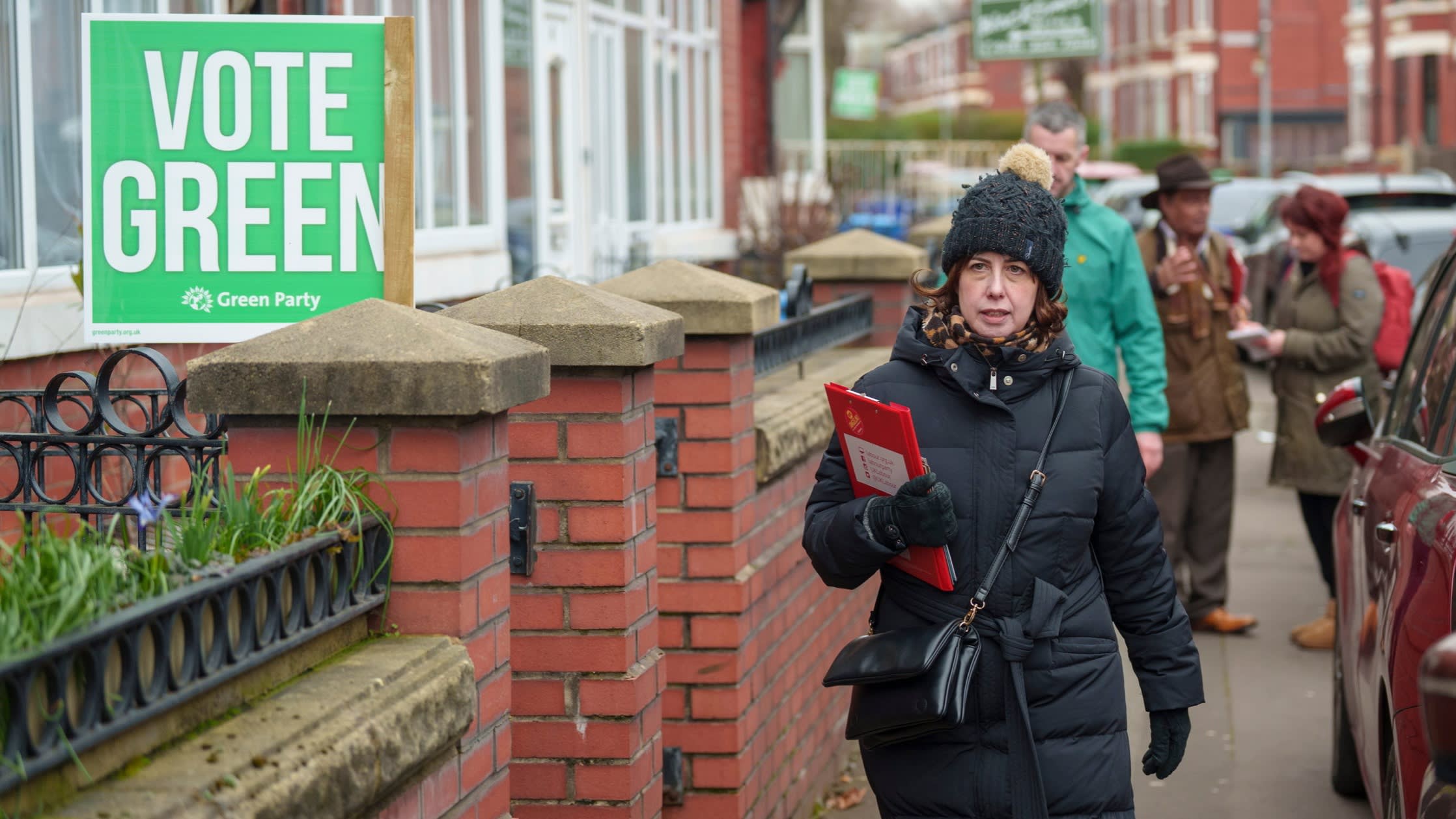
The British political landscape is currently navigating a period of profound transformation, characterized by a paradox of high polling leads for the opposition and a deep-seated sense of voter disaffection that threatens to upend traditional electoral calculus. As the Labour Party prepares for a series of high-stakes by-elections, the challenge is no longer a simple binary struggle against a weakened Conservative government. Instead, Keir Starmer’s party finds itself entangled in a complex three-way dynamic, where the resurgence of the Liberal Democrats in affluent southern "Blue Wall" seats and the disruptive rise of Reform UK on the right flank are rewriting the rules of engagement. This fragmentation of the electorate serves as a microcosm of a broader Western trend: the erosion of the traditional center-left and center-right duopoly in favor of a more volatile, issue-driven political marketplace.
For the Labour Party, the current climate is one of cautious optimism tempered by the reality of a "shallow" lead. While national polling consistently places the party 15 to 20 points ahead of the incumbent Conservatives, by-election results often reveal a more nuanced story. Disaffection among core demographics—ranging from young urban professionals concerned about housing costs to traditional working-class voters in the "Red Wall" who feel alienated by shifts in social policy—has created an opening for third-party insurgents. This disaffection is not merely a reaction to specific policy proposals but is rooted in a decade of stagnant real wage growth and a perception that the political establishment is ill-equipped to handle the structural shifts in the global economy.
Economic data provides the somber backdrop to this electoral friction. The United Kingdom has grappled with a "lost decade" of productivity, with the Office for National Statistics (ONS) reporting that output per hour worked has grown at a significantly slower pace since the 2008 financial crisis compared to the pre-crisis trend. This productivity puzzle has direct implications for the Treasury’s fiscal headroom, limiting the ability of any incoming government to promise the kind of expansive public spending that traditionally energizes a disaffected base. With the tax burden at its highest level since the post-war era and public services—most notably the National Health Service (NHS)—facing record backlogs, the electorate is exhibiting a "plague on both your houses" mentality that complicates Labour’s path to a decisive majority.
The "three-way" nature of these contests is particularly visible in constituencies where the Liberal Democrats have positioned themselves as the tactical alternative for anti-Conservative voters who remain skeptical of Labour’s economic platform. In the affluent "commuter belt," the debate often centers on the "squeezed middle"—households earning above-average incomes who nonetheless feel the bite of fiscal drag and rising mortgage rates. The Bank of England’s aggressive monetary tightening cycle, which saw interest rates climb to 5.25% in an effort to curb post-pandemic inflation, has transformed the political geography of the UK. For the first time in a generation, the "mortgage bomb" has become a central campaign issue, often superseding traditional ideological debates.
Simultaneously, the rise of Reform UK represents a different kind of threat to the Labour-Conservative binary. By capturing the protest vote of those disillusioned with the post-Brexit settlement and the scale of net migration, Reform UK acts as a spoiler that can inadvertently hand victories to Labour by splitting the right-wing vote, or conversely, peel off socially conservative Labour voters in northern heartlands. This fragmentation mirrors the rise of the AfD in Germany or the National Rally in France, where voters who feel left behind by globalization and urban-centric policy-making seek refuge in populist alternatives. For Labour, the strategic dilemma is whether to move toward the center to capture disillusioned Conservatives or to sharpen its populist rhetoric to shore up its traditional base.
Market analysts and institutional investors are watching these by-elections with an intensity usually reserved for general elections. The "City" is looking for signals of fiscal discipline from the Labour leadership. Shadow Chancellor Rachel Reeves has gone to great lengths to emphasize "iron-clad" fiscal rules, seeking to reassure the bond markets that a Labour government would not repeat the volatility seen during the brief tenure of Liz Truss. However, this commitment to fiscal rectitude creates a political vacuum. When Labour scales back investment pledges—such as the recent adjustment to its flagship green prosperity plan—it risks deepening the disaffection among voters who view climate action and industrial renewal as the only viable path to long-term economic growth.
The global context further complicates the domestic narrative. As the UK attempts to define its "Global Britain" identity outside the European Union, it faces a world characterized by "polycrisis"—the simultaneous occurrence of geopolitical instability, energy transitions, and technological disruption. The conflict in Gaza, for instance, has emerged as an unexpected but potent factor in recent by-elections, highlighting the difficulties of maintaining a "big tent" coalition. In areas with significant minority populations, Labour has faced a backlash over its foreign policy stance, illustrating how international issues can rapidly domesticate and influence local electoral outcomes.
Statistical analysis of recent electoral swings suggests that while the Conservative "floor" is collapsing, the Labour "ceiling" remains untested. In several recent contests, the swing to Labour has been driven as much by Conservative stay-at-homes as by active conversions. This "voter apathy" is perhaps the greatest challenge facing the democratic process in the UK. When voters feel that the fundamental economic trajectory of the country remains unchanged regardless of the party in power, turnout drops, and the influence of fringe parties grows. This phenomenon is not unique to Britain; voter turnout in the most recent US midterm elections and various European parliamentary contests shows a similar trend of polarization and withdrawal among the youth and the economically marginalized.
The economic impact of this political uncertainty cannot be overstated. Business investment in the UK has remained largely flat since the 2016 referendum, as corporations wait for a clearer picture of the future regulatory and tax environment. A string of by-election losses for the government, or underwhelming wins for the opposition, extends this period of "wait-and-see," potentially delaying a much-needed recovery in capital expenditure. Economists argue that for the UK to break out of its low-growth trap, it requires a period of sustained political stability and a clear industrial strategy that transcends the five-year electoral cycle.
As the parties move toward a general election, the lessons from these three-way by-election battles will be crucial. For Labour, the task is to transform "not being the Conservatives" into a positive, hopeful mandate for change that can bridge the divide between its disparate voter blocs. For the Conservatives, it is a battle for survival and the soul of the party, as they attempt to reconcile their traditional economic liberalism with a more populist, interventionist wing. And for the third parties, these contests are an opportunity to prove that the era of two-party dominance is an anachronism in a modern, multi-polar Britain.
Ultimately, the disaffection witnessed on the doorsteps of Britain’s by-election constituencies is a symptom of a deeper malaise. It is a demand for a new social contract that addresses the realities of the 21st-century economy—one that provides security in the face of AI-driven job displacement, housing that is affordable for the next generation, and a healthcare system fit for an aging population. Whether any of the major parties can articulate such a vision, while constrained by the harsh realities of the national balance sheet, remains the defining question of contemporary British politics. The coming months will reveal whether the current political volatility is a temporary fever or the permanent new temperature of the nation’s democracy.