

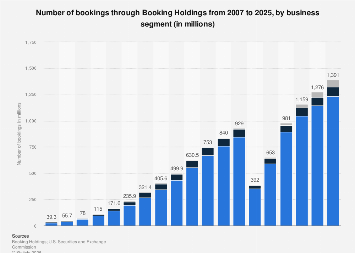
Booking Holdings, a titan in the global online travel agency (OTA) landscape, has demonstrated a significant upswing in its total bookings for 2025, reflecting a robust recovery and expansion within the post-pandemic travel sector. The company’s performance in 2025 showcases a notable year-on-year expansion, with a reported increase of [Redacted Percentage]% in its overall booking volume compared to the preceding year. This surge underscores a renewed consumer appetite for travel and the enduring strength of digital platforms in facilitating these journeys.
Within Booking Holdings’ diverse portfolio, the accommodation segment, primarily driven by room nights booked, continues to stand as its most substantial revenue-generating pillar. In 2025, this segment achieved an impressive milestone, exceeding [Redacted Billion] billion room nights. This figure not only highlights the sheer volume of lodging reservations facilitated by the company but also points to a sustained demand for hotel stays, vacation rentals, and other forms of accommodation that form the bedrock of the travel experience. The dominance of room nights underscores Booking Holdings’ foundational strength in the hospitality sector, a market that has seen significant innovation and adaptation in recent years, including the rise of alternative accommodations and personalized booking experiences.
While accommodation remains the bedrock, the airline ticketing segment emerged as the star performer in terms of year-on-year growth during 2025. This sub-sector experienced a remarkable [Redacted Percentage]% annual increase in bookings. This impressive acceleration in air travel bookings signals a strong resurgence in long-haul and international travel, as well as a return to pre-pandemic travel patterns for many consumers. Factors contributing to this growth likely include the easing of travel restrictions, a pent-up demand for global exploration, and potentially more competitive airfares as airlines ramp up operations. The robust expansion in airline bookings is a critical indicator of the broader health of the global travel ecosystem, as air connectivity is a prerequisite for many international tourism activities.
The strategic importance of these two segments – accommodation and air travel – cannot be overstated for Booking Holdings. They represent the core services that attract and retain a vast customer base. The company’s ability to manage and optimize bookings across these diverse verticals is a testament to its sophisticated technology infrastructure, extensive network of partners, and deep understanding of consumer travel preferences. Furthermore, the performance in 2025 suggests that Booking Holdings has successfully navigated the complexities of the evolving travel market, adapting its offerings and marketing strategies to meet changing consumer behaviors and economic conditions.
Looking at the broader digital travel landscape, Booking Holdings’ flagship brand, Booking.com, continues to assert its dominance. As of January 2026, Booking.com held the coveted position of the most visited travel and tourism website globally. This ranking is a powerful indicator of brand recognition, user trust, and the platform’s ability to consistently attract and convert visitors into bookers. In an increasingly competitive online environment, maintaining such a leading position requires continuous investment in user experience, search functionality, personalized recommendations, and a vast inventory of travel options. The platform’s success can be attributed to its user-friendly interface, comprehensive search filters, and a strong emphasis on customer reviews and ratings, which build confidence among travelers.
The competitive set surrounding Booking.com is formidable, featuring other major players in the travel technology space. Following closely in the global website traffic rankings are Americanexpress.com and Tripadvisor.com. The presence of American Express highlights the increasing convergence of financial services and travel booking, with many consumers opting for integrated platforms that offer both booking capabilities and travel rewards or financing options. Tripadvisor, on the other hand, represents a different but complementary segment of the online travel ecosystem, focusing heavily on user-generated reviews, destination information, and a broad spectrum of travel planning resources. While Tripadvisor offers a wealth of information and recommendations, Booking.com excels in the transactional aspect, converting user intent into concrete bookings.
The sustained leadership of Booking.com in website traffic suggests a powerful network effect. A larger user base attracts more suppliers (hotels, airlines, etc.), which in turn enhances the breadth and depth of offerings available to users, creating a virtuous cycle of growth. This dominance also provides Booking Holdings with invaluable data analytics capabilities, allowing for sophisticated market trend analysis, predictive modeling of consumer demand, and the optimization of pricing and promotional strategies. Understanding user behavior on such a massive scale is a significant competitive advantage in the data-driven world of online commerce.
The economic implications of Booking Holdings’ performance extend beyond the company itself. Its success directly impacts a vast network of tourism-related businesses, including hotels, airlines, tour operators, and local service providers. The increased bookings translate into higher occupancy rates for hotels, greater passenger numbers for airlines, and increased demand for ancillary services, all of which contribute to job creation and economic activity within the travel and hospitality sectors. Furthermore, the company’s investments in technology and platform development stimulate innovation within the digital travel industry.
Globally, the travel industry is in a dynamic state of recovery and transformation. While regions and segments are experiencing varied rates of growth, the overall trend points towards a sustained rebound. Emerging markets, in particular, are showing significant potential for future growth, as rising disposable incomes and a growing middle class fuel an increased propensity for international travel. Booking Holdings, with its global reach and diverse brand portfolio, is well-positioned to capitalize on these evolving market dynamics. The company’s strategic investments in areas such as alternative accommodations, experiences, and its loyalty programs are likely designed to capture a broader share of the traveler’s spending throughout their entire trip.
The competitive landscape is also characterized by ongoing consolidation and strategic partnerships. OTAs are increasingly looking to differentiate themselves not just on price and inventory but also on the quality of the customer experience, the uniqueness of offerings, and the seamless integration of various travel components. The rise of metasearch engines and direct booking channels also presents ongoing challenges, requiring OTAs like Booking Holdings to continuously innovate and demonstrate their value proposition to both consumers and suppliers. The company’s ability to adapt to these shifting market forces, while maintaining its core strengths, will be crucial for its continued success in the years to come. The data from 2025 provides a strong foundation, indicating that Booking Holdings is navigating this complex environment with considerable efficacy.