

In the heart of India, nestled within the poverty-stricken Bundelkhand region of Madhya Pradesh, lies Panna – a district whose name evokes a stark dichotomy. On one hand, it is a land steeped in ancient history, home to the UNESCO World Heritage temples of Khajuraho and a sprawling tiger reserve, attracting wildlife enthusiasts and cultural tourists alike. On the other, Panna is India’s sole active diamond mining region, yet paradoxically, it remains one of the nation’s most economically distressed areas, a magnet for "troubled souls" seeking a miraculous escape from crushing debt and destitution. This unique blend of potential wealth and pervasive poverty has fostered an informal economy centered on artisanal diamond mining, driven by hope, desperation, and the slimmest of odds.

The allure of Panna’s diamonds is a potent force, drawing individuals from various walks of life into its dusty, cratered landscape. Ram Kumar Gupta, once a transport business owner from neighboring Chhatarpur, exemplifies this migration of hope. His fleet of six trucks once traversed states, but a series of unforeseen accidents and business reversals plunged him into a staggering debt exceeding ₹40 lakh (approximately $48,000 USD). For Gupta, as for many others, Panna represents a last resort, a desperate gamble that a single sparkling stone could erase years of financial ruin. While the dream is often deferred, the occasional spectacular find fuels the collective imagination: in 2025, a local farmer, Swamidin Pal, unearthed a 32-carat diamond from his field, which subsequently fetched ₹2.21 crore (approximately $265,000 USD) at auction, turning him into an instant millionaire. Such stories, amplified through local lore and digital media, reinforce the potent myth of Panna as a land of sudden fortune.
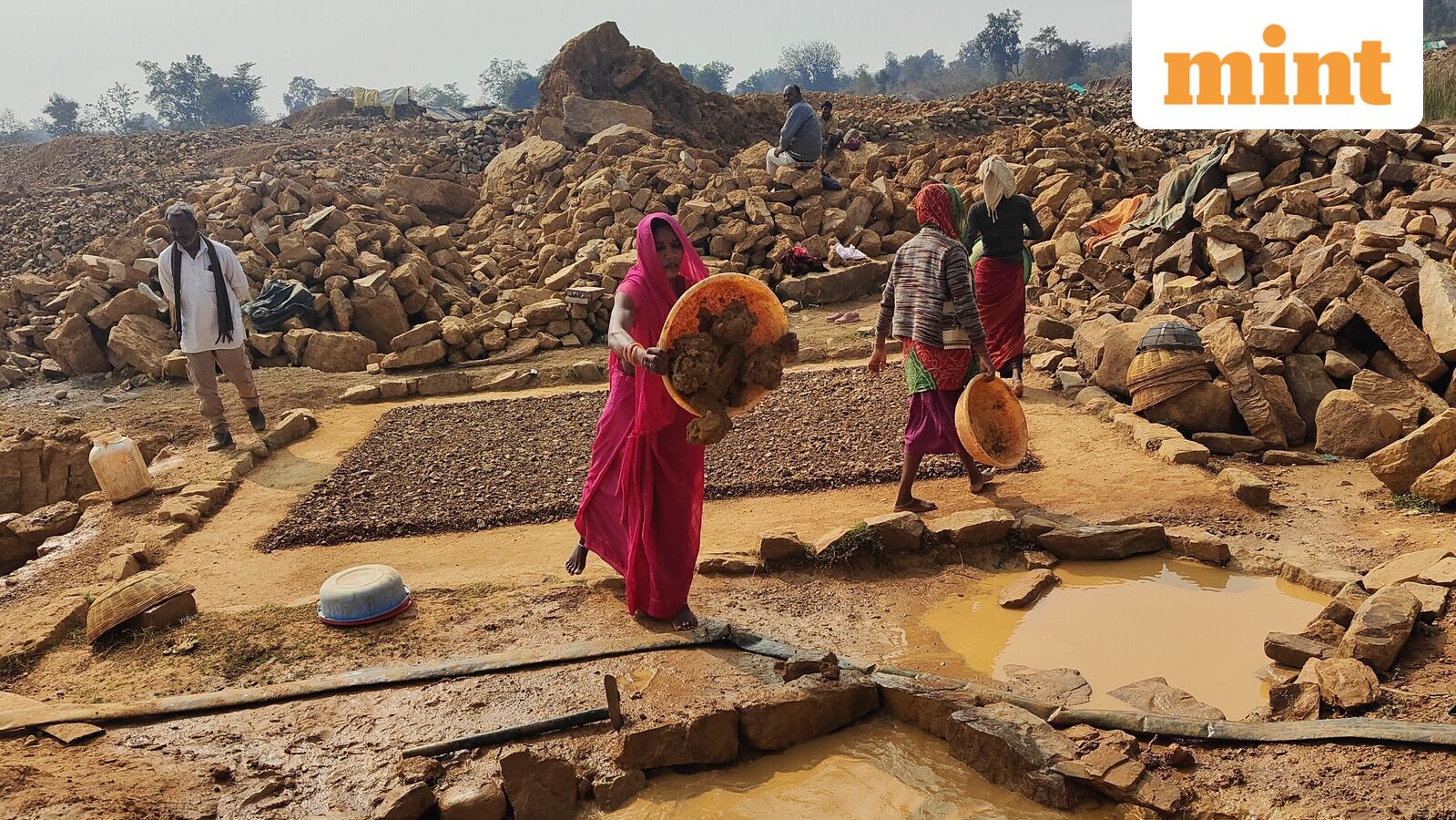
The entry barrier to this high-stakes lottery is remarkably low, democratizing the pursuit of wealth for India’s poorest. Any Indian citizen can lease an 8-meter by 8-meter plot – less than half the size of a volleyball court – for a nominal annual fee of just ₹200 (approximately $2.40 USD) from the district’s diamond office. However, the ensuing labor is anything but trivial. Miners, armed with rudimentary hand tools, embark on a physically grueling process, excavating topsoil and digging pits often 8 to 10 feet deep, sometimes deeper. Some fortunate few, or those pooling resources, might afford to rent earthmovers or drilling machines to blast larger rock formations, but the majority rely on sheer manual labor, breaking sandstone chunks with hammers. The excavated gravel, nestled between rocks, is meticulously collected, sieved, and washed to remove soil, then laid out to dry. The final, painstaking step involves sifting through the dried gravel, searching for any glimmer of a diamond.

This arduous endeavor comes with significant, often unrecoverable, costs for the artisanal miners. Individuals like Gupta can easily spend ₹1-1.5 lakh (approximately $1,200-$1,800 USD) within a year on basic accommodation (around ₹2,500 per month), food, and occasionally, hired labor. The poorest often forgo even this, living in flimsy, makeshift tents directly on the mining sites, exposed to the elements. The "andha kaam," or "blind work," as it’s locally known, is akin to finding a needle in a haystack while blindfolded. The odds of striking rich are astronomically low, especially in these secondary deposits of alluvial diamonds, which are far less concentrated than primary kimberlite sources. Even for those who find a diamond, the financial relief can be minimal. Puran Pal, for instance, found a 7-carat diamond on his farmland in Sarkoha village, which sold for ₹16 lakh (approximately $19,000 USD). Yet, after sharing the proceeds with seven business partners and paying hired labor, he was left with almost nothing, illustrating the precarious economics of collaborative artisanal mining.
The human cost of this relentless pursuit is profound. Santosh Harijan, a 48-year-old sanitation worker, has spent decades digging in Panna without success, his feet permanently stained by the yellow earth. His lifelong gamble has meant he couldn’t afford to educate his children, who now work as casual laborers, their futures mirroring his own struggle. His daughter awaits marriage, a significant financial burden that Harijan desperately hopes a diamond will alleviate. For such individuals, Panna represents not just a quest for wealth, but a sacrifice of their present for an ever-receding future, an ongoing gamble against overwhelming opportunity costs.

The district administration plays a crucial role in regulating this informal sector. Ravi Patel, Panna’s district mining officer, oversees the issuance of approximately 500 leases to artisanal miners annually. Any discovered diamond must be deposited with his office, which then facilitates its auction. From the auction proceeds, an 11.5% royalty is deducted for the state government, along with a 1% tax deducted at source, before the remainder is credited to the finder’s bank account. Despite the legal framework, Patel acknowledges the inherent economic futility for most: "The entire artisanal mining industry, therefore, is a loss-making venture, particularly for destitute miners who stake years of their lives and earnings in the hope of striking it rich." Annually, Panna’s artisanal operations contribute a modest 300-500 carats to the state’s coffers, generating less than ₹1.5 crore (approximately $180,000 USD) in royalties. However, the administration permits this activity to continue, recognizing that barring legal leases would only drive all mining underground, fostering a black market rife with illegal trade, violence, and unaccounted cash. This concern is validated by estimates suggesting that 300-500 carats of diamonds are sold in the illegal market daily from unauthorized mines in Panna’s forest areas and unlicensed riverbeds, far exceeding the officially reported figures.
The paradox of Panna extends to its industrial mining operations. The only mechanized diamond mine in India, operated by the central government-controlled NMDC Ltd in Majhgawan, approximately 15 km from Panna town, has been extracting diamonds from primary kimberlite deposits since the early 1970s. With an annual production capacity of 84,000 carats, one might expect it to be a commercial success. Yet, a senior NMDC official revealed that the project has rarely been commercially viable, subsidized by the public sector undertaking’s more profitable iron ore mining ventures elsewhere. This highlights a critical irony: advanced, mechanized mining, backed by substantial capital and technology, struggles for viability, while thousands of artisanal miners with hand tools continue to toil in shallow, less productive secondary deposits. Further underscoring this systemic challenge, global mining giant Rio Tinto abandoned its potentially massive Bunder diamond project in the neighboring Chhatarpur district in 2017. The Bunder kimberlite deposits were estimated to contain over 27 million carats, making it India’s largest potential source, but prolonged delays in environmental clearances rendered the project unfeasible.

Globally, India holds a unique position in the diamond industry. Historically, India was the sole source of diamonds for millennia, with famous gems like the Koh-i-Noor originating from its ancient Golconda mines. However, discoveries in Brazil in the 1700s, and particularly in Kimberley, South Africa, in 1866, shifted the epicenter of diamond production. By 1900, De Beers’ South African mines controlled an estimated 90% of the world market. Today, major producers include Botswana, Russia, Canada, and the Democratic Republic of Congo. While India’s contribution to global rough diamond production is negligible, it remains the undisputed global leader in diamond processing, cutting and polishing over 90% of the world’s rough diamonds, a testament to its skilled workforce and established infrastructure in cities like Surat.
The diamonds of Panna, though limited in supply, offer a stark contrast to the infamous "blood diamonds" that fueled civil wars in parts of Africa during the 1990s. While Panna’s diamonds are not products of conflict, they can unequivocally be termed "sweat diamonds" – extracted through the sheer physical toil of individuals trapped in cycles of debt and extreme poverty. This desperate pursuit is made even more precarious by evolving global market dynamics. By 2025, rough diamond prices had reportedly crashed by 40% from their 2021-2022 highs, driven by increased competition from more affordable lab-grown diamonds and an oversupply of natural diamond inventory. This market volatility further diminishes the already slim chances of profitability for Panna’s artisanal miners, many of whom remain oblivious to these global economic headwinds.

On a wintry January morning, the riverbed of Runj, a site for a new irrigation dam, buzzes with activity. Here, migrant workers from Rajasthan and Telangana share meager breakfasts before beginning their day’s digging. Among them is Shankar Adivasi, 27, who lost his farmland and home to the very dam project he now mines beside. For six years, he has relentlessly dug, enduring the Sisyphean task of bailing out his pit nightly as it fills with river water. His four young children, all under five, have never seen a school. The family lives in a flimsy tent by the river, their existence a testament to the harsh realities of Panna. When asked about his enduring quest, Shankar offers a cryptic, faith-laden response, echoing the sentiment of many others caught in Panna’s embrace: "There’s a divine debt all of us owe. When mine is repaid with hard labor, I will find one." This profound statement encapsulates the complex interplay of poverty, policy, global market forces, and an unwavering, almost spiritual, human resilience that defines the diamond fields of Panna.