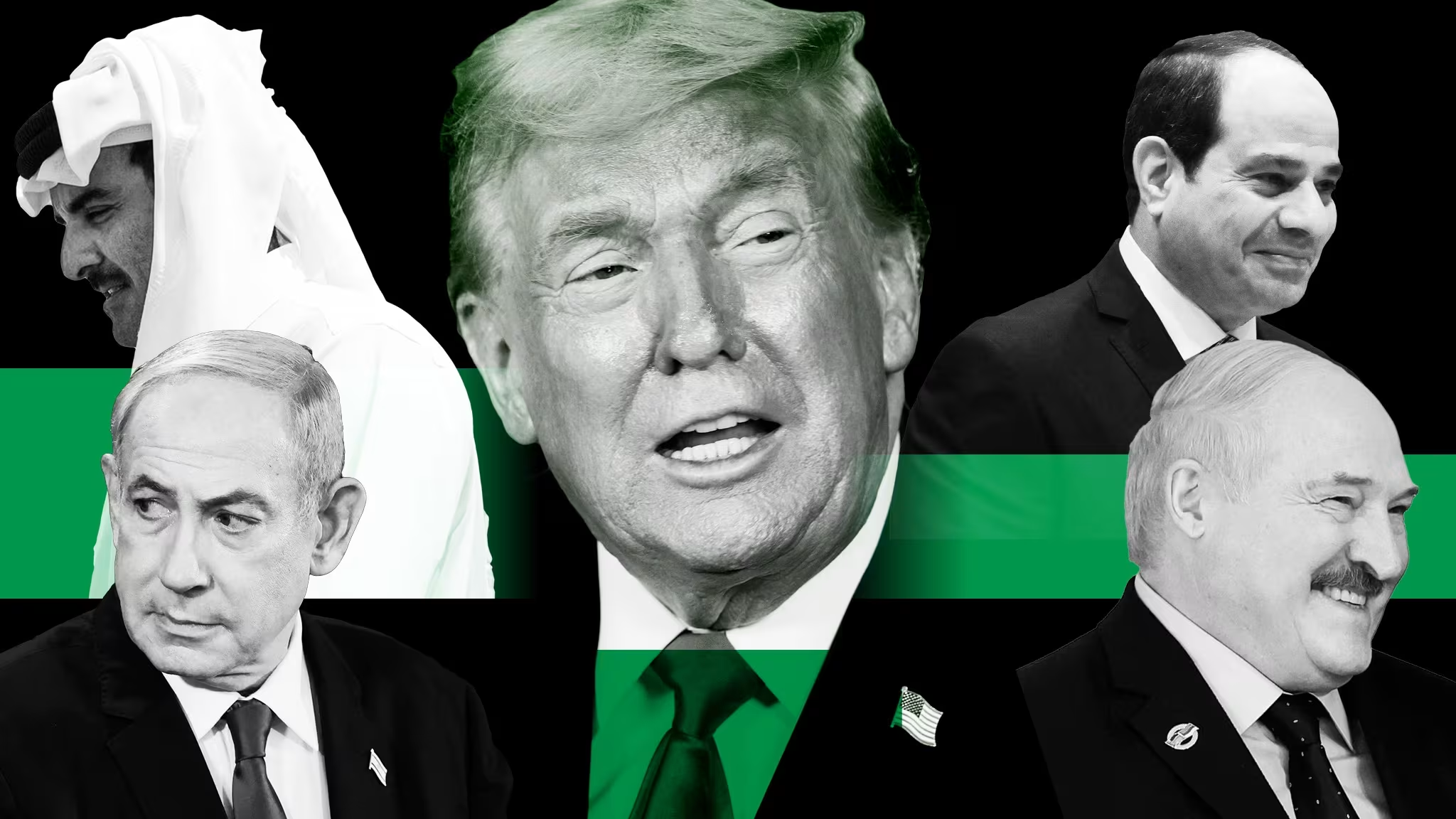
The conceptualization of a "Board of Peace"—a specialized advisory body reportedly under consideration by Donald Trump’s inner circle—represents a radical departure from the traditional conduits of American foreign policy. As the geopolitical landscape shifts toward a more fragmented, multipolar reality, the proposal suggests a pivot from the institutionalized diplomacy of the State Department toward a more streamlined, executive-led, and transactional model of international relations. This initiative, while still in the formative stages of policy discussion, seeks to centralize the negotiation of global conflicts within a hand-picked group of loyalists and business-minded pragmatists, signaling a potential overhaul of how the United States engages with both allies and adversaries.
The structural logic behind such a board is rooted in the "America First" doctrine, which prioritizes immediate national interests and cost-benefit analyses over long-standing multilateral commitments. For investors and global markets, the emergence of this concept introduces a dual-edged sword of potential stability through rapid deal-making and heightened volatility due to the bypassing of established diplomatic norms. By examining the potential composition, strategic objectives, and economic ramifications of this "Board of Peace," one can begin to map the contours of a secondary Trump administration’s approach to a world currently engulfed in high-stakes conflicts from Eastern Europe to the Levant.
Central to the "Board of Peace" is the rejection of what proponents call the "interagency quagmire." Historically, American foreign policy is the product of a slow-moving consensus built between the State Department, the Department of Defense, and the National Security Council. Critics of this system argue that it is prone to "forever wars" and bureaucratic inertia. In contrast, the proposed board would likely function as a "red team" of negotiators, empowered to bypass traditional diplomatic hierarchies to reach direct settlements. Names frequently linked to such an initiative include former Director of National Intelligence Richard Grenell, retired Lieutenant General Keith Kellogg, and former Pentagon official Elbridge Colby. These figures share a common skepticism of international institutions and a preference for bilateralism, viewing global stability not as a product of shared values, but as a series of negotiated settlements backed by economic and military leverage.
The primary focus of this body would almost certainly be the resolution of the war in Ukraine. The economic toll of the conflict has been staggering, with the World Bank estimating Ukraine’s reconstruction costs at over $486 billion. For the United States, the conflict has become a focal point of domestic fiscal debate, with billions in aid scrutinized by a populist wing of the Republican Party. A "Board of Peace" would likely pursue a "peace through strength" strategy that leans heavily on transactional realism—potentially leveraging U.S. energy exports and military aid to force both Kyiv and Moscow to the negotiating table. Such a move would have immediate impacts on global energy markets, particularly for European nations currently transitioning away from Russian gas. A forced settlement could lead to a "peace dividend" for markets, reducing the risk premium on European equities, yet it risks alienating NATO allies who view territorial integrity as non-negotiable.
In the Middle East, the board’s mandate would likely involve an expansion of the Abraham Accords, the landmark normalization agreements between Israel and several Arab nations. From a business perspective, the Accords were as much about economic integration as they were about security. A "Board of Peace" would likely view the current regional instability through the lens of lost trade opportunities and disrupted supply chains, particularly in the Red Sea. By prioritizing economic corridors—such as the proposed India-Middle East-Europe Economic Corridor (IMEC)—the board would attempt to use commercial interests as a de-escalation tool. The economic logic here is that deeply intertwined economies are less likely to engage in kinetic warfare, a philosophy that mirrors the post-WWII integration of Europe but applied with a 21st-century, transactional veneer.
However, the shift toward an ad-hoc board of negotiators presents significant risks for global trade stability. Modern markets rely on the predictability of the rules-based international order. When diplomacy becomes a series of "deals" brokered by a rotating cast of advisors, the long-term reliability of U.S. security guarantees may be called into question. For defense contractors like Lockheed Martin, Raytheon, and General Dynamics, a sudden shift toward isolationist-leaning "peace boards" could signal a cooling of the defense spending boom triggered by the war in Ukraine. Conversely, if the board emphasizes "burden-sharing," it could force European and Asian allies to increase their domestic defense budgets, creating new markets for American military exports while straining the fiscal positions of allied governments.
Furthermore, the "Board of Peace" would have to navigate the complex legal and ethical waters of the Logan Act, which prohibits unauthorized citizens from negotiating with foreign governments. While members of an official presidential board would have a degree of legal cover, the use of private-sector surrogates to conduct "shadow diplomacy" could lead to institutional friction with the career civil service. This tension was a hallmark of the first Trump term and would likely be amplified in a second, as the proposed "Schedule F" executive order aims to reclassify thousands of civil service roles as political appointments, further eroding the barrier between professional diplomacy and political deal-making.
The economic impact analysis of such a shift must also account for the U.S. relationship with China. While the board’s title suggests a focus on ending wars, its underlying strategy would likely involve "de-risking" the U.S. economy from Chinese influence. By attempting to settle conflicts in Europe and the Middle East, the administration would aim to free up resources for a more intense economic and technological competition with Beijing. This "pivot to Asia" 2.0 would use trade tariffs and export controls as primary weapons. If the "Board of Peace" succeeds in reducing American involvement in secondary theaters, it allows for a more concentrated application of economic pressure on China, potentially leading to a more bifurcated global trade system.
Global comparisons illustrate the uniqueness of this approach. While nations like France and Turkey often utilize "special envoys" for specific conflicts, the creation of a centralized, overarching board to manage global peace efforts is a distinctly American populist innovation. It reflects a growing trend of "anti-diplomacy," where traditional protocols are viewed as impediments to national greatness. For emerging markets, this style of diplomacy offers both opportunity and peril. Nations that can offer the U.S. favorable trade terms or strategic alignment may find themselves fast-tracked for investment, while those relying on traditional diplomatic advocacy may find their influence waning.
Expert insights suggest that the success of a "Board of Peace" would depend entirely on the credibility of the "carrots and sticks" it employs. Without the backing of a unified government and the support of the broader international community, the board’s "deals" may prove fragile. Economic historians point to the 1920s as a cautionary tale, where a retreat from international institutions and a focus on transactional debts contributed to global instability. However, proponents argue that the current system has failed to prevent the largest land war in Europe since 1945 and that a "disruptor" model is exactly what is needed to break the cycle of escalation.
Ultimately, the "Board of Peace" represents a gamble on the power of personality and the efficacy of the "art of the deal" in a geopolitical context. It assumes that world leaders are rational actors who can be swayed by economic incentives and clear-eyed threats, rather than actors driven by deep-seated historical grievances or ideological missions. For the global economy, the implementation of such a board would mark the end of the post-Cold War era of institutional diplomacy and the beginning of a new, more volatile age of transactional realism. Whether this leads to a more peaceful world or simply a more divided one remains the central question for policymakers and investors alike as they watch the evolution of this unconventional diplomatic blueprint.